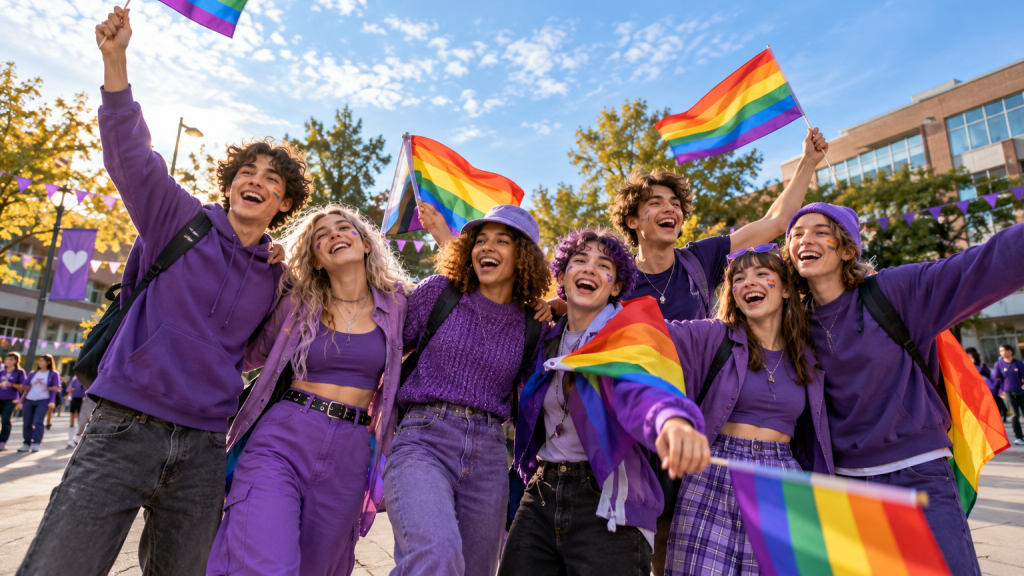
With purple clothing and a wide range of activities, schools and higher education institutions in the Netherlands are taking a stand today against discrimination against LGBTQ+ young people. The nationwide day of action, “Paarse Vrijdag” (“Purple Friday”), aims to promote greater acceptance of different sexual orientations and gender identities. This year, it is taking place in October for the first time.
Key points at a glance
- Today, people at Dutch schools and higher education institutions are wearing purple to show their solidarity with LGBTQ+ young people.
- For the first time, “Paarse Vrijdag” is taking place in October. Previously, it was observed in mid-December.
- Under the slogan “Our Purple Friday”, pupils, teachers and school staff are being encouraged to take joint action against exclusion.
- According to a study, only 22 per cent of boys under 18 in the Netherlands now have a positive attitude towards homosexuality.
- The organisers want not just to raise awareness for a day, but to make schools safer and more welcoming in the long term.
A stand against bullying
With the new date, the organisers are changing a long-standing tradition. Until now, “Paarse Vrijdag” has been observed in mid-December. In future, the day of action will fall on the second Friday in October. The decision was made by the organisers, GSA Netwerk and COC Nederland. They say the move is primarily due to the many events and commitments that schools usually have in December. Holidays and end-of-year activities had made it increasingly difficult to give the issue the attention they wanted.
The new timing is intended to enable schools to send a clear message in support of diversity, safety and mutual respect right at the start of the school year. It also brings “Paarse Vrijdag” closer to International Coming Out Day, which is observed this coming Sunday, 11 October. “Purple Friday” was launched in the Netherlands in 2010. The initiative was directly inspired by the US “Wear It Purple Day”, on which people also wear purple clothing to take a stand against the bullying of LGBTQ+ young people. This year, the day was already observed in the US in late August.
“Purple Friday” for everyone
This year’s campaign focuses on the responsibility of the entire school community. Under the slogan “Onze Paarse Vrijdag” (“Our Purple Friday”), the organisers want to make it clear that an environment free from discrimination can only be created through collective action. The campaign addresses not only LGBTQ+ young people, but also their fellow pupils, teachers, school leaders and other staff. Support from people who do not themselves face discrimination because of their sexual orientation or gender identity plays an important role. “Purple Friday is about being there for one another, with one another and together for the whole school,” the campaign materials state.
To help schools put this into practice, the organisers provide free activity packs. These contain information materials, videos and ideas for joint activities. They are intended to spark conversations about diversity, discrimination and acceptance. The materials are also designed to help develop initiatives that will continue beyond the day of action. Gender & Sexuality Alliances (GSAs) were also involved in developing the campaign. These are groups of school and university students who work for equality and acceptance for LGBTQ+ people.
Acceptance of homosexuality
This year’s campaign comes at a time when social acceptance of homosexuality among Dutch young people is declining significantly, according to recent research. A study by Utrecht University and the Trimbos Institute revealed a striking trend, particularly among boys aged between 12 and 16. According to the findings, the proportion of boys with a positive attitude towards homosexuality has almost halved within four years. Only 22 per cent now express such positive views. The researchers cite several possible reasons for the decline. These include the influence of the so-called “manosphere” (German), a network of predominantly male online communities in which, among other things, traditional gender roles and negative attitudes towards homosexuality are spread. The researchers also point to a broader shift towards more conservative attitudes in society. In the organisers’ view, the study highlights why visible solidarity and active support for LGBTQ+ young people remain necessary.
Exclusion at school
For many gay, lesbian, bisexual and queer young people, school is still not always a safe place. Other academic studies have shown for years that LGBTQ+ pupils are more frequently subjected to bullying, derogatory remarks and social exclusion. Such experiences can have serious consequences. Some of the young people affected withdraw from school community life or try to avoid distressing situations by staying away from lessons. The purple clothing is therefore intended to show those affected that they are not alone and that other people at their school are standing up for their safety and equal rights. The focus is not solely on personal solidarity. The day of action is also intended to encourage schools to review their existing anti-discrimination measures and expand them where necessary.








