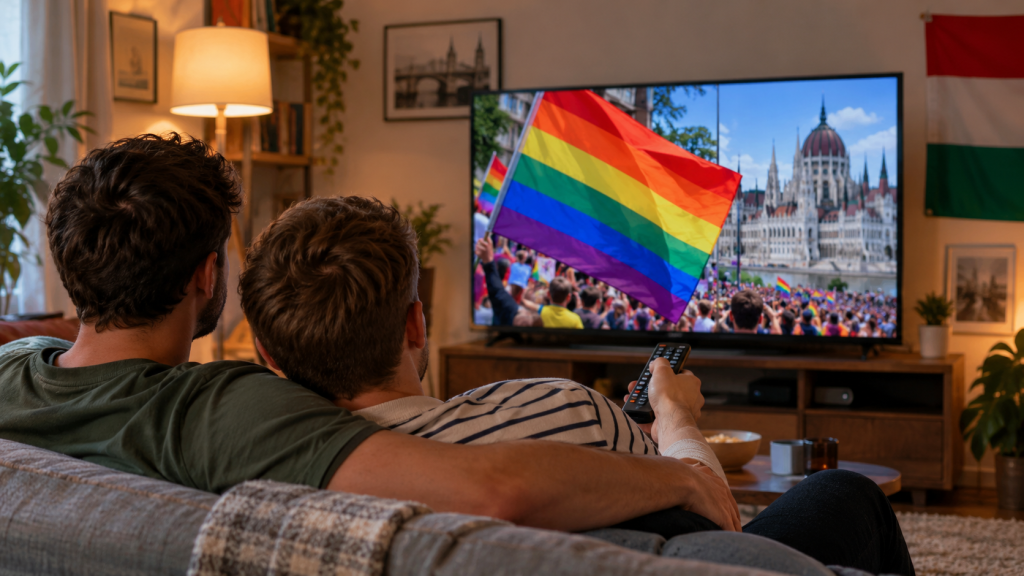
For years, Hungary’s public service media under Prime Minister Viktor Orbán disseminated pro-government messages, including increasingly frequent attempts to stir up hostility towards gay and queer people. The European Union, for example, was accused of influencing children with alleged “LGBTQ+ propaganda”. Following the change of government in spring 2026, public service broadcasting is now set for a fundamental overhaul. Prime Minister Péter Magyar wants to turn his predecessor’s former instrument of power back into an independent and credible media institution (German), and the first steps have now been taken.
Key points at a glance
- LGBTQ+ people cast as the enemy: under Viktor Orbán, gay and queer people were the target of a state-backed political campaign.
- From 2021, Hungarian laws restricted the depiction of homosexuality to minors.
- Following his election victory in spring 2026, Prime Minister Péter Magyar declared reform of public service broadcasting a priority.
- Public apology: news programmes were temporarily suspended. The broadcaster apologised for past misrepresentations and announced changes.
- The first staff members who were forced to leave state broadcasting under Orbán are now returning.
- A difficult overhaul: staffing decisions, funding questions and unresolved long-term leadership are complicating efforts to build an independent broadcasting service.
Coverage of homosexuality
Coverage of LGBTQ+ people was part of a broader political campaign by the former government. Alongside migrants and political opponents, sexual and gender minorities were repeatedly portrayed negatively. Deutsche Welle describes the public service media during Orbán’s 16 years in government as a platform for disinformation, hate and political propaganda. Political interference in the media went hand in hand with legal restrictions. In June 2021, the Hungarian parliament passed a law, with votes from the then governing party Fidesz, that significantly restricted the depiction of homosexuality and gender transition to minors.
Television programmes, advertising and educational provision in schools were among the areas affected. Content depicting or discussing homosexuality could no longer be made freely accessible to minors. Television programming of this kind had to be subject to specific age restrictions. The rules thus also made it more difficult to present factual or positive portrayals of gay and queer people’s lives in programmes for younger viewers. The government at the time justified the rules on the grounds of protecting children. They drew considerable criticism at European level. The European Commission initiated legal action against Hungary. In April 2026, the European Court of Justice also considered the restrictions on LGBTQ+ content.
Political enemies on television
The restrictions were part of a media policy that critics believed was designed to influence public opinion in line with the Orbán government’s agenda. This was particularly evident at the public service news channel M1. It had been converted into a news channel under Orbán in 2015 and was increasingly described by media observers as a government propaganda tool. Its programmes promoted images of political enemies. These included the claim that the European Union wanted to indoctrinate Hungarian children with “LGBTQ+ propaganda”. Migrants, US billionaire George Soros and Ukraine were also regularly targeted by pro-government campaigns. According to Deutsche Welle, political interference in public service broadcasting reached a level that was exceptional within the European Union.
Public apology
Following the election victory of Péter Magyar and his Tisza party in spring 2026, the new government began restructuring the public service media. On 7 July, television channel M1’s regular news programming was interrupted for several hours. Instead of the usual programmes, a message appeared in white text on a black background. In it, the broadcaster apologised for years of disseminating false information and announced a fundamental restructuring. News and political programmes on other public service television and radio channels were also temporarily replaced by the statement. Only the state news agency MTI continued to publish political news reports. Magyar described the move as a historic turning point and declared that the era of propaganda broadcasts in the public service media was over.
Restoring credibility
Reform of public service broadcasting is one of the new Hungarian government’s central projects. The aim is to curb political interference and restore journalistic independence. Senior figures responsible for the news channel M1 under its previous structure have already been removed from their posts. Staffing changes have also begun in newsrooms and at management level. Some journalists who left public service broadcasting during the Orbán years are now returning. The return of former staff, which has now begun, is intended to help re-establish journalistic standards and regain public trust.
Despite the changes initiated, the new leadership faces considerable challenges. The public service media were shaped politically and organisationally over more than a decade and a half. Controversial staffing decisions, unresolved funding questions and the lack of permanent leadership so far are complicating the reform process. There is also the question of how editorial independence can be safeguarded against political interference in the long term.
Restructuring remains difficult
Past coverage of LGBTQ+ people in particular illustrates the importance of this task. During the Orbán years, gay ways of life were repeatedly portrayed as a threat to society in pro-government campaigns. At the same time, legal provisions limited the visibility of gay and queer people in media content for minors. Whether the reforms enable balanced coverage free from discrimination in future will also be judged by how public service broadcasting treats social minorities and politically contentious issues. The new government has announced a comprehensive fresh start. However, several media experts have now stressed, as the first measures get under way, that it is likely to take time for this to develop into a public service media system with lasting independence.








