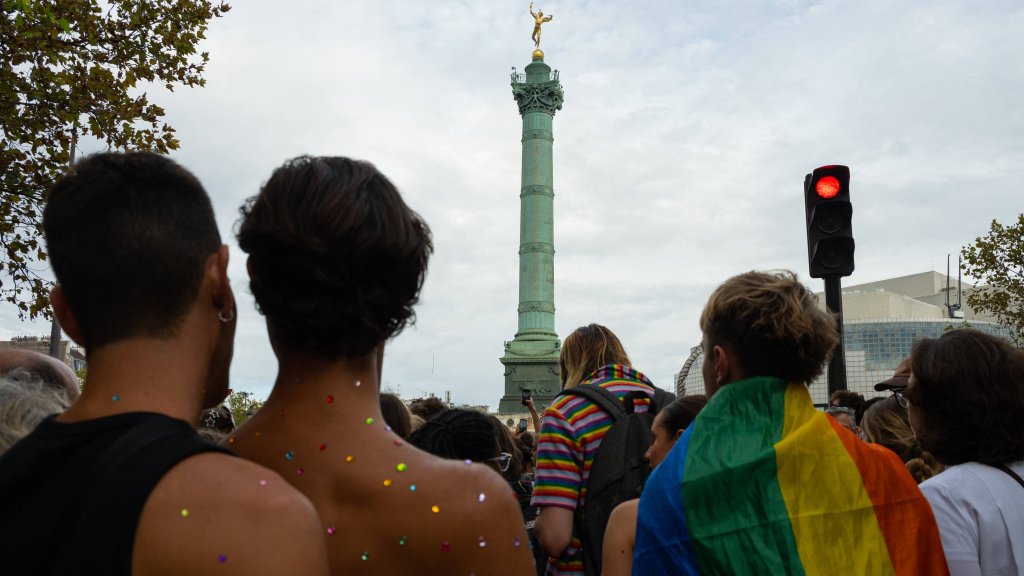
A gay volunteer with an LGBTQ+ organisation was subjected to a serious violent attack following Pride in the French capital, it has now emerged. Several men allegedly subjected the activist to homophobic abuse before brutally beating him during the night of 3–4 October. The victim sustained numerous serious injuries and still requires medical and psychological care. In the wake of the incident, human rights organisations are calling for better protection for queer people in Parisian nightlife.
The key points at a glance
- Violence after Pride: a volunteer with the French organisation PlaySafe was brutally attacked by several men in Paris.
- Before the attack, the victim was repeatedly insulted because of his sexual orientation. The attackers struck him repeatedly.
- The victim sustained serious injuries to his face, eyes, ear and knees, as well as partial memory loss.
- Police investigation: the complaint was recorded as assault with a possible homophobic motive and attempted theft committed jointly.
- LGBTQ+ organisations are calling for a greater police presence, safe journeys home and better support services in the Marais nightlife district of Paris.
- In France, the public debate about anti-LGBTQ+ violence.
Several men launch an attack
The victim is a man named Mario, who volunteers for the French organisation PlaySafe. He was on his way home from a prevention event for the LGBTQ+ community when the attack took place. PlaySafe was founded in 2012 and works to prevent ill health and reduce health risks, particularly in nightlife settings. This includes providing information about synthetic drugs, GHB, GBL, ketamine, addiction and risks associated with chemsex.
According to the victim, the confrontation began with repeated homophobic abuse. Mario was walking at night when several men insulted him with an anti-gay slur. One of the men then allegedly demanded five euros from him. Fearing a robbery, Mario took the precaution of hiding his mobile phone and wallet under his clothes. Shortly afterwards, he was struck hard from behind near his left ear. At least two people then punched him in the face. He fell to his knees, bleeding heavily from his face. The attackers continued to beat him before eventually fleeing. None of his belongings were stolen.
Serious injuries
The French press reports that the young man was beaten “half to death”. The consequences for his health are indeed particularly serious. Mario reported partial memory loss after the attack. Bleeding and seriously injured, the activist was taken to hospital and given initial medical treatment. The injuries primarily affected his left ear, both eyes, nose, mouth and knees. Mario has since been discharged from hospital but remains under medical care. As well as his physical symptoms, the activist still needs further support for the psychological effects of the attack.
Assault investigation
The attack was reported to the police. The investigation concerns assault, taking into account a possible aggravating factor related to the victim’s sexual orientation, and attempted theft committed jointly. The French organisation STOP Homophobie has since pledged its support to the victim. Michel Mau, the organisation’s chair, paid tribute to the attacked man’s voluntary work. He also made clear that violence against gay people must not be accepted as an inevitable part of public life. “He has devoted his time to other people. Today, we want to tell him that he is not alone. Everyone must be able to go out, socialise and return home safely. No form of violence should be regarded as inevitable.”
Debate about safety
The fact that the physical attack was preceded by homophobic abuse was also described as particularly worrying. “Homophobic insults are no trivial matter: when they are followed by physical violence, they show the tangible consequences that anti-LGBTQ+ hostility can have for the safety of those affected.” The incident has reignited debate about the safety of gay and queer people in Paris’s nightlife districts. Particular attention is focused on the Marais district of Paris. It is home to numerous bars, clubs and other venues popular with LGBTQ+ people. Some venues have protective measures and support services in place. However, human rights organisations believe these are insufficient if visitors have to walk home alone through the streets after a night out.
People outside these protected venues could be at increased risk, particularly at night. Paris city councillor Pierre Baty also expressed concern about the attack. “Unfortunately, this attack is one of many.” In this context, STOP Homophobie points to an increase in homophobic attacks as well as sexist and sexualised violence, particularly in the Marais. The organisation is calling on the Paris city administration to introduce additional safety measures and increase the municipal police presence at known danger spots.
Calls for more police
STOP Homophobie believes that greater attention should be paid to visitors’ safety, particularly around the closing times of bars and clubs. Alongside an increased police presence, the organisation proposes deploying specially trained mediation teams. “A stronger presence of law enforcement officers at closing times, supplemented by mediation teams trained to deal with anti-LGBTQ+ incidents, would make it possible to prevent incidents more effectively and intervene more quickly when problems arise.” The design of public spaces also needed greater consideration. “Particular attention could also be paid to lighting, CCTV coverage and areas where people risk finding themselves isolated at the end of the evening.” The organisation envisages such measures being introduced or expanded both in the Marais and in neighbouring streets.
Safe spaces and support
Alongside public safety measures, STOP Homophobie believes closer cooperation between nightlife venues is necessary. Bars, clubs and other businesses could form a network offering immediate refuge to people under threat. “Venues could also participate in a shared system for welcoming people and directing them to support. A network of partner businesses would enable people who feel in danger to quickly find somewhere they can ask for help.” Mobile support teams could also be deployed in nightlife districts. These should assist particularly vulnerable people and, where necessary, put them in touch with medical or other support services.
Another key demand concerns immediate care following a violent attack. In STOP Homophobie’s view, people attacked in the street must not be left to fend for themselves. “Someone who has experienced violence should not have to deal with the immediate aftermath of an attack alone.” The organisation therefore proposes providing short-term accommodation and prompt referrals to medical, psychological and legal support services. However, responsibility for such measures must not rest solely with bar and club operators or voluntary organisations. In the activists’ view, protecting queer people must be understood as a shared responsibility of public institutions, law enforcement agencies and nightlife venues.








