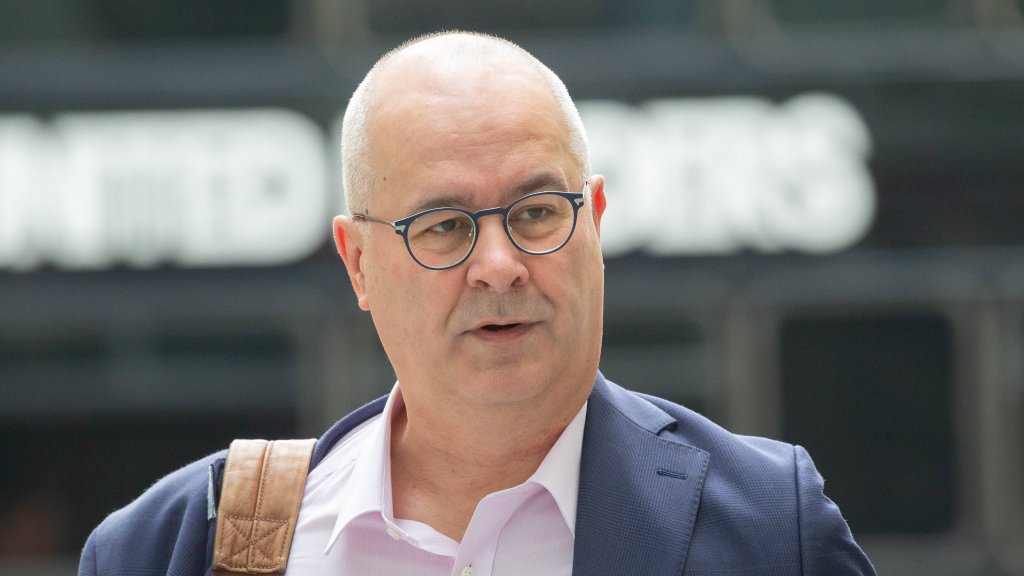
British radio presenter and former Conservative politician Iain Dale has spoken in an extensive interview about his life as a gay man, his political ambitions and his sexual experiences. The 64-year-old describes how homophobia affected his career, why he only came out to his parents at the age of 40 and why he regrets the disappearance of gay meeting places.
The key points at a glance
- Coming out at 40: British radio presenter Iain Dale only told his parents he was gay in 2002. He had already told friends at the age of 28.
- Homophobia in politics: Dale is convinced that he would have become an MP had he not been gay.
- The 64-year-old describes regular visits to gay saunas, anonymous sexual encounters and an attempted sexual assault.
- Dale admits that he long underestimated the effects of Britain's Section 28, which prohibited the so-called promotion of homosexuality by public bodies.
- Dale entered into a civil partnership with his partner John in 2008. The couple married in 2015.
Coming out at the age of 40
Dale initially became involved in the Conservative Party, later worked in public relations and made a name for himself as a political journalist, blogger and bookseller. Today, he presents four talk shows a week on radio station LBC. He has no thoughts of retiring. “I don't want to stop at all. I love it, and the longer I can do it, the better,” Dale said. The Briton knew he was gay long before his 40th birthday. He told his friends about his sexuality at 28, but remained silent with his parents for another twelve years. “I remember sitting in the car with my mother, having a deep conversation. I was on the verge of telling her, but I just couldn't pluck up the courage,” he recalled. It was not until 2002 that he spoke openly to his parents about it.
Afterwards, he said, the family largely avoided the subject. “It was put in a convenient cupboard that was never to be opened, and it didn't particularly bother me,” Dale said. He had never defined himself solely by his sexual orientation. He had never attended a Pride event. He had “always seen myself as a man who happens to be gay, rather than a gay man who happens to be a man”. His mother, he said, had been strongly shaped by her rural surroundings and the views of her generation. She had paid little attention to social changes beyond her immediate world.
She once asked his sister: “What is a wanker?” “We often laughed about how sweet and innocent she was,” Dale recalled. After he came out, mother and son did not discuss his sexuality again. She did, however, give his partner John an extremely warm welcome. “She got on brilliantly with John from the start. Even after she learned the terrible truth, she always treated him wonderfully and confided things in him that she didn't even tell my sisters.”
“Obviously gay”
While Dale says he rarely experienced disadvantages because of his sexuality in his private and working life, he believes it significantly hampered his political career. Before he stood for the House of Commons in the North Norfolk constituency in 2005, his attendance at an event organised by the Tory Campaign for Homosexual Equality had sparked rumours. At a local election event, Dale responded with humour. “Yes, I'm gay, but I'm also a West Ham United supporter – which is probably far worse in Norfolk.” His sexuality also became a public talking point when he sought selection as a candidate in the Bracknell constituency. “The Daily Mail published a column at the time describing me as ‘obviously gay’. I complained to the Press Complaints Commission and lost.”
Dale believes he would have pursued a parliamentary career without these prejudices. “If I hadn't been gay, I would have become an MP. But I'm not sitting here thinking: ‘Oh, if only ...’” Outside politics, he said, he had not had comparable experiences. “In my non-political working life, I can't think of anything that being gay has negatively affected.” Despite his experiences, Dale views the importance of gay men within the Conservative Party with a certain humour. “The Conservative Party wouldn't exist without gay men.”
Belated criticism of Section 28
Dale now also takes a more nuanced view of his party's earlier legislation. This applies particularly to the so-called Section 28, which from 1988 prohibited public bodies in Britain from “promoting” homosexuality (German). The provision was repealed in Scotland in 2000 and in England and Wales in 2003. Dale said he initially viewed the law in simple terms. “I just had the rather simplistic view that, in my opinion, anything to do with sex didn't really belong in schools.” Today, however, he recognises the chilling effect the law could have on teachers and gay young people. “If that had been ten years earlier and I had wanted to talk to a teacher as a 15-year-old, they might have thought they weren't even allowed to broach the subject.”
Looking back, he cannot understand the stance of the then prime minister, Margaret Thatcher, either. “I still can't understand Margaret Thatcher's logic behind it. She was never particularly keen on censorship, and many of her advisers were gay.” However, Dale finds it “a bit odd” that the provision is still cited as an argument against the Conservative Party, saying: “I think to myself: just look at everything that has happened since.”
Life as a “sauna slut”
Dale also speaks unusually openly about his earlier love life and sex life. In the late 1980s, he had relationships with women, although he does not describe himself as bisexual. “I didn't have a girlfriend to hide the fact that I was gay, and I genuinely had feelings for these women. But once it reached a certain point, I just didn't go any further.” He later discovered London's gay saunas. “I was a sauna slut,” Dale says in retrospect. “I wouldn't say I was ever addicted to sex itself, but I was addicted to that whole sauna experience.”
There were numerous such venues in the 1990s, he said. They were not only places for sexual encounters, but also important meeting places for gay men. Dale met two men there with whom he later had longer-term relationships. Several friendships also developed during his sauna visits. “It was like being in a bar where you could just start a conversation that didn't necessarily have to lead to anything else.” He regrets that many of these venues have since disappeared. “They were everywhere. I do rather regret that they've gone. The apps have displaced them, and everything there is so much more anonymous than interacting with real people.”
In a sauna, he said, you could also talk to men to whom you felt no sexual attraction. “Of course, you might think someone is awful, and they might think you're awful too. But you can still talk to them.” Today, Dale sees fewer opportunities to meet new people, particularly for older gay men. “If you're not in a relationship and you're now around my age, how are you supposed to meet anyone other than through Grindr?”
Life during the AIDS crisis
Dale also discusses his sexual experiences during the AIDS crisis in the interview. Asked whether he had feared HIV infection during his anonymous sexual encounters in London saunas, he explained: “I don't really have anal sex, and I never really have. I could probably count the number of times I've done it on the fingers of both hands.” His assessment of the risk at the time reflected this. “I don't remember being worried about HIV/AIDS because I thought: ‘I don't do that.’” In his autobiography, Dale also describes a sexual assault from his youth. A drunken man, he said, repeatedly tried to rape him. Dale describes a violent physical struggle in which he tried to fend off the attacker. Eventually, he managed to escape.
Changes in a short space of time
The change in Dale's circumstances becomes particularly clear when looking at legal equality for gay people. When he was born in 1962, sexual acts between men were still criminal offences in Britain. In 2008, he entered into a civil partnership with his partner John. The couple married in 2015. “I don't think people realise that all these laws were introduced within just a quarter of a century.” The social and legal changes had far exceeded his earlier expectations. “I could never have foreseen that gay people would be allowed to adopt children, get married and have exactly the same rights as everyone else. For something like that to happen in such a short time is phenomenal.”








