
A man is swallowed by a whale, fights an octopus in its stomach and has only minutes of oxygen left. The new survival thriller ‘Whalefall’ relies on an unusual scenario and graphic imagery. Yet it is a brief exchange about the main character’s possible sexual orientation that gives the story an additional layer of meaning.
The key points at a glance
- A fight for survival inside a whale: in ‘Whalefall’, Austin Abrams plays a diver who is swallowed by a whale and must fight for his life with a limited supply of oxygen.
- A difficult father–son relationship: Josh Brolin plays a deceased father who belittled his son during his lifetime for his supposed weakness and lack of masculinity.
- When the father asks his son about a girlfriend and then a boyfriend, the story takes on a potentially gay dimension.
- Sexual orientation remains unresolved: the film does not explicitly confirm whether the main character is gay. However, the scene leaves room for that interpretation.
- More than a horror film: director Brian Duffield combines the fight for survival with themes such as grief, psychological distress, notions of masculinity and self-acceptance.
A question of identity
In the film by director Brian Duffield, Austin Abrams takes on the role of Jay, a diver. After ending up inside a whale, he has only around 40 minutes of oxygen left. As he tries to find a way out, he is confronted with memories of his deceased father. What initially appears to be a conventional survival film with a difficult father–son relationship thus also develops a psychological dimension. A seemingly casual question eventually raises the possibility that Jay is not only fighting for his life but also grappling with a previously unspoken side of his identity.
An octopus in the stomach
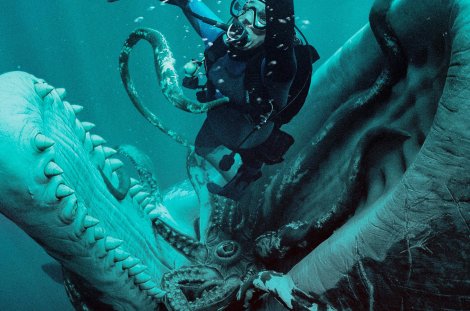
The very premise of ‘Whalefall’ is extraordinary. Jay is inside a whale’s digestive tract, trying to stay alive in extreme conditions. But his dwindling oxygen supply is not the only threat he faces. Inside the animal, he is also attacked by an octopus. Its snapping beak and the pools of stomach acid in particular provide graphic imagery. The film thus combines elements of creature horror with a survival thriller. For the main character, the situation becomes increasingly hopeless. With every minute, the risk of Jay losing consciousness grows. At the same time, memories and thoughts come to the fore that extend far beyond the immediate threat to his physical survival.
Josh Brolin plays the father
Jay’s relationship with his father Mitt, played by Josh Brolin, has a central role. Mitt was a diving instructor and the captain of a boat offering whale-watching tours. At the beginning of the film, he dies by suicide at sea. Flashbacks reveal that the relationship between father and son had been marked by conflict since Jay’s childhood. Mitt comes across as a hot-tempered, authoritarian man who has high expectations of his son. He repeatedly criticises Jay for failing to live up to his ideas of masculinity. Among other things, he mocks his physical condition and speaks disparagingly of his ‘weak lungs’.
Jay’s emotional nature and slight build also become grounds for belittling him. Memories of these experiences accompany Jay as he fights for survival. His deceased father’s voice is repeatedly present in his thoughts. At first, this dynamic follows a familiar narrative pattern: a son tries to break free from a domineering father’s expectations. But as the story progresses, the relationship takes on an additional, unexpected dimension. As Jay increasingly slips out of consciousness, he hears his deceased father’s voice again. Mitt asks him a personal question: ‘Do you have a girlfriend?’ Jay replies that he does not. His father then asks: ‘A boyfriend?’
A distinctive conversation
The brief exchange is one of the film’s most remarkable moments. Until then, Jay’s sexual orientation has not been explicitly addressed. Nor does the plot provide any clear confirmation that he is heterosexual. By asking about a possible male partner, ‘Whalefall’ therefore opens up a new interpretation of its main character. The scene leaves open whether Jay is gay, bisexual or still exploring his sexual orientation. The dialogue provides no definitive answer. According to gay film fans online, it is precisely this restraint that makes it particularly effective.
The British press is now also celebrating this small cinematic moment. Film critics suggest that ‘Whalefall’ manages to introduce an additional psychological layer in just a few words, without turning it into a separate coming-out storyline. Other major film productions sometimes merely hint at queer identities through vague clues or raise expectations among audiences without subsequently following them up. ‘Whalefall’ differs in that its potentially gay dimension is not artificially pushed to the fore. Instead, it appears as part of a broader exploration of Jay’s personality, his past and his relationship with his father.
A notion of masculinity
On this reading, the scene is particularly revealing in the context of the expectations Mitt placed on his son. Since childhood, Jay had experienced his father treating certain qualities as weaknesses. These included emotional openness, physical vulnerability and behaviour that did not fit his traditional image of a man. One possible interpretation, therefore, is that Jay may have learnt to suppress parts of his personality to meet his father’s expectations. If he is indeed gay, these experiences could also have influenced how he deals with his own sexual orientation. In this way, the film also draws attention to a widespread pattern of perception: unless a character is portrayed otherwise, heterosexuality is often taken as the unspoken norm. This expectation can also exist among people who are themselves gay or queer.
The whale as a symbol
The question of Jay’s possible gay identity also changes the symbolic meaning of his surroundings. The whale’s stomach is initially a life-threatening place from which the diver must escape. At the same time, it can be understood as a symbol of psychological captivity. Jay moves through the animal’s pulsating inner chambers while mentally wrestling with his father and his past. His external struggle for survival may thus reflect an internal conflict, British film critics go on to suggest. Jay must escape the whale.
At the same time, his survival could symbolise freeing himself from distressing memories, other people’s expectations and possibly repressed feelings. Whether or not this is a debate for film nerds, one thing is clear: ‘Whalefall’ is probably more than an ordinary creature horror film. Ultimately, more is at stake than whether Jay can escape the whale alive. The film also raises the question of whether he can break free from his father’s expectations and find his own way of coming to terms with who he is. An extraordinary survival scenario thus also becomes a story about the search for one’s own identity.








