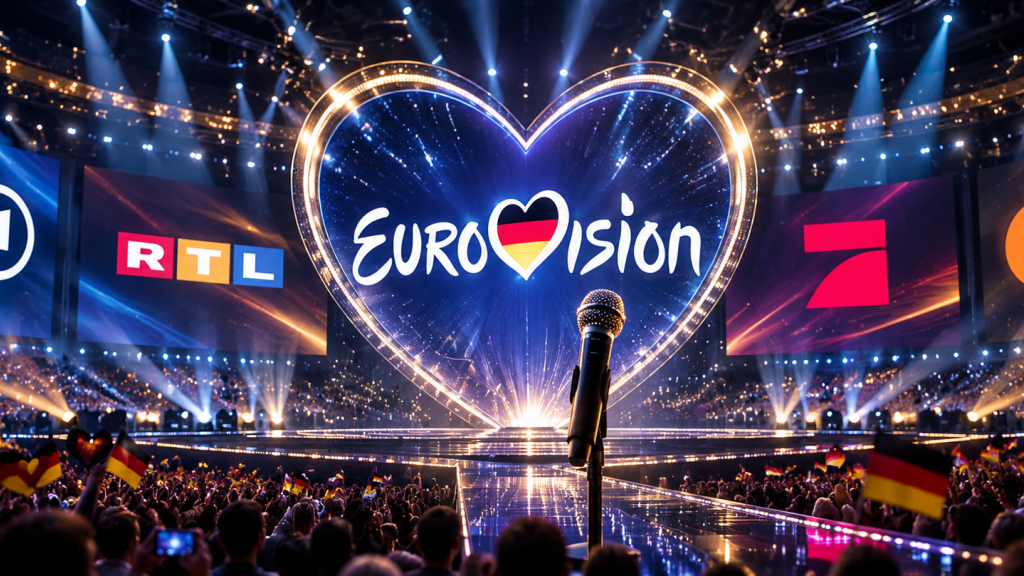
The German national selection for the Eurovision Song Contest (ESC) could in future be organised jointly by several major television broadcasters. ARD director of programming Christine Strobl has called for broader cooperation between public service and commercial TV broadcasters. Representatives of RTL and ProSiebenSat.1 also expressed interest in principle.
The key points at a glance
- New broadcasting alliance: ARD director of programming Christine Strobl wants to organise Germany’s Eurovision Song Contest national selection jointly with several major television broadcasters in future.
- RTL signals support: RTL’s chief content officer Inga Leschek views the collaboration between ARD and RTL on the 2025 national selection positively and is open to continuing it.
- ProSiebenSat.1 willing to talk: Chief content officer Henrik Pabst can also envisage taking part, provided the conditions are right.
- 2028 at the earliest: As planning for Eurovision 2027 is already under way, led by SWR, implementing the new concept in 2028 is considered a possibility.
- ZDF involvement uncertain: It is not yet known whether Zweites Deutsches Fernsehen might also join. No concrete agreements have been reached.
Joining forces for Eurovision
The proposals were made public at the TV summit during Medientage München. Leading programming executives discussed opportunities for closer cooperation within the German television industry. Strobl suggested the Eurovision Song Contest as an example of a joint project. Her vision goes beyond the existing collaboration between ARD and RTL. In future, several broadcasting groups could pool their resources to select Germany’s entry for the international music competition together. “I’m still dreaming of it, I’ll say that quite openly,” the ARD director of programming said. The experience with RTL had shown that such cooperation could work. She now hoped “that we can make this partnership even bigger than it is today”. Her aim was to share responsibility for the national Eurovision selection among several partners and “make something really big out of it together”.
Initial talks under way
The proposals apparently amount to more than a long-term aspiration. Strobl made clear that those involved were already looking at how they might put them into practice. “We’re working on it, and perhaps it will work out,” she said at the event. The ARD director of programming did not disclose how far the talks had progressed. Nor did she provide details of any potential agreements, a specific concept or a firm timetable.
The idea of a cross-broadcaster Eurovision selection would represent an unusual collaboration within Germany’s television industry. Public service and commercial broadcasters, which otherwise compete for ratings and viewers, could join forces for one of the best-known international music competitions. This would involve more than simply broadcasting individual programmes. Under Strobl’s proposals, several major broadcasting groups could help organise and shape Germany’s national selection.
Successful collaboration in 2025
Strobl received support from RTL’s chief content officer Inga Leschek. She pointed to the joint production of Germany’s 2025 Eurovision national selection, on which RTL and ARD had already worked together. On that occasion, the commercial broadcaster was allowed to organise the selection of Germany’s entry in cooperation with ARD. For RTL, this was a special opportunity to take part in an established international television event. Leschek was emphatically positive about that collaboration. “That was the best partnership we’ve had in the last two years,” she said at the TV summit.
RTL had been grateful that ARD had entrusted the broadcaster with the Eurovision Song Contest brand. The experience had apparently strengthened its desire to work on joint projects again in future. Leschek expressed confidence that the collaboration could continue. “We’re confident that we can pick up where we left off before long. Sharing is caring. If ProSieben wants to join in, I’m certainly not going to say no.” The RTL executive thus explicitly raised the prospect of expanding the existing model. Alongside ARD and RTL, ProSiebenSat.1 could therefore also become part of a joint Eurovision project.
ProSiebenSat.1 open to the idea
The invitation to ProSiebenSat.1 did not go unanswered at the event. Henrik Pabst, the television group’s chief content officer, was sitting next to Leschek during the discussion and responded positively in principle. He did not rule out working with the other broadcasting groups. However, constructive negotiations and a convincing joint outcome would be prerequisites. “We won’t close ourselves off to it if the talks are conducted properly and the outcome ultimately sends a positive signal. Then, of course, we’ll be delighted if we can be part of it too,” Pabst said.
At the same time, he made clear that any potential agreements would first need to be discussed calmly. “Let’s take our time to talk about it,” the programming executive added. Three major players in the German television industry thus signalled at the TV summit that they were willing in principle to discuss a joint Eurovision national selection. However, this does not yet constitute a firm commitment from ProSiebenSat.1. Whether and in what form the group would take part depends on further talks.
New concept in 2028 at the earliest
A comprehensive reorganisation of Germany’s national selection for the Eurovision Song Contest 2027 now appears barely realistic. Preparations for the next edition have already begun within ARD. Südwestrundfunk (SWR), which has taken over responsibility for Germany’s Eurovision participation within the broadcasting network, is leading the process. Any potential collaboration between several major TV groups is therefore likely to be discussed primarily with the Eurovision Song Contest 2028 in mind. However, no official start date for the planned joint project was announced at the TV summit. The precise division of responsibilities between the potential partners also remains unclear. Nevertheless, the programming executives’ public comments indicate interest in expanding the existing collaboration.
Could ZDF take part?
It remains unclear whether other television broadcasters besides ARD, RTL and ProSiebenSat.1 might take part in a joint German Eurovision national selection. ZDF’s role, in particular, has yet to be clarified. Representatives of the Mainz-based broadcaster did not take part in the relevant discussion at the TV summit. As a result, no specific position from ZDF on the proposals emerged. However, Strobl’s broadly worded invitation to cooperate more widely could also extend to Zweites Deutsches Fernsehen. Whether it is interested in taking part cannot be inferred from the comments made so far. If several public service and commercial broadcasters were to agree on a joint model, this would represent a far-reaching change in the organisation of Germany’s Eurovision national selection.
Proposals were discussed back in 2024
The idea of broader cooperation on the Eurovision Song Contest is not new. Several potential partners had already discussed a cross-broadcaster concept for selecting Germany’s Eurovision entry in 2024. Those discussions largely took place away from the public eye. The aim was to explore options for jointly organising the national selection. However, the plans were not implemented. Instead, a collaboration emerged between ARD and RTL, in which entertainer Stefan Raab played a central role. Under the title “Chefsache ESC”, Germany’s 2025 national selection was organised by those two partners. No other major broadcasting groups took part. That collaboration now serves as an important reference point for the new proposals. Both Strobl and Leschek highlighted their positive experiences of the joint project.








