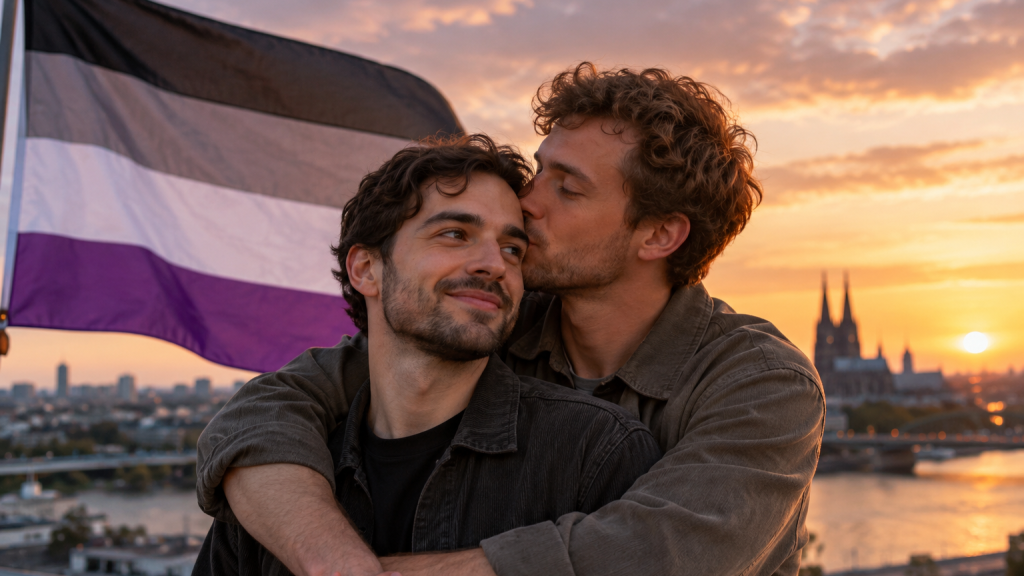
Asexual people face discrimination, violence and unequal treatment in healthcare in numerous countries (German). This is the finding of a new international report by the human rights organisation Outright International. Attempts to change people's sexual orientation and a lack of legal protections are identified as particularly problematic.
Key points at a glance
- Human rights violations worldwide: a new report by Outright International documents discrimination, sexual violence, bullying and unequal treatment of asexual people.
- Widespread conversion practices: in a survey of nearly 9,000 participants, more than ten per cent reported that such measures had been offered or recommended to them, or that they had experienced them themselves.
- According to the report, asexuality is often wrongly regarded as a mental illness or sexual dysfunction.
- Inadequate legal protection: in many places, anti-discrimination laws do not explicitly cover asexual people. Anti-LGBTQ+ laws, meanwhile, can also affect them.
- International collaboration: advocacy groups from ten countries contributed to the report.
- The human rights organisation is calling for legal protections and greater inclusion of asexual people within the LGBTQ+ movement.
Comprehensive report
The study was produced jointly with British asexuality activist Yasmin Benoit and advocacy groups from Australia, Bangladesh, Botswana, Hungary, India, Indonesia, Italy, Kenya, Mexico and Vietnam. Through the report, Outright International aims to draw the attention of policymakers, human rights organisations and leaders within the queer movement to the situation of asexual people. The aim is to “make policymakers, human rights organisations and leaders of the queer movement aware of these human rights violations and support discussions about how we can better address the specific needs and demands of asexual people”, the organisation explained. Benoit said: “I am constantly asked how asexual people are discriminated against. Now we have a report that explains just how far-reaching the problem really is.”
What asexuality means
The report describes asexuality as “an umbrella term for people who experience little to no sexual attraction to others, regardless of their gender”. This is not necessarily a uniform experience. Some people who describe themselves as asexual or “ace” understand asexuality as a spectrum encompassing different forms and degrees of sexual attraction. It is not yet possible to reliably determine how many people worldwide are asexual. The available research is limited and comes predominantly from Western Europe and North America. It suggests that asexual people make up a small percentage of the population.
The report's authors point out that asexuality is still often misunderstood in society and medicine. This includes the assumption that people who experience little or no sexual attraction are mentally ill or have a sexual dysfunction. “Asexual people experience pathologisation, discrimination and violence because of their sexual orientation,” the report states. “They are subjected to conversion practices, sexual violence, bullying in schools, workplace harassment and discrimination in healthcare.”
Widespread conversion practices
According to the human rights organisation, attempts to change asexual people's sexual orientation against their will or under social pressure are particularly serious. A 2022 survey of nearly 9,000 asexual people found that more than ten per cent of participants had already encountered such conversion practices. They said that such measures had been offered or recommended to them, or that they had undergone them themselves. Conversion practices aim to change a person's sexual orientation.
In the case of asexual people, such attempts seek to eliminate their lack of, or low level of, sexual attraction. The report also refers to several studies from the United Kingdom, the United States, Spain, Vietnam and Australia. These suggest that asexual people are disproportionately likely to have experienced various forms of such practices. In some cases, these included sexual assault or violence within relationships intended to supposedly “correct” the sexual orientation of those affected.
Frequent misdiagnoses
Healthcare is another focus of the report. According to Outright International, asexual people frequently receive medical diagnoses that do not reflect their actual situation. This can lead to their sexual orientation being regarded as a condition requiring treatment and to them not receiving appropriate medical care. As an example, the report cites the World Health Organization's (WHO) International Classification of Diseases (ICD). It describes a condition involving reduced sexual desire, known in English as Hypoactive Sexual Desire Dysfunction (HSDD), as “the absence or a marked reduction in the desire or motivation to engage in sexual activity … associated with clinically significant distress”.
According to the human rights organisation, this does not adequately account for the fact that asexual people do not necessarily experience distress or have a dysfunction because of their low or absent sexual desire. A Canadian study from 2015 supports the distinction between asexuality and a medically diagnosed sexual desire disorder. The researchers examined a total of 423 people and found “notable differences” between people who identified themselves as asexual and those who met the diagnostic criteria for HSDD. They concluded that “asexuality is a distinct category that differs from a sexual desire disorder”.
Gaps in legal protection
The report also takes a critical view of the legal situation of asexual people. Outright International points out that laws targeting LGBTQ+ people in various countries can be interpreted in ways that also criminalise asexual people, even if asexuality is not explicitly mentioned in the relevant provisions. Conversely, legal provisions protecting against discrimination on the grounds of sexual orientation rarely explicitly mention asexual people.
The organisation sees this as a problem linked in part to a lack of knowledge and social prejudice. “The mistaken assumptions that asexual people do not exist, that asexuality is not a legitimate sexual orientation or that asexual people do not experience discrimination and violence render them invisible in national laws and policies – including provisions protecting against discrimination,” the report continues. The lack of explicit inclusion could contribute to specific forms of disadvantage not being adequately considered in policy decisions and legal reforms.
Advocacy within the community
British activist Yasmin Benoit, who was involved in producing the report, sees the findings as a basis for broader social and political engagement with asexuality and stressed: “This is happening all over the world.” Benoit also called for greater commitment within the queer community. “It has never been more important to advocate for the asexual community and ensure that our LGBTQ+ organisations explicitly include asexual people.” The international collaboration on the study is intended to help ensure that the situation of asexual people is not viewed solely from the perspective of Western countries. Alongside experiences from Europe and North America, the report therefore also incorporates perspectives from Africa, Asia, Australia and Latin America.
Outright International is calling on governments to adapt their human rights and anti-discrimination policies accordingly. Venus Aves, a research and programme officer at the organisation, explained: “States must respond to these human rights violations with policies and laws that explicitly include asexual people. At the same time, general human rights protections and laws prohibiting discrimination on the grounds of sexual orientation must be understood to apply to asexual people too.”








