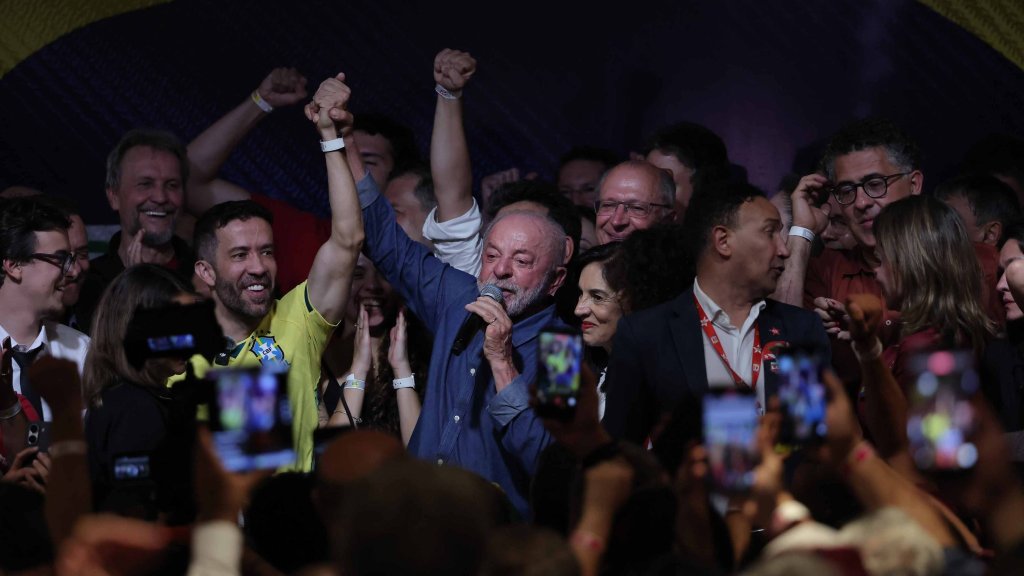
For Brazil’s LGBTQ+ community, the outcome of the presidential election is an important signal: it was not the right-wing Flávio Bolsonaro but the left-wing incumbent Luiz Inácio Lula da Silva who prevailed in the decisive vote. The country has thus been spared a political takeover by the son of the far-right former president Jair Bolsonaro. The result is likely to raise hopes, particularly among those who view a return of the Bolsonaro camp with concern.
The key points at a glance
- Hope for the LGBTQ+ community: the election victory of left-wing President Luiz Inácio Lula da Silva prevents the right-wing Bolsonaro camp from taking power. For gay and queer people, the result is an important political signal.
- A close election result: Silva wins the run-off with 51.8 per cent against Flávio Bolsonaro, who receives 48.2 per cent. The margin is almost 4.4 million votes.
- Dispute over the result: Bolsonaro refuses to accept defeat and announces plans to seek the annulment of the election.
- Silva interprets his re-election as a decision by the people to preserve democratic structures.
- A political signal: the left-wing incumbent’s success interrupts a series of election victories in Latin America by right-wing politicians allied with US President Donald Trump.
A lead after a close race
However, it remains unclear whether this pivotal election will bring any concrete improvements in LGBTQ+ rights, and what those might be. What is clear, however, is that the election was a choice between two fundamentally different political directions. While Bolsonaro stands for a right-wing course, Silva represents the political left. According to official figures from the Superior Electoral Court, Silva received 51.8 per cent of the votes in the run-off. His challenger Flávio Bolsonaro secured 48.2 per cent. The difference amounts to almost 4.4 million votes. The head of state, who celebrates his 81st birthday this week, thus secured a fourth term in office. Electoral researchers attribute the president’s success in part to the surprisingly high turnout. They say this ultimately played a decisive role in enabling Silva to win what had initially been expected to be an extremely close race.
Bolsonaro refuses to accept defeat
While the president’s supporters celebrated the election result, his defeated opponent questioned the legitimacy of the vote. Flávio Bolsonaro announced plans to challenge the result in court. “It is impossible to accept the result,” Bolsonaro said in Brasilia. “I will request the annulment of these elections,” Bolsonaro added. His criticism centres on a last-minute Supreme Court decision to extend polling station opening hours by two hours. Bolsonaro described the move as unprecedented and cited it as grounds for his demand for an annulment.
However, the extension had not come about solely at the urging of the Silva camp. Both presidential candidates had in fact spoken in favour of giving people more time to vote. They differed only on the scope of the request: while Silva supported a general extension, Bolsonaro wanted to restrict it to certain states. The decision was prompted by public transport difficulties and adverse weather conditions in several parts of the country. Both had made it harder to reach polling stations.
A decision for democracy
For the re-elected president, the result has a significance that goes beyond party-political competition. Following his success, Silva emphasised the democratic character of the vote in particular. Brazilians had voted “to safeguard democracy”, Silva said. His supporters responded with exuberant celebrations. Thousands of people gathered in the streets to celebrate the left-wing politician’s election victory. The outcome is also of considerable significance for Brazil’s political future. As Latin America’s largest economy, the country plays an important role in the region. The two candidates represented opposing visions of the direction Brazil should take in future. The differences were particularly pronounced in social policy, the approach to climate change and foreign relations with the United States. This was another reason why the run-off was closely followed far beyond the country’s borders.
Son of the former president
For Flávio Bolsonaro, the defeat is a setback in his attempt to carry on his father’s political legacy. The homophobic former president Jair Bolsonaro had put his son forward as a candidate. He himself was unable to stand. The right-wing populist former head of state was sentenced to more than 27 years in prison for his involvement in an attempted coup. Jair Bolsonaro is currently under house arrest for health reasons. Just a few weeks before the run-off, many signs had pointed to a victory for his son. In the first round of voting in early October, Flávio Bolsonaro had unexpectedly emerged as the leading candidate. Opinion polls subsequently indicated an extremely close race in the second round. The fact that the incumbent ultimately secured a lead of several million votes was also attributed to the higher turnout.
The balance of power in Latin America
Silva’s re-election has also interrupted, for now, a series of successes for right-wing politicians in Latin America. In Chile, Peru and Colombia, candidates regarded as allies of US President Donald Trump had prevailed over the course of the year. Silva, by contrast, is one of Trump’s political opponents. His re-election thus prevents a further shift in the regional balance of power in favour of the American president and his political partners. For Brazil, the result means above all the continuation of a government that sets different priorities from the Bolsonaro camp on key issues. Alongside its international outlook, future economic and social policy in particular is likely to determine how the political mood in the country develops.
For the LGBTQ+ community and other groups in society that view the right-wing Bolsonaro camp critically, one political prospect above all is therefore preserved: Brazil will continue to be governed by a left-wing president. What concrete social and legal changes will follow will only become clear as his term in office progresses.








