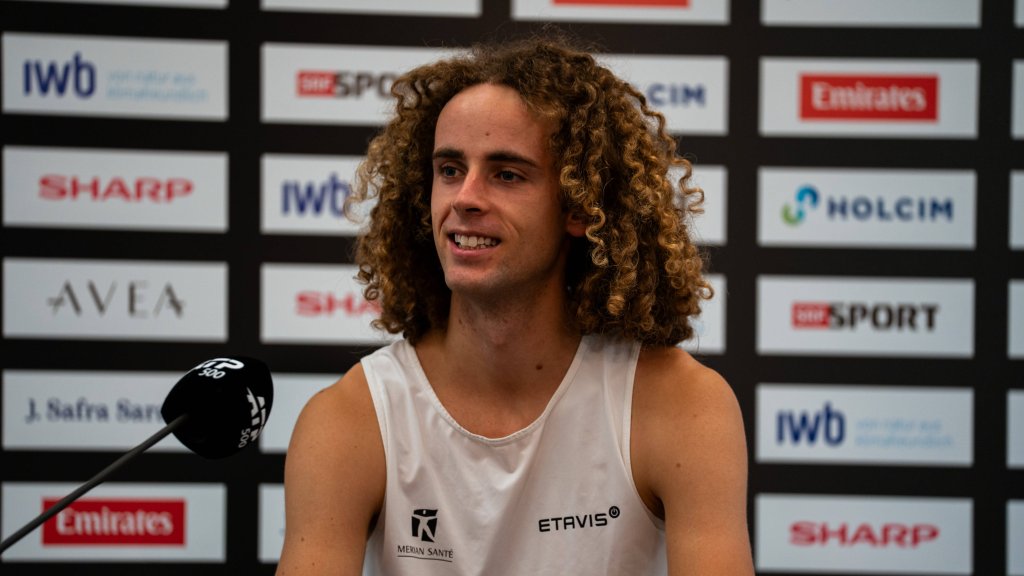
Two Challenger titles, a place among the world's top 200 tennis players for the first time and newfound confidence: things have never been better for Swiss tennis professional Mika Brunold (German). The 22-year-old from the canton of Basel-Landschaft has made a remarkable rise in the sport within just a few weeks. He also sees a connection with his coming out (German) last November.
The key points at a glance
- Sporting breakthrough: Mika Brunold has won 14 of his past 15 matches and climbed from 410th to 195th in the world rankings within six weeks.
- Two tournament victories: The 22-year-old Swiss player won the Challenger tournaments in Tulln, Austria, and Roanne, France. This makes him the second-highest-ranked Swiss male tennis player behind Stan Wawrinka.
- Coming out as a liberation: Brunold publicly came out as gay in November 2025. Since then, he has felt more confident and says he can concentrate better on his sport.
- A role model for other gay people: His coming-out post received around 75,000 likes on Instagram. He was particularly moved by messages from people whom his decision had given the courage to come out themselves.
- Ambitious sporting goals: Brunold wants to succeed at the Swiss Indoors in Basel and continue climbing the world rankings. Breaking into the top 200 means he can enter qualifying for the Australian Open for the first time.
More energy after coming out
“I feel it on court too. I have more confidence and fewer negative thoughts. And I can put more energy into my tennis,” Brunold said in an interview with the Swiss newspaper Tages-Anzeiger. The tennis player is one of the few active male professionals who are openly gay. For him, this part of his life now feels entirely natural. At the same time, he knows that coming out publicly can help other people. However, he wants sport to remain the focus of his career. “I'm a tennis player, not the gay tennis player,” Brunold stressed.
14 wins in 15 matches
The Swiss player's recent results underline his rise in the sport. Brunold has won 14 of his past 15 matches. He claimed the title at both the Tulln and Roanne Challenger tournaments. In just six weeks, he climbed from 410th to 195th in the world rankings. Among Swiss male tennis players, he now trails only Stan Wawrinka, who is nearing the end of his career. Brunold explained that he had known for some time that he could reach this level. Until now, however, he had been unable to perform consistently throughout an entire tournament week.
That consistency was crucial, he said, because there was little to separate players on the Challenger Tour. Since April, Brunold has been working with Italian coach Gianluca Carbone. The coach has experience with players ranked in the world's top 50 and top 20. Together, they had worked on various areas, including mental preparation, handling stress, nutrition and recovery. Brunold had previously worked with various coaches, including former Swiss Davis Cup player Henri Laaksonen. He said he had learnt something from each of them. Working with Carbone had now helped him take the next step in his development.
Tennis runs in the family
Brunold comes from a tennis-loving family. Both his mother and his father were once among the country's leading players. His father, Armando Brunold, even beat a young Roger Federer at a Satellite tournament in Küblis. At home, however, that victory had never been made much of, Brunold said with a laugh. He thought he had actually discovered the story himself while reading a biography of Federer. His older brother also played tennis. The two trained together as children. His brother later had to give up competitive sport because of hip problems and now plays only as a hobby.
For Mika Brunold, by contrast, it was clear from an early age that he wanted to become a professional tennis player. Unlike some other promising young Swiss players, he was introduced gradually to the demands of competitive sport by his parents. At around 14, he said, he was not yet spending countless hours training every day. His parents had made sure that he could develop physically at a gradual pace and get used to increasing training volumes. This may also be one reason why Brunold has so far avoided serious injuries. He was already receiving physiotherapy support at the age of 12 and regularly did injury-prevention exercises.
During his junior years, Brunold was often in the shadow of other talented Swiss players. Dominic Stricker, Jérôme Kym and Leandro Riedi attracted more attention at the time. He has since overtaken all three in the world rankings. The 22-year-old is happy with his progress so far. His steady development and careful physical conditioning had paid off, he said. Brunold has also already made his mark in the Davis Cup. In February, he won his singles match against Tunisia on his debut. He is now among the rising Swiss players considered capable of taking the next step onto the major international tennis stage.
Personal development
Brunold had already attracted international attention in November 2025, when he publicly came out as gay on Instagram. He said the decision was the result of a longer process of personal development. Back in January this year, he spoke about his positive experiences after coming out (German), something he has now reaffirmed. He had long known that he wanted to live openly as a gay man one day. After the end of the season, the timing had felt right. “For me, it was the right time. The season was over, and my gut feeling told me I was ready,” Brunold explained. By then, it had no longer felt like a particularly dramatic decision to him. The thought had been with him for quite some time. Before coming out publicly, he also spoke to his parents, particularly his mother. She had encouraged him to be open about being gay and no longer feel he had to hide.
Moving messages
His Instagram post prompted an exceptionally strong response. Around 75,000 people liked it. For Brunold, however, the large number of reactions was not what mattered. “I did it for myself, not for the likes. Whether it's 500 likes or five million doesn't matter to me,” he said. The personal messages he received afterwards meant far more to him. Some people told him that his example had given them the courage to speak openly about being gay themselves. “Your coming out helped me come out myself,” one person wrote to him, for example.
Another message read: “Now I've managed to tell my parents too.” Brunold describes feedback like this as the loveliest response to his decision. “It's cool that I can be a role model for others,” he explained. He does not find the role a burden. It did not mean he had to change or behave differently. Rather, he sees it as a special opportunity to help other gay people who are struggling with their sexual orientation and the fear of rejection.
More confidence on court
Coming out affected Brunold not only personally but also as a player. For a long time, he said, he had not fully realised how much he had been trying to fit in or holding himself back in certain situations. Only in recent years had he begun to express his opinions more openly and speak about his personal needs. This concerned not only being gay, but also his dealings with coaches, team members and his family.
Previously, he had often accepted what worked for others, even when he did not feel entirely comfortable with it. Now, he could say more clearly when something bothered him. This change had also affected his tennis. He felt freer, had fewer negative thoughts and could focus more of his energy on training and competition. Brunold therefore explicitly described coming out as a liberation.
Loneliness on the tennis tour
Despite his positive experiences, Brunold still sees problems in society's attitudes towards homosexuality. In his view, whether someone is gay or not should not really matter. In reality, however, it remained an issue that preoccupied and burdened many people. The situation could be particularly difficult in professional tennis when gay players knew hardly any other professionals who were open about their sexual orientation. “And if you don't know anyone on the tennis tour who is like you, you feel alone,” Brunold said.
This gave rise to fears and questions that heterosexual colleagues might not have to deal with. In his original Instagram post, he had already pointed out that being gay meant far more than simply loving someone of the same sex. It also involved the fear of not being accepted and the pressure to keep one's sexual orientation secret.
Silva gave him courage
Brazilian tennis professional João Lucas Reis da Silva (German) also played an important part in Brunold's journey. He had publicly come out as gay the previous year, becoming the first active male tennis professional to take that step. Brunold observed that the reactions to the Brazilian's coming out were predominantly positive. This had reinforced his own decision. There was a special sporting encounter at the Challenger tournament in Tulln, Austria. There, the two openly gay professionals faced each other in the final. Brunold won the match, securing his first Challenger title. However, the Swiss player said they had not discussed their coming out during the tournament. Instead, they talked about tennis, upcoming tournaments and their sporting plans. His sexuality had hardly been a topic of conversation at other encounters on the tour either. For Brunold, that is exactly the right approach.
Homosexuality in men's tennis
Brunold and Reis da Silva remain the only active male tennis professionals who have publicly come out as gay. The Swiss player did not want to judge whether the tennis tour should therefore be described as backward. Instead, he pointed out that society as a whole was not yet as far advanced in its attitudes towards homosexuality as it should be. That social situation was also reflected in tennis. Brunold takes a nuanced view of the fact that his coming out sometimes receives more attention in interviews than his sporting achievements. On the one hand, he wants to be recognised primarily for his performances as a tennis player. On the other, he has no problem speaking openly about being gay, because it is also part of who he is.
Climbing further up the world rankings
Following his recent successes, Brunold is turning his attention to the Swiss Indoors in Basel. Not long ago, he discovered an old friendship book from his childhood. Asked about his biggest dream, he had written that he wanted to win the Swiss Indoors one day. He is still pursuing that goal. Breaking into the world's top 200 has also opened up new opportunities for Brunold elsewhere. In January, he will be able to enter qualifying for the Australian Open for the first time. Brunold therefore sees his sporting breakthrough as an important milestone, not the end of his development. He wants to climb as high as possible in the world rankings.








