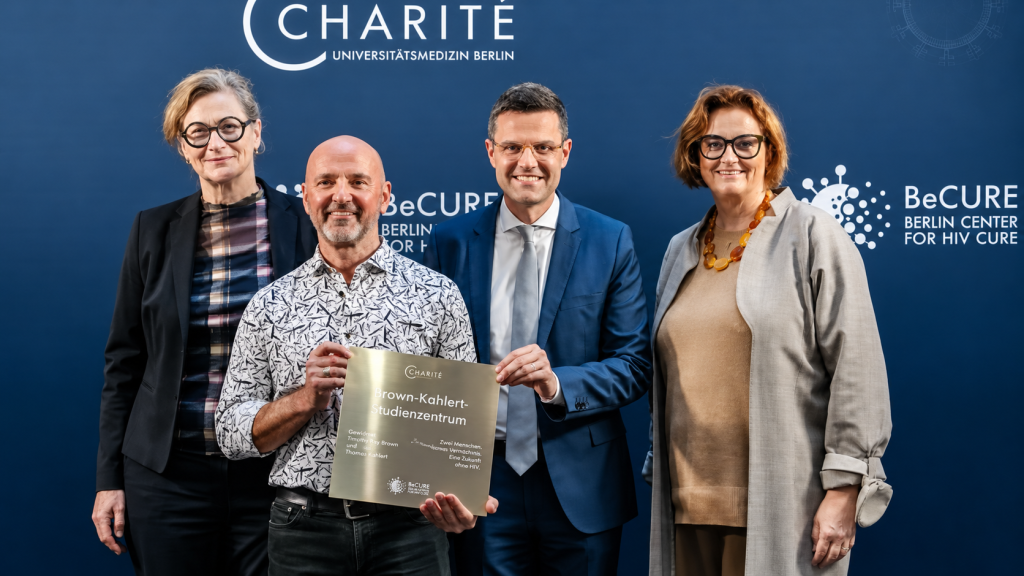
Eleven years after a stem cell transplant that freed him of HIV and a serious form of cancer, a 62-year-old Berlin resident has spoken publicly for the first time about his extraordinary medical history. Thomas Kahlert is the man previously known in medical circles only as the “second Berlin patient”. HIV has been undetectable in his body for years, even though he no longer takes HIV medication.
Key points at a glance
- HIV cure in Berlin: 62-year-old Thomas Kahlert is the man previously known only as the “second Berlin patient”, in whom HIV could no longer be detected following a stem cell transplant.
- Years without HIV medication: Following a transplant in October 2015, Kahlert is free of both leukaemia and HIV. He stopped his antiretroviral therapy in 2018.
- Medically exceptional case: Unlike in the case of the first patient cured of HIV, the transplanted stem cells were not fully resistant to HIV. Nevertheless, the virus disappeared.
- Only 13 cases of a cure worldwide: Everyone so far considered cured received a stem cell transplant because of a serious form of blood cancer.
- New research approaches: Scientists want to use the findings to eliminate or control HIV permanently in future without a risky transplant.
Man cured of HIV speaks out
Kahlert has now appeared under his full name for the first time at an event at Berlin’s Charité university hospital. Asked about his health, he said he was doing “very well”. His case had already been presented to the scientific community in 2024. At the time, however, his identity remained confidential. Kahlert has worked at Charité for 38 years and was also treated there. The timing of his public appearance had a special significance: exactly eleven years earlier, he had received the stem cell transplant that not only treated his leukaemia but apparently also completely eliminated his HIV infection. Scientists see his medical history as providing important clues to how an HIV cure might be achieved without the particularly risky treatments required to date.
Kahlert’s medical history began in 2009. A routine examination revealed that he had contracted HIV. Effective antiretroviral medicines capable of suppressing the virus’s replication were already available at that time. In 2015, however, Kahlert received another serious diagnosis: acute myeloid leukaemia, an aggressive form of blood cancer. A stem cell transplant was necessary to treat the disease, and in October 2015 he received blood stem cells from a healthy female donor.
In this procedure, the diseased blood-forming system is replaced with stem cells from another person. A new immune system develops from these cells. The treatment was successful. Neither cancer cells nor HIV have been detected in Kahlert since then, and in 2018 he decided to stop his antiretroviral therapy. Normally, HIV would start replicating again once medication was stopped. In Kahlert’s case, however, this rebound did not occur. The fact that the virus remained undetectable even years later makes his case particularly significant for medical research.
Cure surprises scientists
What makes Kahlert’s cure unusual becomes clear when it is compared with that of the first so-called Berlin patient. The American Timothy Ray Brown was also treated for leukaemia with a stem cell transplant at Charité in 2008. This also cured an existing HIV infection for the first time anywhere in the world. Brown received stem cells from a donor with a rare genetic characteristic. To infect human immune cells, HIV uses, among other things, a receptor on their surface. Known as CCR5, it serves as an entry point for certain variants of the virus. Around one per cent of people of European ancestry have a genetic alteration called CCR5-delta32 in both copies of the gene. This mutation means that functional CCR5 receptors are largely absent from the cell surface. People with this genetic make-up are therefore largely protected against HIV variants that require this receptor. Brown’s stem cell donor had this genetic alteration in both copies. As a result, his new immune system was resistant to the corresponding HIV variants.
For Thomas Kahlert, the situation was fundamentally different. Both he and his stem cell donor had inherited the CCR5-delta32 mutation from only one parent. Having just one copy does not provide reliable protection against HIV infection. Nevertheless, after the transplant, the virus disappeared completely from the samples examined so far. The case therefore disproves the earlier assumption that curing HIV through a stem cell transplant necessarily requires a donor immune system that is resistant to HIV.
Immune system eliminated the virus
One possible explanation for Kahlert’s cure lies in the particular effect of the transplanted immune system. HIV has the ability to establish itself permanently in certain immune cells. These so-called viral reservoirs can persist for many years. While modern HIV medicines reliably suppress the virus’s replication, they do not fully reach these hidden viral reservoirs. This is why HIV begins replicating again in most people as soon as antiretroviral treatment is stopped. In Kahlert’s case, the stem cell transplant appears to have interrupted this mechanism.
Scientific analyses, the results of which were published in the journal “Nature” in December 2025, provide indications that the new immune system may itself have eliminated the remaining infected cells. Antibodies may have played an important role in this. They can mark HIV-infected cells so that specialised immune cells recognise and destroy them. Infectious disease researcher Christian Gaebler of Charité explained: “Our analyses suggest that Thomas Kahlert’s new immune system itself eliminated the places where the virus was hiding.” He added: “Antibodies apparently played an important role, marking HIV-infected cells so that the immune system’s killer cells could destroy them.” This finding opens up a new avenue of research. If the crucial defence mechanisms can be specifically replicated, it might be possible to cure HIV without replacing the entire immune system.
13 people cured worldwide
Despite these extraordinary successes, an HIV cure remains a medical exception. Around 41 million people worldwide are living with HIV. According to Charité, only 13 people are so far considered cured of the infection. All known cases of a cure are linked to a stem cell transplant carried out because the person also had a serious form of blood cancer. The procedure carries substantial health risks. Before such a transplant, the existing blood-forming system must be largely suppressed through intensive treatment with chemotherapy and, in some cases, radiotherapy.
This severely weakens the body’s immune defences for an extended period. Even infections that are normally harmless can then become life-threatening. There is also a risk that the transplanted immune cells will attack the recipient’s body. This so-called graft-versus-host reaction can cause severe organ damage. A stem cell transplant is therefore generally only an option for sufficiently serious illnesses, such as certain forms of blood cancer. For people whose HIV infection can be well controlled with medication, the risk of such treatment would not be justified.
HIV remains in the body
Medical care for people with HIV has improved considerably over recent decades. Modern antiretroviral therapies can permanently suppress the virus’s replication. With an early start to treatment and consistent adherence to medication, a largely normal life expectancy and quality of life are now possible. Particularly important is the medically established principle of U=U, short for “Undetectable = Untransmittable”. In German, this is “Nicht nachweisbar = Nicht übertragbar”. People with HIV whose viral load remains below the detection threshold through treatment do not transmit the virus during sex.
However, successful treatment does not prevent HIV from remaining in hidden cellular reservoirs. Without medication, the virus can therefore usually start replicating again. Untreated, the infection can increasingly damage the immune system and eventually become life-threatening. According to Charité, people with HIV also have an increased risk of certain cardiovascular and metabolic diseases, even with good medical care. Social exclusion and stigmatisation also remain a burden for many people affected. A safe cure could therefore not only remove the need for lifelong medication but also improve many people’s health and social prospects.
New centre for HIV research
The findings from the cases of Thomas Kahlert and Timothy Ray Brown are now to be used specifically to develop new treatments. To this end, Berlin’s Charité university hospital opened the Berlin Center for HIV Cure (BeCURE) in mid-October. Alongside Kahlert, those attending the event included Berlin’s Senator for Science, Ina Czyborra, and representatives of Charité. The new research centre is headed by infectious disease researcher Professor Christian Gaebler, who works at the Department of Infectious Diseases and Intensive Care Medicine and the Berlin Institute of Health at Charité. “We want to fundamentally improve the outlook for people living with HIV,” Gaebler said. The long-term goal is either to remove HIV from the body completely or to keep the infection permanently under control without medication.
The scientists particularly want to investigate the mechanisms that helped eliminate the virus in those cured so far. The focus is on modern antibody treatments, immunotherapies, and gene and cell therapies. Initial clinical trials involving antibodies have already begun. “We want to find ways to remove the virus from the body or keep it permanently in check without a risky stem cell transplant, so that this approach to a cure is suitable for as many people affected as possible,” Gaebler explained. The research could also become relevant to other chronic viral infections. Of particular interest is hepatitis B, an infectious disease of the liver that around 240 million people worldwide live with. Here too, the challenge is to control the virus over the long term or eliminate it completely.
Directly involving people with HIV
The new research centre combines basic medical research with clinical trials and social science studies. Experts in infectious diseases, virology, immunology, haematology, obstetrics and hepatology are involved. The systematic analysis of medical research data is also part of the approach. Charité places particular importance on the direct involvement of people with HIV. “We have established a Community Collaboration Board through which people who live with HIV or understand their needs help shape the research,” Gaebler said. “We also want to be a point of contact for people affected in Berlin and the surrounding area, who can access clinical trials of new therapies with us.”
Berlin’s Senator for Science, Health and Care, Ina Czyborra, emphasised: “Almost twenty years ago, a person was cured of HIV for the first time at Charité. This demonstrates impressively what medicine can achieve when it directly reaches patients. The new field of research established by that breakthrough now has a permanent home in BeCURE. Excellent research for people is taking place here, and with this ambition we are developing Berlin into the world’s leading centre for health research.” Berlin also plays a special role from an epidemiological perspective: around one in five people diagnosed with HIV in Germany lives in the capital.








