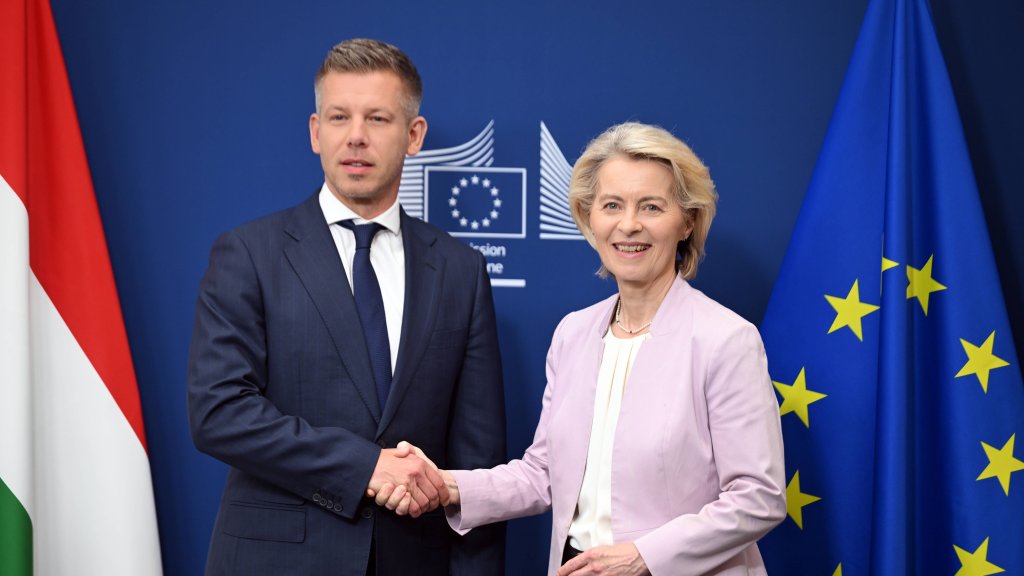
Hungary’s political direction has changed noticeably under Prime Minister Péter Magyar. However, the European Parliament still sees a considerable need for action on the rights of gay, lesbian, bisexual, trans and queer people. This was the conclusion reached by a delegation that visited Budapest this week.
Key points at a glance
- Following a visit to Budapest, a European Parliament delegation judged the reforms introduced so far by Péter Magyar’s government to be insufficient.
- Although anti-LGBTQ+ passages were removed from the Child Protection Act in mid-October, numerous discriminatory provisions remain in place.
- Among other measures, the MEPs are calling for changes to Hungary’s constitution.
- The possible banning of Budapest Pride, restrictions on trans people and discrimination against same-sex families also face criticism.
- On the rule of law, however, the delegation acknowledges clear progress since the end of Viktor Orbán’s government.
- Around €500 million in EU funding is to remain frozen because of discrimination against LGBTQ+ people.
It is not enough
The delegation’s leader, Sophie Wilmès, a Vice-President of the European Parliament and member of the liberal Renew group, made clear that the measures taken so far are not enough. “Is it sufficient overall? No, it is not sufficient,” she said, according to the ANSA news agency. Alessandro Zan was the sole representative of the social democratic S&D group. Before the trip, he had already called for both the ban on Budapest Pride and the discriminatory provisions in the constitution adopted under former Prime Minister Viktor Orbán to be abolished.
Discrimination only partly addressed
Specifically, the delegation also considers the reform of 13 October not far-reaching enough. On that day, the Hungarian government removed provisions discriminating against LGBTQ+ people from the Child Protection Act. Adopted in 2021, the so-called anti-gay law had already been condemned by the European Court of Justice in April. In Wilmès’s assessment, however, the problems are not confined to this legislation. “The entire political framework affecting the community is also reflected in other parts of the legislation,” she explained. The issue therefore needed to be addressed at a more fundamental level. This explicitly included amending the constitution.
Restrictions on books with LGBTQ+ content remain in force. Certain children’s and young adult books that address homosexuality or gender diversity must be sold in Hungary separately from other publications for those age groups and in sealed packaging. Sales are also prohibited near certain institutions. Trans people still face obstacles to legal recognition of their gender identity. Wilmès does acknowledge efforts by Magyar’s government to create a more open society. The prime minister had, for example, spoken in favour of allowing same-sex couples to adopt.
His overall position on the rights of gay and queer people nevertheless remained unclear (German). “We will follow very closely how all this translates into reality,” the delegation leader said. Following the three-day trip, Alessandro Zan published his own assessment on social media. He acknowledged that Magyar’s government had already implemented numerous changes. At the same time, considerable problems remained. The legal basis for a possible ban on Budapest Pride also remained in place. Provisions that, in his view, “criminalise” same-sex families were still in force too.
A noticeable change
The assessment of the general trajectory on the rule of law is, however, considerably more positive. As recently as April 2025, the government then led by Viktor Orbán had not even been willing to receive a European Parliament delegation. Under the new government, by contrast, there had been a noticeable change, Wilmès also emphasised. “Things have changed. You can feel it,” she said. Developments went “far beyond the stated intentions”. Since Magyar’s election victory in April, the state of emergency and campaigns against non-governmental organisations have ended. The Sovereignty Protection Office has also been abolished. Hungary has joined the European Public Prosecutor’s Office too. Conditions for the work of civil society organisations had also improved. In Wilmès’s words, the organisations had “finally come out of the basement”.
Despite this progress, the delegation still sees numerous unresolved issues. Limiting MPs to three terms of office raised “legitimate concerns”. Nor had comprehensive media pluralism yet been achieved. In the judicial system, the European Parliament is calling for clear and transparent procedures for both the appointment of judges and the allocation of court cases. Hungary must also consistently implement rulings by the European Court of Justice. Under Orbán, such judgments had frequently been ignored.
Billions in EU funding frozen
Financial support from Brussels was another topic during the delegation’s visit. Wilmès left open whether further EU funds could be released to Hungary. The possible ending of the proceedings under Article 7 of the EU Treaty, which have been ongoing since 2018, was not part of the delegation’s remit. Its report is first to be submitted to the Committee on Civil Liberties, Justice and Home Affairs (LIBE). On 13 October, the European Union had already released €4.2 billion in previously blocked funding. A further sum of around €500 million is to remain withheld because of discrimination against LGBTQ+ people.
Zan had already called in 2025 for financial assistance to Hungary under Orbán to be frozen. Before the current trip began, he reiterated to ANSA that “concrete, verifiable and sustainable progress” was necessary for this. The social democrat maintains this position following the visit to Budapest: “No money without clear reforms advancing rights.” Zan also explicitly linked his demand to a warning to Giorgia Meloni’s Italian government: “Of course, this also applies to Giorgia Meloni’s government. Be careful, because Europe is always vigilant when it comes to blocking funds as soon as the rule of law is trampled underfoot.” Hungary’s Fidesz party rejects the criticism from Brussels. MEP András László accuses the European Union of “double standards” favouring the Tisza party. His party demands that all outstanding EU funds be paid immediately and without additional conditions.








