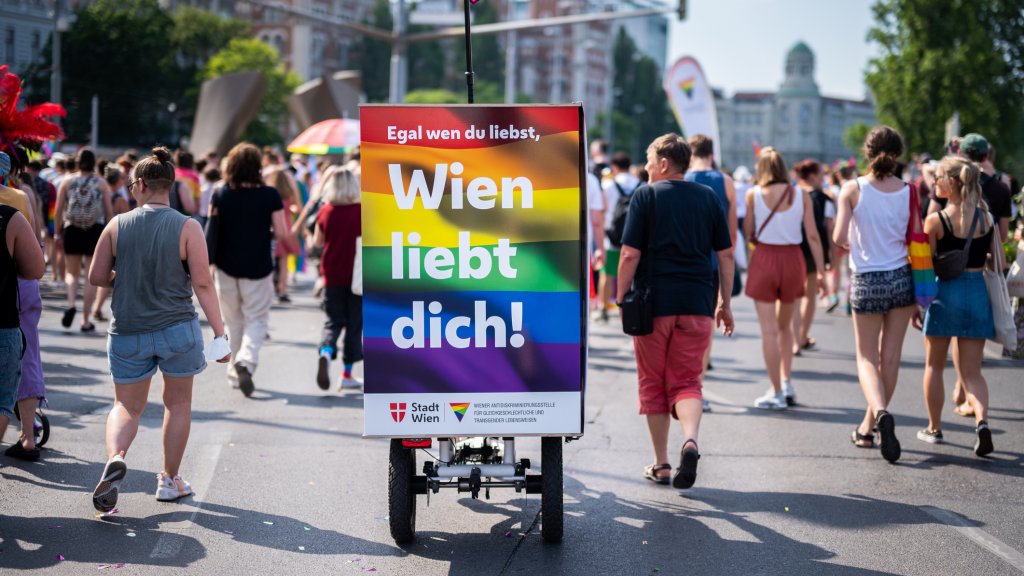
Anyone who experienced harassment, discrimination or violence while out at night along Vienna's Danube Canal, on Karlsplatz or in Stadtpark in recent summers could turn directly to the mobile teams run by the organisation AwA*. Now, however, this support service reportedly faces closure: from 2027, the City of Vienna intends to withdraw its existing funding. The office of Deputy Mayor and City Councillor for Youth Bettina Emmerling (NEOS) has now confirmed the decision. The organisation fears this will leave a significant gap in support for people particularly frequently subjected to attacks, especially LGBTQ+ people.
Key points at a glance
- The City of Vienna intends to stop funding the mobile awareness teams run by AwA* from 2027.
- The teams have been working at popular Vienna meeting places such as the Danube Canal, Karlsplatz and Stadtpark.
- According to the organisation, the teams held more than 16,800 conversations and documented 50 cases of sexual violence in summer 2026.
- The city says the funding cut is due to pressure on its budget and the prioritisation of year-round work with children and young people.
- According to the organisation, the loss of €246,000 puts three year-round and 21 seasonal jobs at risk.
- AwA* is calling for funding to continue and has launched a petition.
High praise in spring
During the summer months, the awareness teams worked from 7pm to 4am at weekends and on the nights before public holidays. Staff travelled through public meeting places on illuminated cargo bikes, making them immediately recognisable to anyone seeking help. Their duties included mediating in conflicts, crisis intervention and supporting people who had experienced violence.
As recently as mid-May, the City of Vienna highlighted the importance of the service in a statement of its own. It said young women, members of the LGBTQ+ community and people experiencing discrimination particularly benefited from the teams. Their work helped improve these groups' sense of safety. The city explicitly noted that staff also provided support following sexual, racist and anti-queer attacks.
Conversations and cases of violence
The organisation's figures for the 2026 season illustrate how widely the service was used. According to AwA*, more than 16,800 conversations with people took place between May and September. The organisation also recorded 50 cases of sexual violence, compared with 18 the previous year. In a related development, cases of homophobic attacks have recently risen again in Austria (German). The mobile support points were therefore intended particularly to reach people in acutely distressing situations who need easily accessible help. Alongside people affected by sexual violence, this includes those subjected to racist or anti-queer attacks, as well as people experiencing psychosocial crises. In AwA*'s view, other services cannot readily take over this work. It says the end of funding would mean the loss of an easily accessible support service for which there is currently no comparable alternative.
Financial priorities
Vienna's city administration cites its difficult budget situation as the reason for the decision. It says the available financial resources will need to be focused more heavily on year-round work with children and young people. Emmerling's office told the newspaper Mein-Bezirk that the withdrawal of funding should in no way be understood as criticism of the organisation's work to date. According to AwA*, the final decision therefore came as a major surprise. The organisation says it only learnt in mid-October that its financial support was to be cut entirely. At that point, it was just about to submit its planned funding application for the following year.
The night-time situation
The consequences could be significant: according to the organisation, the loss of €246,000 in funding puts three year-round and 21 seasonal posts at risk. The planned cut only affects the mobile teams working in public spaces; other forms of awareness work in Vienna, for example at events, are not generally expected to disappear as a result. However, the future situation at freely accessible places such as the Danube Canal will be very different. There is no event organiser there responsible for providing such support services. This is precisely where AwA* sees a crucial gap, and it poses the central question: which service will be available at night in the same places for comparable groups of people in future, and provide help in acute situations? It remains unclear whether those responsible will reconsider their decision or make alternative funding possible. AwA* is now using a petition to press for a rethink so that the services can continue.








