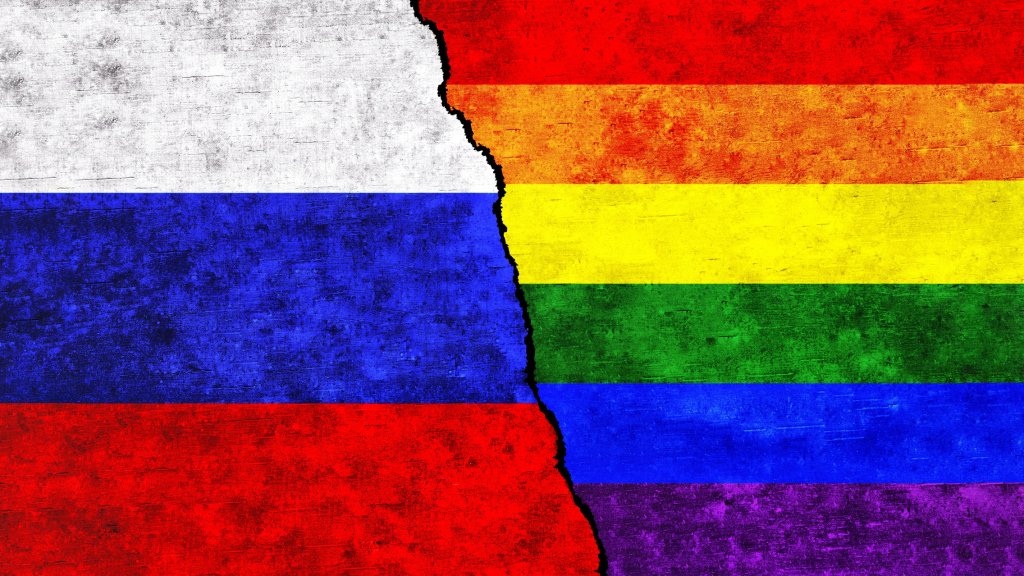
Russia’s intensified crackdown on LGBTQ+ people is increasingly also affecting citizens who explicitly support the state’s restrictions. Several people have now been punished for posting rainbow flags, even though their posts were directed against LGBTQ+ people.
Key points at a glance
- Pensioner fined: A woman who had welcomed Russia’s LGBTQ+ ban must pay 1,500 roubles over old online posts featuring rainbow flags.
- Five known cases: Independent news outlet Mediazona has documented proceedings in which the authorities apparently disregarded the context of the published images.
- Prison and fines: Those affected received fines of up to 100,000 roubles or served brief prison sentences.
- Russia’s Supreme Court declared the so-called international LGBTQ+ movement extremist.
- Priest expelled: A Catholic priest lost his residence permit over a post featuring a rainbow flag.
Pensioner fined
Independent Russian news outlet Mediazona has compiled five such cases from recent months. Its reporting shows that, when assessing the posts, the authorities apparently did not consider the context in which the symbols were used. Those affected include pensioner Vera Makejewa from Kurgan. She had welcomed the Russian authorities’ decision to ban the so-called international LGBTQ+ movement (German). Six months later, however, she herself was fined 1,500 roubles, equivalent to around €17. The fine concerned older social media posts containing homophobic content and images of rainbow flags. “I have only myself to blame. I hadn’t tidied up my photo albums for 13 years. Some people were apparently interested enough to look through them,” Makejewa said.
Prison sentence over photomontage
An online post also led to punishment in the southern Russian city of Pjatigorsk. Pjotr Woronin had shared a photomontage showing the presidents of Ukraine and France alongside a swastika and a rainbow flag. The authorities treated the symbols as extremist imagery. A court sentenced Woronin to one day in prison. He said he had intended the image to mock Ukraine and France. The authorities’ decision outraged him. He complained that “the FSB’s AI decided that I was spreading propaganda”. He was referring to Russia’s domestic intelligence service, the FSB, and its alleged use of artificial intelligence to review online content.
Numerous proceedings
The intensified persecution is based on a November 2023 ruling by Russia’s Supreme Court (German). The so-called international LGBTQ+ movement was then designated extremist and banned. The decision drew strong international criticism. Human rights organisations warned that not only activists but also people who publicly discuss queer and homosexual ways of life could face criminal consequences. Since the designation, dozens of criminal investigations have been opened on the grounds of alleged LGBTQ+ extremism. There have also been an estimated hundreds of administrative offence proceedings. The cases documented by Mediazona show that the authorities are now also taking action against posts whose authors hold hostile views towards LGBTQ+ people.
Fines for homophobic posts
In Russia’s Kemerowo region, pensioner Wladimir Sugakow was fined 100,000 roubles – equivalent to around €1,100. He had published several homophobic posts. These included a series of images from Pride events. The photos were accompanied by the song “Petuschki” by Russian singer Sergej Trofimow. The title translates as “Cockerels”. In Russian prison slang, the word is also used as a derogatory term for gay men. Although this post, too, was directed against LGBTQ+ people, the authorities classified it as prohibited LGBTQ+ propaganda. A similar case occurred in Moscow. There, a fine of 100,000 roubles was likewise imposed over a video entitled “Nazi Initiation”. The person who had posted the video said it had only been intended “as a joke”.
Priest loses right of residence
Proceedings against Polish Catholic priest Grzegorz Zwoliński, also known as Father Grigori, had particularly serious consequences. The priest had lived in the Russian city of Kirow for many years. He had included a rainbow flag in an online post about Archbishop Paolo Pezzi. He said he had merely wanted to “attract attention”. The authorities initially imposed a fine of 1,000 roubles. Subsequently, however, the priest’s Russian residence permit was also revoked. He was also banned from re-entering Russia. After a total of 24 years in the country, Zwoliński had to return to Poland.








