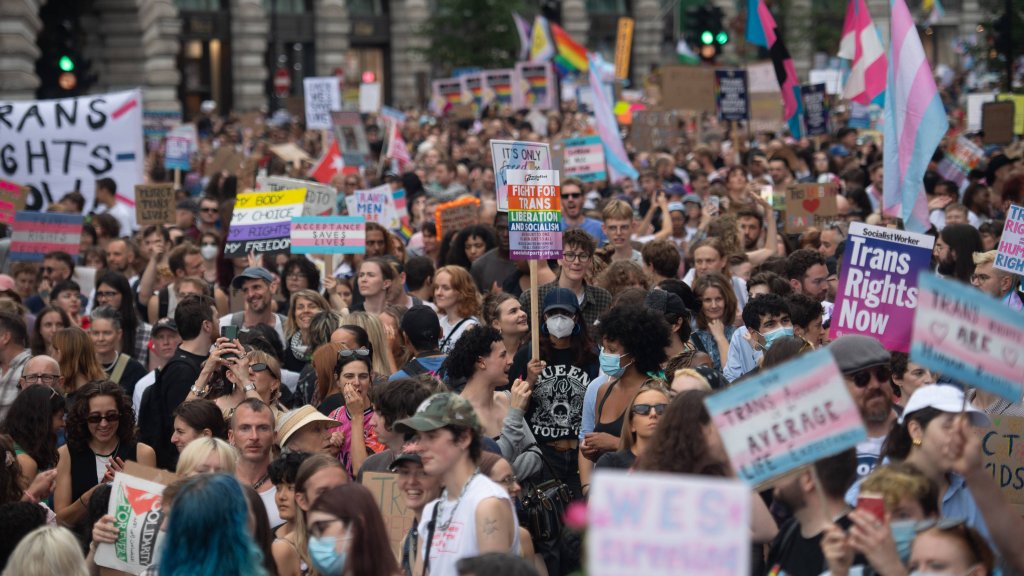
Many queer and trans people in Britain say they increasingly feel excluded from society. Some are withdrawing from public spaces as a result. These are the findings of a new study by British LGBTQ+ organisation Stonewall. Stonewall chief executive Simon Blake has now made an appeal to the community.
Key points at a glance
- Declining acceptance: 58 per cent of trans respondents and 75 per cent of trans women feel less accepted by society than they did ten years ago.
- Withdrawing from everyday life: Almost half of trans respondents avoid certain bars and restaurants. Some 37 per cent avoid certain toilets and changing rooms.
- Widespread pessimism: 80 per cent of trans respondents are pessimistic about the future of equal rights.
- New strategy: Stonewall chief executive Simon Blake wants to make public dialogue more measured while ensuring that trans people are protected.
Pessimism in the trans community
This is the first major analysis since the UK Supreme Court's ruling in April 2025 that the term sex in the UK's Equality Act refers only to biological sex. While almost half of LGBTQ+ respondents feel more accepted by society today than they did ten years ago, 58 per cent of trans respondents report a deterioration. Among trans women, the figure is as high as 75 per cent. Almost half of trans respondents now avoid certain bars and restaurants because they do not feel safe there. Some 37 per cent avoid using certain sex-segregated facilities such as toilets and changing rooms. A further 29 per cent avoid exercise classes or sports teams. Their outlook on the future is particularly striking: 80 per cent of trans respondents expressed pessimism about future progress towards equal rights. By contrast, when Stonewall asked a comparable question in 2017, hope for progress still prevailed.
Far-reaching consequences
Stonewall chief executive Simon Blake believes the Supreme Court's decision has significant implications for trans people's lives. Among other things, he points to warnings that trans patients could forgo necessary hospital treatment in future for fear of discrimination. “If you feel that policies are affecting your ability to take part in public life, to get treatment when you are ill, or to use the toilets you have used at work for ten years without any problems – if it feels as though your rights are secondary rather than equal – that makes you incredibly pessimistic,” Blake told the British newspaper the Guardian. Some women's rights organisations and gender-critical activists reject this portrayal, regarding the ruling as a step forward in safeguarding women's rights.
Discrimination remains discrimination
Blake also stressed that Stonewall did not intend to seek to overturn the Supreme Court ruling. “We understand that this is the law. But we also want to ensure that trans people are protected, and we are working with other organisations to explore what that could look like.” Discrimination on the grounds of gender reassignment remains prohibited under UK law. The Supreme Court justices had also emphasised that their decision should not be understood as a victory for one side over the other in a bitter culture war. “It is up to the government, our regulators and everyone responsible to understand the implications and take action where negative consequences arise,” Blake said.
Progress takes time
According to the Guardian, the chief executive's more restrained strategy is also linked to the difficult period his organisation has been through. Numerous institutions, including British government departments and the BBC, have withdrawn from Stonewall's workplace diversity programme since 2024. The programme had been an important source of income for the organisation. The withdrawals came amid controversy over Stonewall's political methods and the quality of its legal advice. To regain public trust, Blake is reportedly now taking inspiration from the organisation's early years.
At that time, Stonewall had sought to achieve social change through conversation and persuasion. Blake therefore invited veteran campaigners such as actor Ian McKellen (German) to talk to staff about successful campaigns in difficult social circumstances. McKellen was one of Stonewall's co-founders in 1989. “Progress takes time. You have to bring people together, enable conversations and sometimes be pragmatic,” Blake said of his strategy.
Determination and compromise
In its chief executive's view, Stonewall must continue to stand firmly for the interests of the LGBTQ+ community. At the same time, the organisation must not approach every political dispute solely through confrontation. “Our first core value was the courage to do what we believe is best for the LGBTQ+ community. Sometimes that means moving forward very, very quickly, and sometimes you have to recognise that a first step is needed before anything else.” Blake wants to ensure that differing views can be discussed openly without conversations turning into personal attacks. Stonewall had experienced similar disputes during earlier reforms. “We had the same conversations about same-sex marriage and the age of consent,” he said.
The culture war continues
Blake attributes the situation partly to changes in society's treatment of trans people. Ten years ago, public knowledge of trans and non-binary people had been much more limited. At that point, these issues had not yet become the focus of a long-running political culture war. Today, trans people's lives were often discussed as though they were abstract political questions rather than the actual experiences of individuals. This kind of debate could leave those affected feeling dehumanised. The previous stance of some activists, who had refused to discuss any potential conflicts between trans rights and women's rights, was also raised in the conversation with Blake.
Asked whether this position, known as “No debate”, had been counterproductive, he pointed to the circumstances at the time. As he recalled it, the initial aim had been to acknowledge that trans people existed and had to be involved in conversations about their rights. When trans people had actually been at the table for certain discussions, some of those conversations had been so difficult that those affected had no longer felt able to take part. Blake therefore advocates a different approach to disagreements. “Everyone must be able to ask questions, we must be able to debate, but we have to find ways to do that without inflaming the atmosphere.”
A ban on conversion practices
Blake attaches particular importance to a second major issue: the UK ban on so-called conversion practices, which has been planned for more than eight years. These are practices aimed at changing or suppressing a person's sexual orientation or gender identity. The UK Parliament is currently considering legislation on the issue. (German) Blake believes it is crucial that such a ban also includes trans people. For him, this would send an important message to society: “You do not need to be changed, you are good enough.” He says this is exactly the reassurance he himself would have needed as a gay teenager.








