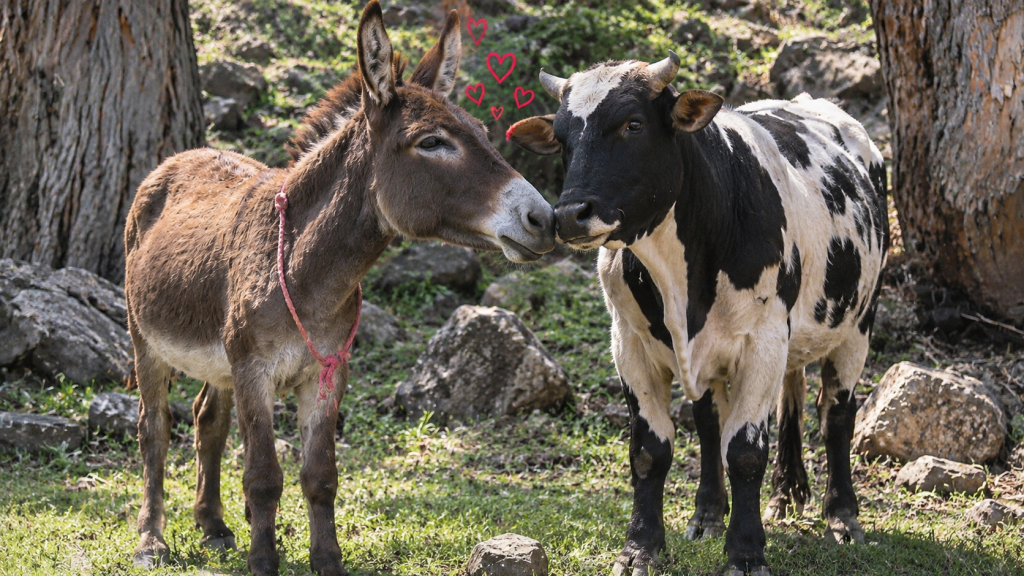
A bull and a male donkey have attracted the interest of Italian animal behaviour researchers in a pasture in Ethiopia. The two male animals not only repeatedly engage in sexual behaviour with each other, but also appear to maintain a particularly close social relationship. Scientists documented 51 sexual interactions in just two weeks.
Key points at a glance
- Unusual animal pair: On the Ethiopian plateau, Italian scientists observed a close social and sexual relationship between a bull and a male donkey.
- 51 sexual encounters: Within two weeks, the research team documented 51 sexual interactions between the animals.
- Voluntary contact: Both animals repeatedly sought each other out. The donkey showed no defensive behaviour during the sexual encounters.
- Preferred partner: Although other members of their respective species were available, the relationship centred on these two animals.
- Scientific puzzle: The researchers are investigating whether the sexual encounters might serve to build social bonds, foster cohesion or relieve tension.
Animal togetherness
Achille, a black-and-white spotted bull, and Patroclo, a male donkey, live on the Ethiopian plateau near Debre Libanos monastery in the Oromia region. They meet there while grazing. The observations were published in the scientific journal “Current Biology”. According to the researchers, what is remarkable is not simply that two male animals of different species have sexual contact. Above all, the stability of their relationship and their mutual interest make the case unusual.
The scientists observed Achille repeatedly seeking out the male donkey. The bull approached Patroclo as he grazed, nudging him, rubbing against his body, sniffing him and licking his coat. Patroclo did not reject these approaches. Instead, he reciprocated the physical contact and also sought the bull's company. During several encounters, mutual sniffing and touching were followed by sexual acts. The animals belong to different owners and spend time together only while grazing. Nevertheless, according to the research team, they repeatedly found their way back to each other, even though other males and females of their respective species were also available in the pasture.
Lots of sex in 14 days
In March 2026, the scientists systematically studied the two animals' behaviour over a period of just under two weeks. During those days, they recorded a total of 51 sexual interactions in which Achille the bull mounted Patroclo the male donkey. The frequency of the encounters, however, was only one part of their observations. “The sexual interactions between Achille, the bull, and Patroclo, the male donkey, were not isolated incidents,” explained Elisabetta Palagi of the University of Pisa, who was involved in the study. Rather, the key point was that the animals also interacted strikingly often outside their sexual encounters. “What really caught our attention was that these interactions were embedded in a highly selective and stable social relationship between the two individuals.” The scientists therefore believe these were not merely chance sexual encounters.
No defensive response
The research team first noticed the two animals while working on another scientific project. The scientists observed that Patroclo apparently allowed the bull's sexual advances. Rather than moving away or resisting Achille, the male donkey stayed close to him. This behaviour prompted the researchers to document the two animals' interactions in greater detail. They recorded every observed encounter involving at least one of the two animals, examining both sexual acts and other forms of social contact. The results showed that the animals developed a marked preference for each other.
This preference became particularly clear when compared with other animals. Patroclo repeatedly presented his hindquarters to the bull and nibbled at his body. Even when Achille mounted him, the male donkey made no discernible attempt to prevent the contact. He did not move away, kick at the bull or try in any other way to keep him at a distance. Two other encounters showed that this behaviour was by no means a given. During the study period, Achille twice mounted another male donkey. This donkey reacted very differently from Patroclo, displaying defensive behaviour and threatening gestures, including pinned-back ears. For the scientists, this difference is an important indication that the relationship between Achille and Patroclo has a distinctive social component.
More than just sex
Martina Francesconi, the study's lead author, stresses that the scientific significance of the observations extends beyond the sexual acts. “The key finding is not simply that a bull mounted a male donkey,” the scientist explained. Rather, the sexual encounters were part of a broader, selective social relationship. The two animals repeatedly sought each other out and displayed other forms of physical closeness alongside sexual behaviour. In the research team's view, this suggests that the encounters should not be considered in isolation.
Homosexuality in animals
Sexual contact between animals of the same sex has long been known in animal behaviour research (German). Such behaviour has already been documented in numerous mammals, birds and other animal groups. A recent review found that same-sex sexual behaviour had been recorded in all five major primate families and at least 59 primate species. These include chimpanzees, Barbary macaques and mountain gorillas. Scientists have also observed same-sex sexual contact in giraffes, lions, dolphins, penguins and other bird species, as well as various hoofed animals. In total, homosexuality has been documented in more than 1,500 animal species (German). The case of Achille and Patroclo, however, differs from many of these observations through its combination of two features: the animals belong to different species and also display a strikingly stable social relationship. The researchers cannot yet explain what function this interaction serves – but perhaps it is simply love.








