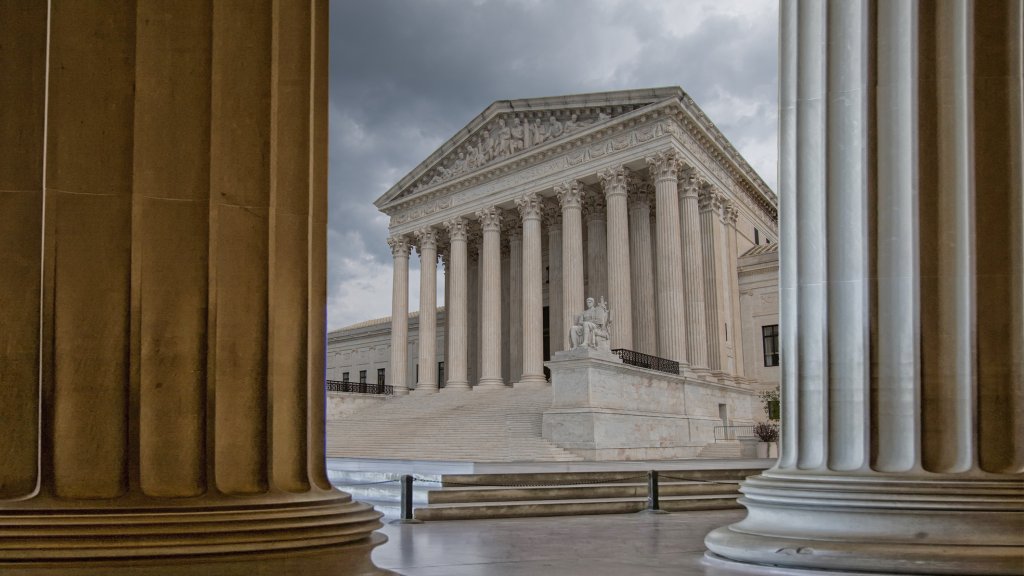
Can religious preschools claim state funding while refusing to admit children because of their parents' sexual orientation? The US Supreme Court is currently considering this question. A hearing revealed clear differences between the court's liberal and conservative members.
Key points at a glance
- Dispute over state funding: The US Supreme Court is examining whether Catholic preschools may receive public money even though they can exclude children of LGBTQ+ parents.
- Religious freedom versus equal treatment: Catholic institutions in Colorado are challenging state anti-discrimination rules. The Trump administration supports their position.
- Justices divided: The three liberal justices are critically questioning the schools' demands. Several conservative justices, by contrast, appear open to exemptions.
- Decision in 2027: A ruling is expected by the end of June 2027. The outcome could have far-reaching consequences for religious educational institutions and LGBTQ+ families.
Religion or discrimination?
While the three liberal justices critically questioned the demands of Catholic institutions from Colorado, several conservative justices signalled sympathy for their appeal to religious freedom. The legal dispute, St. Mary Catholic Parish v. Roy, concerns the conditions attached to a state preschool programme. At its heart is the question of whether religious institutions must be exempted from anti-discrimination requirements if they wish to receive public funding. Colorado introduced a universal preschool programme in 2023 that is open to both public and private institutions. Faith schools can also participate and continue to teach religious content. However, funding is conditional on there being no discrimination on the basis of protected characteristics when admitting children. These include sexual orientation and gender identity.
Two Catholic parishes and the Archdiocese of Denver consider these conditions incompatible with their religious admissions rules. They therefore brought a legal challenge without first applying to participate in the funding programme. The claimants were unsuccessful in the lower courts. Both a federal district court and the relevant federal appeals court, the Tenth Circuit, ruled in Colorado's favour. In April, the Supreme Court agreed to review the case. Among other things, the claimants invoke earlier rulings by the court that states may not exclude religious schools from public funding solely because of their religious character. Colorado, by contrast, argues that faith-based institutions are welcome in principle. It says the conditions govern only non-discriminatory access and do not restrict religious teaching.
Rejection of gay parents
During the hearing, Justice Sonia Sotomayor confronted Nicholas Reaves, the lawyer representing the Catholic institutions, with the possible consequences of an exemption from the state requirements. “Your Catholic schools would reject a child solely because their parents are homosexual?” Sotomayor asked. Reaves defended the institutions' right to take their religious beliefs into account in admissions decisions. “I would say that if this constitutes the claimants' sincere exercise of religion, then in my view that would be permissible,” he replied.
According to the lawyer, families must sincerely affirm the beliefs of the school community concerned. In the case of same-sex couples, this could, under certain circumstances, prevent their children from being admitted. Sotomayor countered that a distinction must be drawn between teaching religious beliefs and rejecting individual children. “You can teach whatever you want to teach. But if parents choose to expose their children to that teaching, you have to admit the child,” the justice said. “That should be the parents' decision, not your decision to exclude them.”
Administration supports schools
The US administration under President Donald Trump also sided with the Catholic institutions in the case. It takes the view that the state funding conditions could infringe religious freedom. Justice Ketanji Brown Jackson challenged this argument. She pointed out that participation in the funding programme was voluntary and that schools could, in principle, decide for themselves which children to admit.
“The school itself does not have to admit anyone it does not want to admit,” Jackson told government representative Sarah Harris. “But if it voluntarily accepts public benefits, these conditions apply.” Jackson also wanted to know whether the government's argument could justify discrimination on grounds of ethnicity. Harris said that, in cases of racial discrimination, particularly stringent constitutional scrutiny would very likely produce a different result. The government is also calling for such scrutiny in the current case.
Jackson criticised this distinction. “But that is simply arbitrary,” she replied. “That is only because the court would say that ethnicity is different, isn't it?” Justice Elena Kagan also asked what consequences a ruling in favour of the Catholic institutions could have for the public school system. “Is the next case then going to involve parents at a public school saying that it is really important to their religious beliefs that their child is not taught alongside children of same-sex parents?” Kagan asked.
Conservative justices consider exemptions
Several conservative members of the court, by contrast, explored the possibility of granting religious schools exemptions from the state requirements. Justice Brett Kavanaugh pointed out that around 2,000 preschools in Colorado participate in the programme and that there are only 34 Catholic institutions. “Why not look for a solution where both sides win?” Kavanaugh asked. In his view, religious schools could retain their beliefs while LGBTQ+ parents would still have numerous other institutions available to them. “There are numerous ways to respect the rights of religious believers while also respecting the ability of LGBTQ+ parents to find a suitable institution for their children among the 2,000 schools,” he said.
Colorado's Deputy Attorney General, Helen Norton, challenged the idea that all preschools were equally suitable. Factors such as opening hours and accessibility could be decisive for families. “Think of a mother who needs a school that opens at 7 am so she can catch the bus to work,” Norton said. Colorado was concerned with “equal opportunities, not just any opportunities”, she stressed. Justice Amy Coney Barrett, in turn, questioned whether conditions that formally apply to everyone might in practice disadvantage religious institutions. “If you know that choosing this requirement will result in those with an opposing belief being excluded, what is the difference?” Barrett asked. Chief Justice John Roberts also expressed doubts. Although he initially distinguished between Colorado's requirements and an explicit exclusion of religious schools, he later described the effects as “pretty much the same”.
Families describe the strain
After the hearing, representatives of the claimants' side described the economic consequences of the legal dispute. Claimant Lisa Sheley said her family had wanted their younger children to receive the same religious education as their older siblings. “All we wanted was for our little ones to get the same education we had already chosen for their older siblings. But Colorado punished us for that choice,” Sheley said. Lawyer Reaves reported that affected families had had to pay several thousand dollars out of their own pockets. At the same time, enrolment at Catholic preschools in the Archdiocese of Denver had fallen by almost 20 per cent. According to him, two institutions had been forced to close because of financial difficulties and falling enrolment. Reaves accused Colorado of effectively excluding Catholic families from the state funding programme. “The state claimed that the Catholic schools were the ones excluding families, while Colorado itself is excluding thousands of Catholic families,” he said.
Warning against exclusion
Civil rights organisations, by contrast, see the case primarily as a question of equal access to education. They warn that children could be excluded from state-funded institutions because of their parents' sexual orientation or gender identity. The organisations Lambda Legal and GLAD Law have submitted a joint brief supporting Colorado's position. Karen Loewy, a lawyer at Lambda Legal, said: “No four-year-old child should be excluded from a taxpayer-funded classroom simply because of who their parents are. That includes children of LGBTQ+ parents.” Kelley Robinson, president of the Human Rights Campaign, also urged the justices to uphold the existing anti-discrimination rules. “Exclusion has no place in our education system,” Robinson said.
The Supreme Court must now determine how far the religious freedom of private educational institutions extends when they wish to receive state funding. Two fundamental interests are at odds: religious schools' claim to apply their beliefs when selecting families, and the state's aim of ensuring that all children have equal access to publicly funded education, regardless of their family background. A decision is expected by the end of June 2027. If the court rules in favour of the Catholic institutions, their lawyer Nicholas Reaves believes they could participate in Colorado's preschool programme as early as the following autumn. Beyond this specific case, the ruling could have implications for the funding of religious educational institutions and protection against discrimination for LGBTQ+ families in the US.








