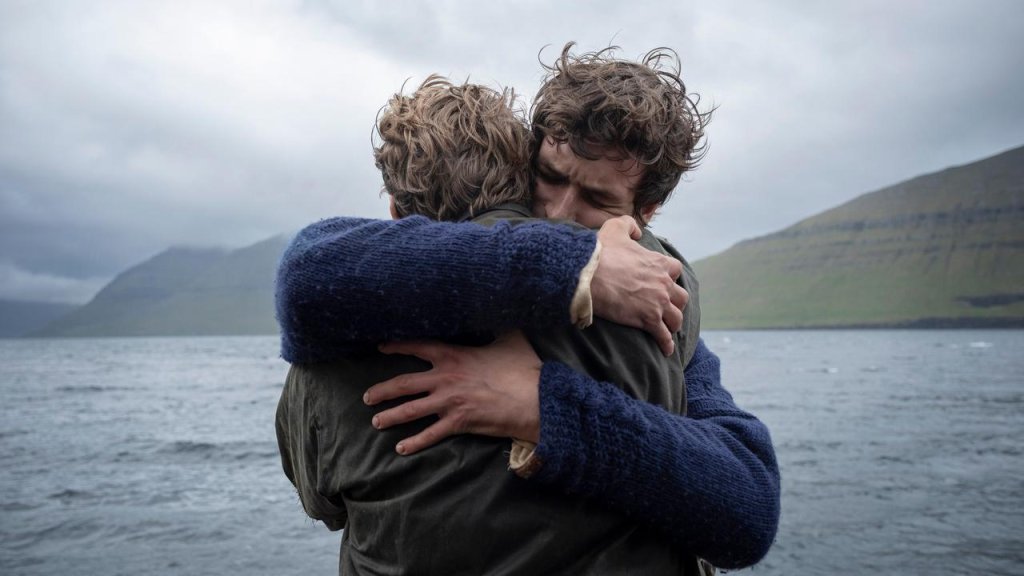
An unusual love story between two men, set on the remote Faroe Islands in the 19th century, has attracted considerable attention at the Nordic Film Days Lübeck. Danish director and screenwriter Kasper Kalle received the NDR Feature Film Award for his historical vampire drama “No Rest for the Wicked”. The film combines a gay love story with elements of Gothic horror, while also exploring themes such as social exclusion, longing and personal freedom
The key points at a glance
- Award in Lübeck: Danish director Kasper Kalle receives the NDR Feature Film Award at the Nordic Film Days for his film “No Rest for the Wicked”.
- Gay love story: The film centres on two men who meet and fall in love on the Faroe Islands in 1862.
- Historical source: The film is based on a vampire short story by East Frisian author Karl Heinrich Ulrichs, published in 1884.
- Difficult filming conditions: Religious reservations, homophobia, a lack of filmmaking infrastructure and extreme weather posed challenges for the crew.
- Personal experiences: Kalle also draws on memories of his own youth, when he faced exclusion because of his homosexuality.
- Cinema release planned: Under the German title “Eine Matrosengeschichte”, the film is scheduled to open in cinemas across Germany in March 2027.
A vampire story from 1884
For the 42-year-old filmmaker, this was his second appearance in the festival’s feature film competition. His new film tells the story of two seamen who meet in 1862. On the windswept Faroe Islands, a romantic relationship develops between young Baldur and the whaler Helge. Its literary source is the short story “Manor” by East Frisian writer Karl Heinrich Ulrichs, who was already exploring homosexual love in the 19th century. The story appeared in 1884, 13 years before Bram Stoker’s famous vampire novel “Dracula”, published in 1897. Kalle made a conscious decision to keep the story in its historical period and to set his film amid the extraordinary landscape of the Faroe Islands.
Homophobia made filming difficult
According to the director, finding a suitable lead actor for the role of Baldur proved particularly difficult. The actor needed not only to suit the character, but also to be familiar with the language and culture of the Faroe Islands. At the same time, he had to be willing to portray a gay love story on camera. Speaking to NDR, Kalle described the social difficulties the production faced. “We filmed on the Faroe Islands. Just over 50,000 people live there — most of them are very religious. They are predominantly Christians. Until a few months ago, abortion was banned, and there is a lot of homophobia. So it wasn’t easy to find a young man who wanted to be part of this gay love story.”
Kalle eventually became aware of model Egor Venned. Born in the Faroe Islands, Venned was living in Los Angeles at the time and working in the fashion industry. The director thought that Venned’s professional environment might already have given him experience of interacting with LGBTQ+ people, and that he might therefore be open to the film project. After an initial conversation on Skype, Venned was invited to Copenhagen. There, he impressed those responsible for casting and was given the role of Baldur. The production also marked his acting debut in a cinema film.
Actors with a special chemistry
For the second lead role, Kalle had a particular performer in mind from the outset: Danish actor Pilou Asbæk. He became known through roles including his appearance in the internationally successful television series “Game of Thrones”. He also appeared as a presenter of the Eurovision Song Contest in Copenhagen in 2009. In “No Rest for the Wicked”, Asbæk plays the whaler Helge, who arrives on the Faroe Islands and meets Baldur there. For Kalle, the actor’s personality made him the ideal choice.
The director was particularly impressed by the interplay between the two leads. While Asbæk had a distinctly open, extroverted and positive presence, he said, Venned was more reserved and self-possessed. “When the two first met, something happened straight away. Pilou has such enormous, positive energy; he’s extroverted. Egor Venned is more of an introvert; he’s at ease with himself. You could really feel how they complemented one another,” Kalle reported. That made it clear to him that the two were the right couple for his film. The contrasts between the two actors are also reflected in their characters. While Baldur has grown up on the remote islands and dreams of another world, Helge, as an outsider, brings new experiences and possibilities into his life.
Filming in storms and fog
It was not only the casting but also the production conditions that posed considerable challenges for the crew. According to Kalle, the Faroe Islands have no film industry of their own that could have supported a production of this kind with the necessary infrastructure. Those responsible therefore had to transport all the technical facilities they needed and much of the production equipment to the islands especially for the shoot. Then there was the unpredictable weather in the North Atlantic.
The director reported that the weather could change completely in a very short time. “One moment it’s sunny and bright. The next, fog rolls in and you can’t see your hand in front of your face. It might then stay like that for two days. Or a storm suddenly blows in.” At the very start of filming, however, the crew experienced unusually good weather. With temperatures of almost 20 degrees and sunshine, conditions were initially almost ideal. Only later, Kalle said, did he learn that the islands had at most five such sunny days a year. Despite the spells of mild weather, the actors also had to tackle physically demanding scenes. The two main characters’ swimming scene together was particularly challenging. According to the director, the water temperature was only around six degrees.
A timeless fairy tale
For Kalle, choosing a historical setting was not just a question of atmosphere. In his view, the love story could just as easily have been told on Denmark’s present-day west coast. However, he wanted to retain both the Faroe Islands as a filming location and the original period of the literary source. He felt that moving the story to the present might have given the impression that the film was aimed directly at contemporary Faroese society. That was an interpretation he wanted to avoid.
“If we had moved the story to the present day, the film could have been understood as a criticism of today’s Faroese society. I wanted to avoid that. But when the story takes place 150 years ago, it feels like a timeless fairy tale,” Kalle explained. Nevertheless, the connection between past and present plays an important role. After all, the film deals with social reservations about homosexual relationships that have not entirely disappeared, even long after the original story was written.
Director discusses his youth
The two men’s story also has personal significance for Kalle. The filmmaker grew up in a small town in Denmark at a time when the internet did not yet offer an easy way to connect with other homosexual people. By his own account, his youth was marked by considerable difficulties. Homosexuality, he said, was heavily stigmatised in the environment in which he lived at the time. Being gay as a boy was seen as something particularly bad.
“I had no role models and struggled to be accepted. And I had no one to talk to about my feelings,” Kalle recalled in the NDR interview. These experiences give his film an additional personal dimension. The longing to belong and the search for a place where homosexual love can be taken for granted are among the story’s central themes. Karl Heinrich Ulrichs’s literary source has particular historical significance in this respect. As early as 1884, the East Frisian author wrote openly about a romantic relationship between men, combining it with the then-popular motif of the vampire.
Driftwood as a symbol of longing
The landscape of the Faroe Islands also plays an important role in “No Rest for the Wicked”. The remote islands are not just a striking backdrop; they shape the entire story. The motif of wood in particular has several meanings for the director. There are hardly any trees on the Faroe Islands. Around 150 years ago, when the story is set, none at all grew there, according to Kalle. The main character, Baldur, has therefore never seen a living tree. He dreams of travelling to other countries one day and discovering a tree there. This longing also represents his desire to leave his familiar surroundings and experience something new.
When the whaler Helge is washed ashore on the island, he embodies precisely this unknown world. His arrival changes Baldur’s life and opens up the possibility of a love that had previously seemed unattainable. The driftwood, too, has a double meaning. It comes from ships that have capsized or sunk at sea. Its origins therefore often lie in tragedy. At the same time, the islanders can use it to build new houses or boats. “When a ship sinks, on the one hand it’s a tragedy. At the same time, the driftwood is used to build a house or a boat on the islands. So wood has a dark element and a beautiful one. Like my film: a mixture of Gothic beauty, darkness and a happy ending,” Kalle said.
An early passion for cinema
Kalle decided he wanted to become a director while he was still a child. Through his older brother, he was introduced at an early age to films that were not really suitable for his age group. Oliver Stone’s “Natural Born Killers” made a particularly lasting impression on him. Kalle recalled being about ten years old when he saw it. What fascinated him most, he said, was its unusual visual style. The film combines different visual approaches, including animation and black-and-white sequences. This experimental way of telling a story first sparked Kalle’s desire to make films himself.
“I found it so exciting how the film had been made using animation and black-and-white elements. That was the first time I thought: ‘I want to become a director,’” the filmmaker recalled. With “No Rest for the Wicked”, he now combines his enthusiasm for extraordinary cinematic imagery with a story that also touches on his personal experiences. The film has already attracted attention at several international genre film festivals and received the NDR Feature Film Award at the Nordic Film Days Lübeck. German audiences should also soon be able to see Baldur and Helge’s story on the big screen. The film will open in cinemas across Germany under the title “Eine Matrosengeschichte” in March 2027.








