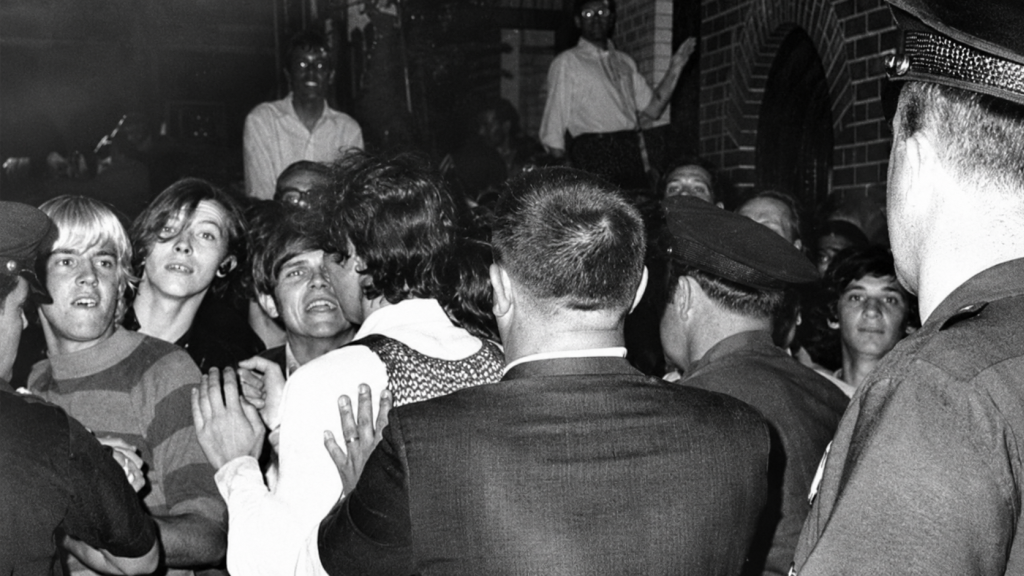
Today, the Stonewall riots are regarded as the birth of the modern LGBTQ+ civil rights movement (German). Yet when patrons of the Stonewall Inn on New York’s Christopher Street fought back against a police raid in late June 1969, public perceptions were entirely different. Rather than recognising the protests as resistance to discrimination, numerous American newspapers described those involved with mockery, prejudice and derogatory language.
Key points at a glance
- A historic turning point: the Stonewall riots against police raids and discrimination against gay people began in New York on 28 June 1969.
- Mockery rather than understanding: numerous newspapers reported using derogatory terms, misogynistic stereotypes and a predominantly police perspective.
- Three newspapers, three perspectives: the New York Daily News opted for sensationalism, the New York Times relied on police reports, and The Village Voice published detailed eyewitness accounts.
- Resistance to the press: activists were already protesting against discriminatory language in September 1969.
An end to silence
A look back at the coverage of the time reveals how little social acceptance gay people enjoyed. At the same time, the articles document a historic moment when a long-marginalised community publicly demanded its rights with unusual determination for the first time. Historian Hugh Ryan told the Washington Post that, despite their discriminatory language, the reports of the time had served an important purpose: “Part of what is important about this is that it gave the events a degree of recognition from heterosexual society.” Before then, the mainstream press had rarely reported on the lives of gay people.
Mocking the protesters
An article published in the New York Daily News on 6 July 1969 was particularly extreme. Under the headline “Homo Nest Raided – Queens Are Raging Mad”, reporter Jerry Lisker described the events in a decidedly sensationalist tone. The journalist, who worked mainly as a sports reporter, repeatedly referred to patrons of the Stonewall Inn as “queens”, “princesses” and “ladies-in-waiting”. Describing one person’s make-up and visible stubble, he wrote: “She is a he.” The clashes with police were also turned into a caricature. “Last weekend, the queens had turned into commando fighters and stood shoulder to shoulder against an invasion by the helmeted Tactical Patrol Force,” Lisker wrote.
Elsewhere, he wrote: “Then, without warning, queen power exploded with all the force of a homosexual atom bomb.” The reporter claimed that protesters had thrown hairpins, powder compacts, hair rollers and lipsticks at police officers. His account contained numerous dramatic details, even though he had not witnessed the events himself. The piece is regarded as an example of so-called “New Journalism”, in which news reports were embellished with literary storytelling techniques. Lisker reported 13 arrests and four injured police officers. He estimated the crowd outside the bar at 500 to 1,000 people.
A local resident defended the bar
Despite his disparaging tone, Lisker also gave a voice to people who defended the Stonewall Inn. Local resident Shirley Evans, a mother of two, disputed the portrayal of the bar as a dangerous meeting place. “There had never been any trouble there until the night of the police raid,” she said. “The homosexuals minded their own business and did not bother anyone. There were never any fights or shouting or anything like that. They just wanted to be left alone.” Evans described the police action with an unusual comparison: “It was like a swarm of hornets attacking a bunch of butterflies.”
A gay man interviewed also directly criticised the newspaper’s coverage. “I don’t like your newspaper. It is against gays and on the side of the police,” he said. Lisker’s article was also among the few reports at the time to point to links between the Stonewall Inn’s operators and the Mafia. Such business relationships were not unusual among New York’s gay bars, given discriminatory regulations and restrictions imposed by the authorities.
The police perspective
The New York Times reported in a much more matter-of-fact, but equally one-sided, manner on 29 June 1969. The article, just 286 words long, ran under the headline “Four Policemen Hurt in Village Raid” and continued: “Hundreds of young men rioted in Greenwich Village shortly after three o’clock yesterday morning after a group of plain-clothes police officers raided a bar that, according to police, was known for its homosexual clientele.” The newspaper reported that bricks, bottles, rubbish, coins and a parking meter had been thrown. Its account was based exclusively on police statements.
Deputy Police Inspector Seymour Pine said the Stonewall Inn had been operating without a liquor licence. Officers had confiscated several cases of alcoholic drinks. According to the newspaper’s account, around 400 people took part in the clashes, which reportedly lasted about 45 minutes. This initial report gave no indication that the protests would flare up again on subsequent nights and develop into a political event with far-reaching consequences. At the end, the New York Times mentioned young men loudly condemning the police outside the bar. It also noted a sign at the entrance: “This is a private club. Members only.”
The significance of the protests
The alternative weekly newspaper The Village Voice provided a more detailed account. Its reporter Lucian K. Truscott IV published an article on 3 July 1969 under the headline “Gay Power Comes to Sheridan Square”. Unlike Lisker, Truscott had apparently witnessed the clashes himself. He described how the mood changed when police tried to take away several people they had arrested. “Suddenly the police van arrived, and the mood of the crowd changed,” he wrote. The protest reportedly became particularly fierce when a lesbian woman resisted arrest. “At that moment, the situation exploded. Limp wrists were forgotten. Beer cans and bottles were hurled at the windows, and a rain of coins fell on the police officers.” Truscott, too, used numerous homophobic terms and stereotypical descriptions. Nevertheless, his account documented the participants’ growing political confidence more clearly than other newspapers did.
A raid became a liberation movement
On the second night of protests, Christopher Street increasingly became the scene of a public demonstration of gay pride. “Gay Power!”, “I like boys!” and “I’m a faggot, and I’m proud of it!” were among the slogans. Truscott described men kissing in public, holding hands and openly displaying their homosexuality. “If Friday night had been the night for picking up, then Saturday night was the night for dates,” he wrote. Outside the damaged Stonewall Inn, patrons had boarded up the broken windows. The boards bore messages such as “We are open” and “Support Gay Power – come on in, girls”.
Another message accused a police inspector of stealing money and items from the bar. Two newspaper articles about the events were also pinned to the boards. These had been “anything but sympathetic to the gay cause”, Truscott noted. According to his account, the second night’s protests had largely ended by around 3.30am. He reported one head injury and several arrests.
A historic turning point
Among the observers was the gay poet Allen Ginsberg (German). He was delighted by the protesters’ new determination. “Gay Power! Isn’t that great? We are one of the largest minorities in the country – ten per cent, you know. It’s time we did something to assert ourselves,” Ginsberg said. He also observed that the young men had lost their former expression of vulnerability. Truscott recognised a clear generational divide. “Older guys had tense faces and spoke in worried whispers as they watched the younger generation embrace their homosexuality and display it in front of the crowds,” the journalist wrote. He ended his report with the words: “Watch out. Liberation is under way.”
Protests against the media
The derogatory coverage did not go unchallenged. On 12 September 1969, the Gay Liberation Front organised a demonstration against The Village Voice. It was prompted by the repeated use of the homophobic slur “faggot” in reports about the riots and their aftermath. The protests made clear that political resistance was not directed solely against police violence and state discrimination. The activists also demanded respectful treatment in public and in the media. Nevertheless, the newspaper articles about the Stonewall riots remain important documents of American social history today. They reveal not only the widespread prejudice against gay people, but also the beginning of a fundamental shift.








