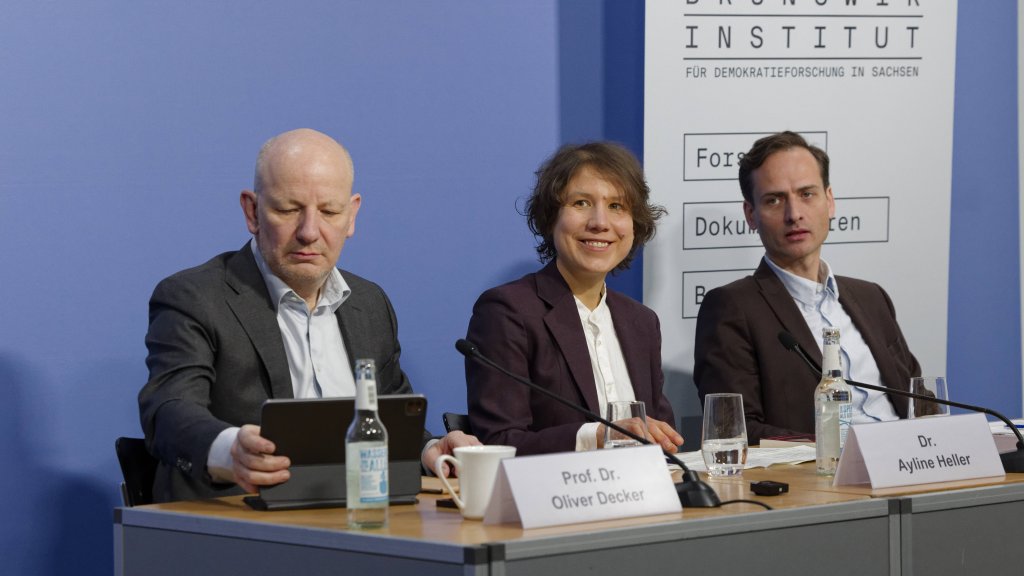
Far-right views appear to be gaining support in Germany, while trust in democracy continues to decline. Human rights organisations are particularly concerned about the consequences for minorities, including LGBTQ+ people. The new Leipzig Authoritarianism Study 2026 documents a growing willingness to accept authoritarian forms of government and question fundamental democratic principles.
Key findings at a glance
- Authoritarian views widespread: 22.3 per cent of respondents want a single strong party that represents the entire population. In eastern Germany, the figure is 30.9 per cent.
- Democracy losing support: only around a third of Germans are satisfied with democracy as they experience it in everyday life. Support for democracy as an idea has fallen below 90 per cent for the first time.
- Risks for LGBTQ+ people: Amnesty International criticises political signals that, in the human rights organisation's assessment, devalue minority rights and encourage anti-LGBTQ+ attitudes.
- Far-right extremism on the rise: 6.9 per cent of respondents hold a consistently far-right worldview. Antisemitic attitudes have more than doubled since 2022.
- Demands on the federal government: Amnesty calls for better protection for civil society organisations working against discrimination and hate.
13th study since 2002
The study has been conducted every two years since 2002. It is led by the Else-Frenkel-Brunswik-Institut für Demokratieforschung at Leipzig University. The study is supported by the Otto-Brenner-Stiftung and the Heinrich-Böll-Stiftung, which is close to the Green Party. For the representative survey, more than 2,500 randomly selected people were approached between mid-March and early June 2026. Around 40 per cent of them completed the extensive questionnaire. This is the 13th study in the series. The findings, now presented in Berlin, show more than growing dissatisfaction with the political situation. The idealisation of the past, the desire for fundamental social upheaval and agreement with antisemitic and nationalist statements have also increased.
Growing loss of trust
The loss of trust is particularly evident in assessments of the democratic system. For the first time since the studies began, support for democracy as a basic form of government is just below 90 per cent. The decline is particularly pronounced in eastern Germany. There, 85.7 per cent of respondents still support democracy as an idea. Democracy as people actually experience it is rated considerably worse. Nationwide, only around a third express satisfaction with its practical implementation. In western Germany, this figure is 36 per cent, compared with just 22.8 per cent in eastern Germany. The figures have fallen significantly in both parts of the country.
At the same time, support for authoritarian ideas is growing. Nationwide, 22.3 per cent of respondents explicitly support the call for a “single strong party that embodies the national community as a whole”. In eastern Germany, support is considerably higher at 30.9 per cent. According to the study's authors, the findings therefore show a widespread openness to authoritarian political concepts. However, agreement with this individual statement should not be equated with unqualified support for every characteristic of a dictatorship. Study leader Oliver Decker believes this development poses significant challenges to the democratic order. “Our democracy is under great pressure. It has lost acceptance across broad sections of the population. What is frightening is the extent to which a yearning for authoritarianism is taking its place,” the social psychologist explained.
Warning over anti-LGBTQ+ hostility
In light of the findings, Amnesty International directs particular criticism at the culture of political debate in Germany. The human rights organisation sees a connection between public statements by political leaders and a social climate in which the rights of certain population groups are called into question. Amnesty explicitly points to the treatment of LGBTQ+ people. The organisation criticises political decisions and statements that, in its assessment, convey the message that not everyone has the same entitlement to recognition and protection of their fundamental rights.
Julia Duchrow, Secretary General of Amnesty International in Germany, describes the study's findings as a serious warning sign. “It is alarming that more and more people in Germany hold views that deny others their humanity. Political debates in which fundamental rights and the dignity of all people are called into question also contribute to this development.” Duchrow explicitly cites the removal of the rainbow flag from the Reichstag building as an example of what she considers a problematic political signal. Anyone who “banishes the rainbow flag from the roof of the Reichstag signals to the population that some people's rights count for less than others'. Politics that takes human dignity seriously must not fuel racist and anti-queer sentiment, but must counter it.” The flag, she says, stands for the visibility and equal rights of LGBTQ+ people.
Far-right worldviews
Alongside the decline in support for democracy, the study documents a further increase in far-right beliefs. According to the findings, such views have become more widespread for the second time in a row. The development in chauvinism is said to be particularly striking. This refers to an exaggerated form of nationalism associated with the belief that one's own nation is inherently superior. At 19.9 per cent, agreement with statements of this kind has reached its highest level since the study series began. The proportion of respondents with a consistently far-right worldview has also grown. It now stands at 6.9 per cent, its highest level since 2014.
There is also a growing willingness to support a radical break with the existing social order. Just under 15 per cent of respondents explicitly agree with the statement that “everything has to fall apart so that something new can emerge”. Almost one in three also believes that “something radical is needed for the current situation to change”. A further 29.1 per cent agree with this statement at least in part. In the study authors' assessment, these findings demonstrate that, for a substantial section of the population, dissatisfaction with the political present is coupled with a fundamental rejection of existing social conditions.
AfD as a home for the far right?
The researchers also examined which political parties are preferred by people with strongly authoritarian and far-right views. According to the findings, a large proportion of eligible voters with these views choose Alternative für Deutschland (AfD). The authors see a connection between the party's political messages and the views of those respondents who support a fundamental change to the democratic system. “Through its violent rhetoric, the AfD promises to realise the political goals of far-right ideology,” the study states.
In the researchers' assessment, both the form and the content of this political communication meet the expectations of a significant section of the population. “It offers a political home to those who subscribe to far-right thinking, while at the same time presenting itself as appealing to a broad section of society.” The study's authors are thus describing the party's ability to appeal to people with far-right beliefs while also gaining political support beyond that group.
Antisemitic attitudes
Another finding concerns the prevalence of antisemitic beliefs. According to the study, the proportion holding them now stands at 6.2 per cent. This figure has more than doubled compared with 2022. The development is therefore part of the general rise in attitudes hostile to others and in authoritarian views identified by the Leipzig researchers. Johannes Kiess, a member of the research team, calls for political action in response. Those in positions of responsibility at all levels of government must, he says, respond to the growing alienation from democracy and develop convincing alternatives to authoritarian ideas. “The rejection of the present must be countered with convincing democratic options and the capacity for political action in the here and now,” Kiess said. In the researchers' view, this is not simply about defending democratic values in principle. It is also crucial that democratic politics is seen as capable of taking effective action in everyday life.
Speaking out politically without fear
Amnesty International links the study's findings to a further demand on the federal government. The human rights organisation calls for stronger safeguards for associations and initiatives working against discrimination and for the rights of social minorities. This also concerns organisations that advise LGBTQ+ people, represent their interests or work against hate and exclusion. In Amnesty's view, such organisations must be able to criticise political developments publicly without jeopardising their legal or financial foundations.
“Anyone who wants to strengthen democracy must also strengthen those who defend it and work to support people affected by discrimination and hate: associations and initiatives must be able to engage in political debates without fear.” The central issue here is the law governing charitable status. Amnesty calls for explicit clarification in law: “The federal government must make it clear in the law governing charitable status that political statements do not jeopardise charitable status or funding. As long as this clarification is lacking, every association will think twice before opposing political decisions. This weakens not only associations, but democracy itself.”
Reversing the trend is possible
Despite the predominantly negative findings, the researchers do not regard the development as irreversible. They say the long-term data from the studies conducted since 2002 show that far-right attitudes have also declined again in the past. While the authors describe the current findings as “alarming”, they point out that social attitudes are subject to change and can be influenced by political developments. “Alongside the influence of social crises, political action and the way it is perceived by society are of central importance.”
The researchers therefore still see opportunities to counter the loss of trust in democratic institutions and the growing prevalence of far-right ideas. For Amnesty International, this includes, in particular, consistently protecting everyone's fundamental rights and strengthening organisations working against discrimination. The debate about the treatment of minorities, including LGBTQ+ people, is therefore also part of the broader debate over the future of democratic society in Germany. Critics of the study argue that the findings need to be considered with nuance. Agreement with the idea of a “single strong party”, for example, does not automatically mean that respondents want a dictatorship. The low participation rate could also affect how representative the study is. The findings should therefore not be equated with actual political behaviour.








