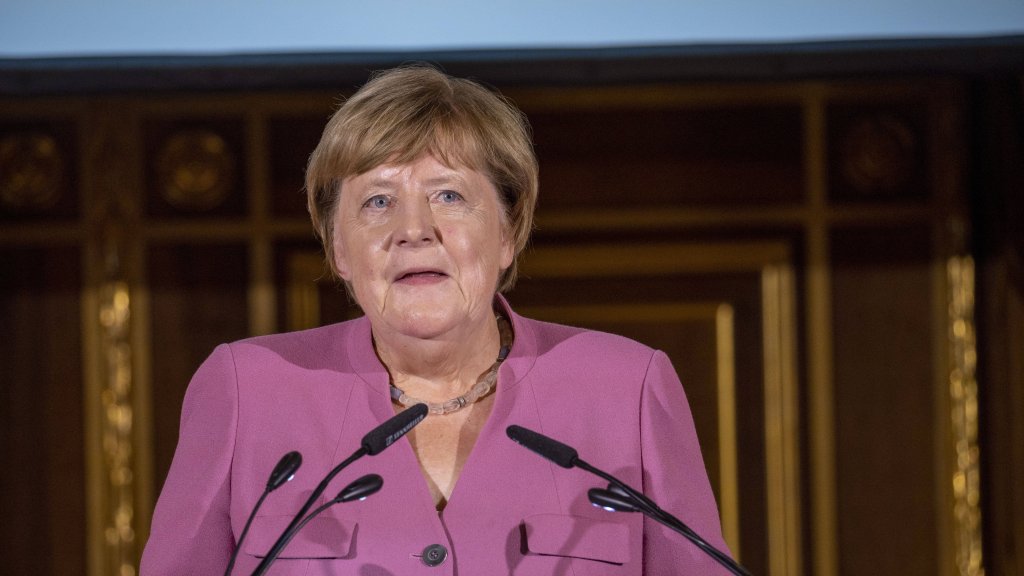
Former German Chancellor Angela Merkel (72) has explicitly voiced support for marriage equality for the first time. On the podcast “Kaffee und Fluchen”, hosts Albert Preußen and Louise Velsen-Zerweck asked whether she would make a different decision today from the one she made in the Bundestag vote in 2017. Merkel's answer was unequivocal: “I would vote in favour today, yes.”
Key points at a glance
- Angela Merkel has changed her position on marriage equality. On the podcast “Kaffee und Fluchen”, she said: “I would vote in favour today, yes.”
- In 2017, she voted in the Bundestag against opening marriage to same-sex couples.
- She had already critically assessed her decision at the time in her autobiography “Freiheit”.
- The former chancellor surprised the audience by attending a queer film premiere in Berlin.
Difficult questions at the time
On 30 June 2017, Merkel had voted against opening marriage to same-sex couples (German). Just a few days earlier, however, she herself had paved the way for the vote by saying that MPs could be allowed a free vote, without being bound by the party whip. Parliament ultimately approved marriage equality by a large majority – with the then chancellor voting against it. In the podcast, Merkel explained her position at the time by citing various concerns. “I had all sorts of worries at the time,” she said. These had included difficult questions surrounding surrogacy and children. She said it had been particularly important to her at the time to allow MPs a free vote according to their conscience. At the same time, she had known many gay people who wanted marriage to be opened up to them.
Self-criticism in her memoirs
Merkel had already reflected on her decision at the time in her autobiography “Freiheit”, published in 2024. In it, she expressed regret without explicitly revising her position. “I had not wanted to discriminate against anyone, but by voting no I had now achieved the exact opposite,” she wrote. The former chancellor acknowledged that gay people who had long fought for marriage equality had felt let down and “outright betrayed” by her. At the same time, she criticised the fact that she had come under “pressure to justify herself” after the vote, even though it had been a matter of conscience.
The AfD and a queer film premiere
In the podcast, Merkel also commented on the AfD and its political direction. She said young people had good reason to ask whether the promise of prosperity still held true for their generation. The AfD's answer to this was based on exclusion. She also called on parties in the political centre to develop stronger visions of their own for the future. They needed to explain how the promise of prosperity would be fulfilled in future, rather than focusing primarily on distancing themselves from other parties “like a rabbit caught in a snake's gaze”. Merkel also spoke about her successor Friedrich Merz (CDU). He had “what a federal chancellor needs, namely the absolute will to power”. What mattered, however, was “that everyone chooses their words very, very carefully”.
Merkel had already attracted attention on Wednesday evening with an unexpected appearance in Berlin. The former chancellor attended the premiere of the film “Lieblingsmenschen” at the cinema in the Kulturbrauerei. Based on a true story, the film tells of an unusual friendship: at its centre are Agnes, a 101-year-old woman from Berlin, and Amir, a 31-year-old gay refugee from Iran. Merkel's attendance at the queer film event came as a surprise to many guests.








