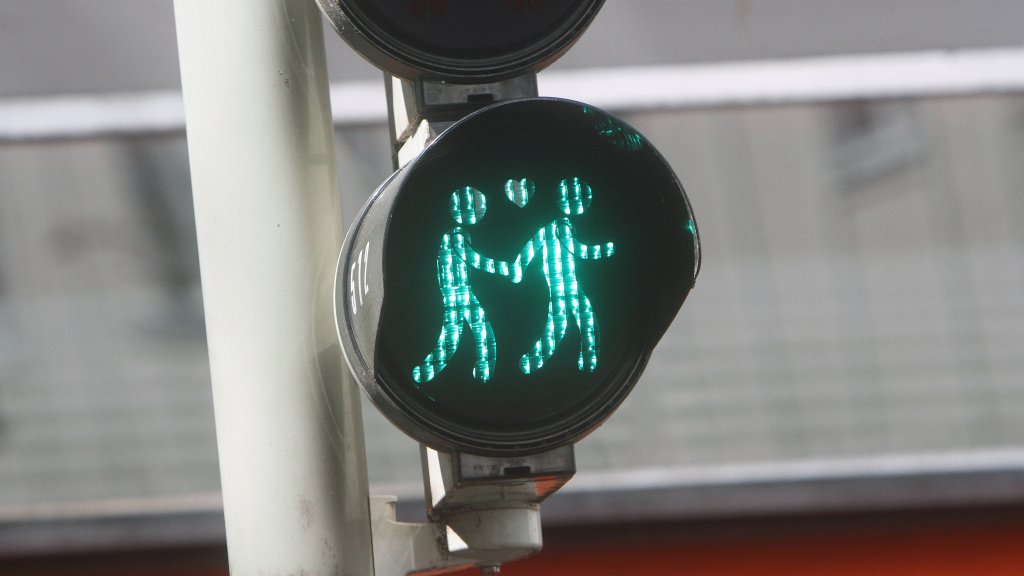
Children at the road safety training centre in Berlin-Kreuzberg will soon not only learn traffic rules but also encounter different ways of life as part of everyday life. The Friedrichshain-Kreuzberg district authority is having pedestrian traffic lights there fitted with new symbols. Instead of the usual single figures, the signals show couples holding hands.
Key points at a glance
- New traffic light designs: traffic lights at the road safety training centre in Berlin-Kreuzberg are being fitted with images of lesbian and gay couples, as well as a couple consisting of a woman and a man.
- A symbol of equality: the Friedrichshain-Kreuzberg district authority wants to use the designs to make social diversity visible and promote mutual acceptance.
- Berlin's transport administration takes the view that the new figures cannot be used on public roads. The Senate department cites mandatory traffic light symbols.
- Other cities are further ahead: Munich, Frankfurt am Main, Cologne and Düsseldorf have already used same-sex traffic light couples. In Düsseldorf, 36 traffic lights have been redesigned this year.
Educational aims
Three different designs are planned: two women, two men, and a woman and a man. A heart symbol completes the figures. With this design, the district wants to increase the visibility of same-sex couples while also signalling its support for equality in society. Initially, the special traffic lights will be used exclusively on the grounds of the road safety training centre. There, children practise navigating traffic safely under conditions that are as realistic as possible. Alongside road signs, right-of-way rules and correct behaviour at junctions, lessons also cover consideration for others and responsible interaction. The district authority therefore explicitly links the new signals to an educational aim. Children should come to see different forms of living together as a natural part of their surroundings.
Making same-sex couples visible
District mayor Clara Herrmann (Greens) supports the redesign. In her view, the lives of LGBTQ+ people are a natural part of Berlin's urban landscape and should also be visible there. With the new traffic light designs, Friedrichshain-Kreuzberg wants to make clear that same-sex relationships are just as much a part of everyday life as relationships between women and men. District councillor for schools Andy Hehmke (SPD) also welcomes the plan. He points to the importance of experiencing social diversity from an early age. Children should learn that people can live and love in different ways without being excluded as a result. The district considers the road safety training centre a suitable setting in which to combine this idea with practical road safety education. As pupils learn what the traffic signals mean, they also encounter different types of couples.
Senate department sees obstacles
For now, however, there are no plans to extend the project to public roads. This is due to opposition from the responsible Berlin Senate department. Although the district would like to use the new symbols outside the road safety training centre too, no agreement has yet been reached with the Senate department. The transport authority considers such a change to pedestrian traffic lights on public roads impermissible. Responding to an enquiry from Berlin newspaper Tagesspiegel, the administration cited legal requirements to explain its position. It said the design of traffic light figures was subject to binding rules and therefore could not be changed.
This argument does, however, raise questions. While the German Road Traffic Regulations stipulate that pedestrian traffic lights must display a pedestrian symbol, they contain no precise description of what that symbol must look like. The authority also cites safety concerns. It fears that unusual designs could confuse road users because they are accustomed to the familiar pedestrian figures. In its view, keeping signal designs as uniform as possible is important to avoid misunderstandings on the roads.
Long-running dispute over traffic light figures
The Senate department's opposition is also being debated because Berlin has already permitted different traffic light designs in the past. One well-known example is the East German Ampelmännchen. The distinctive figure wearing a hat was originally used in East Germany. Since 2005, it has also been used in Berlin's western districts, where it has replaced some of the previously standard symbols. Different forms of pedestrian signals also exist in other German cities. Cologne and Zwickau, for example, have female traffic light figures.
Frankfurt am Main and Munich have also depicted same-sex couples on their traffic lights. Düsseldorf took another approach. In Düsseldorf, the capital of North Rhine-Westphalia, a total of 36 traffic lights have been redesigned this year with images representing social diversity. Despite these examples, Berlin's transport administration maintains its opposition to the new couple designs. This is not the first time that such a proposal has failed in the capital. A similar idea for Pride Month fell through back in 2023.








