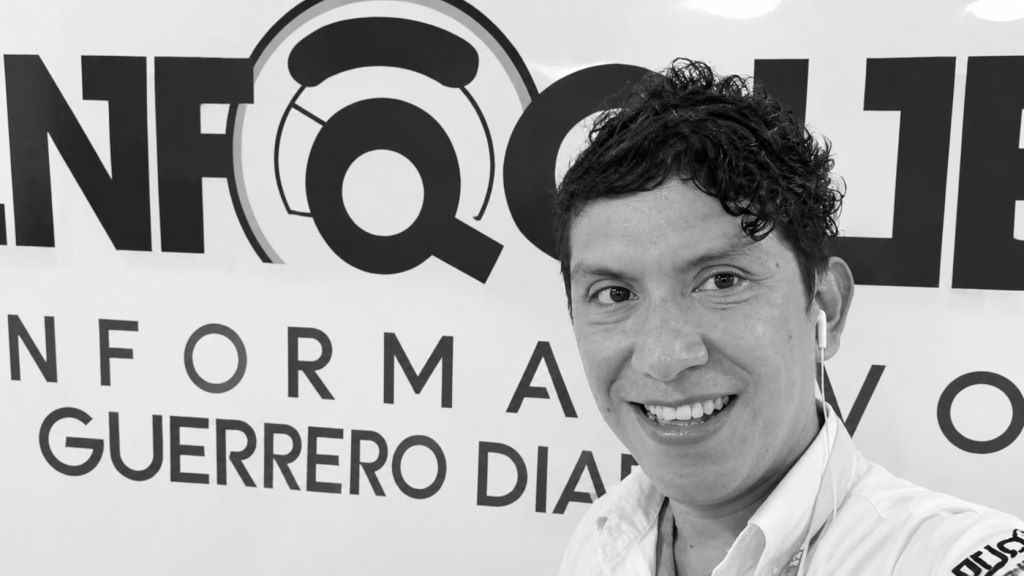
Mexican journalist Eduardo Flores Salado has been murdered at the age of 42. His body was discovered on 14 November at around 9pm in the Canuto Nogueda neighbourhood on the outskirts of Acapulco in the state of Guerrero. The journalist had worked for local news outlet Enfoque Informativo for around ten years, reporting on issues including problems with the water supply, protests in the education sector and missing persons cases. He also advocated for gay and queer people.
Key points at a glance
- Journalist murdered: Eduardo Flores Salado, 42, was found dead on 14 November in the Mexican coastal city of Acapulco.
- LGBTQ+ advocacy: Two years ago, the journalist co-founded the press collective Prensa Rosa, which supports LGBTQ+ journalists and helps them connect.
- Motive unknown: Prosecutors are investigating the murder. Reporters Without Borders is calling for a possible connection to his journalistic work to be investigated.
- Dangerous working conditions: At least 169 journalists have been murdered in Mexico since 2006. Of these cases, 99 per cent have not been fully solved.
- Mexico remains particularly dangerous for LGBTQ+ people, with at least around 574 gay and queer people murdered within six years.
Advocating for LGBTQ+ people
Two years ago, Flores Salado co-founded the press collective Prensa Rosa, which supports LGBTQ+ journalists and helps them connect with one another. Reporters Without Borders (RSF) is calling on the Mexican authorities to examine a possible connection between the murder and his journalistic work as part of their investigation. The Guerrero state prosecutor's office has now opened a murder investigation. So far, it has released neither findings on the cause of death nor information about possible arrests or a motive.
Calls for better protection
The human rights organisation reacted with dismay to the journalist's death. “The murder of Eduardo Flores Salado is deeply shocking and shows once again how urgently journalists, particularly local reporters, need better protection,” said Maren Pfalzgraf, RSF's press officer for Latin America. Pfalzgraf highlighted the continuing violence against media workers in Mexico and called on the government to act. “During our visit in October, we once again drew attention to the ongoing violence against media workers. Claudia Sheinbaum's government must finally deliver on its promises.” Flores Salado had more than 15 years of professional experience. Before joining Enfoque Informativo, he worked for the daily newspaper Novedades Acapulco.
A call for justice
According to colleagues who spoke to Reporters Without Borders, there were no known recent threats against Flores Salado. They also said the journalist was not registered with a state protection programme. However, there had already been an alleged attack on him in March 2019. At the time, journalists protested over an incident connected to reporting on Acapulco's water supply. A security employee of the municipal drinking water and wastewater company CAPAMA allegedly attacked Flores Salado while he was investigating problems with the water supply.
So far, however, there is no evidence linking the incident seven years ago to the current murder. The head of Enfoque Informativo, Héctor Najera Apatiga, told Reporters Without Borders that he had been working on the day's news with Flores Salado as recently as the Friday before the murder. He described the murdered journalist as a valued colleague and friend. At the beginning of this week, journalists in Acapulco published an open letter calling for justice for their murdered colleague.
Threats from drug cartels
The state of Guerrero is one of Mexico's most dangerous regions for journalists. Several drug cartels compete there for control of territory and illegal business activities. According to Reporters Without Borders, criminal organisations exert influence over state bodies and local businesses. Journalists investigating organised crime, corruption and links between the authorities and criminal groups are particularly at risk. According to the organisation, outright zones of silence have developed in some regions. Fear of violence means media workers there no longer report on certain subjects. The entanglement of local authorities and criminal organisations also makes crimes harder to solve and fosters impunity.
Murdered journalists
A recent analysis by Reporters Without Borders illustrates the scale of violence against media workers in Mexico. It found that a total of 169 journalists have been murdered since 2006. Of these, 166, or 98 per cent, were local journalists. The victims had particularly often investigated organised crime and corruption. According to the organisation, 99 per cent of the documented murders have not been fully solved. Mexico ranks 122nd out of 180 countries in the 2026 World Press Freedom Index. Eduardo Flores Salado's death thus adds to a long series of violent crimes against journalists whose investigation continues to pose major challenges for the Mexican authorities.
Violence against LGBTQ+ people
Mexico is among the countries with particularly high levels of violence against LGBTQ+ people. Despite legal progress, gay and queer people continue to face discrimination, threats and fatal attacks. According to the human rights organisation Letra-S, at least 60 people were murdered in 2025 alone because of suspected prejudice based on their sexual orientation or gender identity. The victims included 35 trans women and 19 gay men. The Mexican observatory for crimes against LGBTQ+ people documented a total of 574 murders between 2019 and 2025. The organisation warns that many cases go unreported and that there are difficulties in recording such crimes. Whether the murder of journalist Eduardo Flores Salado is connected to his advocacy for the LGBTQ+ community remains unclear.








