
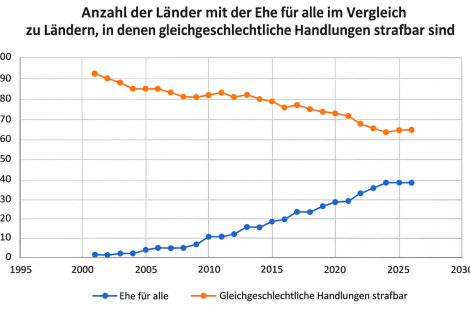
Despite significant progress in decriminalising homosexuality, consensual sexual acts between people of the same sex remain punishable by law in 65 countries worldwide at the end of 2026. In the early 2000s, the figure stood at more than 90. This is according to recent research by the news website 76 Crimes.
Key points at a glance
- 65 countries with criminal laws: Consensual sex between people of the same sex remains punishable by law in 65 countries worldwide. In the early 2000s, the figure was still more than 90.
- Success in Trinidad and Tobago: In mid-November, the highest court with appellate jurisdiction ruled that laws against same-sex intimacy were not sufficiently justified.
- New bans in West Africa: Niger criminalised homosexuality in June 2026. Burkina Faso and Mali had already introduced such laws in 2025.
- Numerous instances of decriminalisation: Since 2022, countries including Singapore, Mauritius, Namibia and St Lucia have repealed their laws against same-sex sexual acts.
- Diverging developments: While court cases and legislative initiatives to abolish the bans are under way in some countries, elsewhere they remain in place or are being newly introduced.
Light and shade
These developments show that many countries have now abolished their former criminal laws. At the same time, the international trend has recently stalled. New bans have been introduced particularly in West Africa, while courts in other parts of the world have declared existing laws incompatible with fundamental freedoms. The latest success in decriminalisation came in Trinidad and Tobago. There, a long-running legal dispute ended on 10 November with a ruling by the Judicial Committee of the Privy Council in London. The court is the highest court of appeal for several former British colonies. The Privy Council ruled that the legal bans on same-sex intimacy were incompatible with the requirements of a society that respects individual rights and freedoms. In its ruling, the court stated that such laws could “not be regarded as reasonably justifiable in a society that properly respects the rights and freedoms of the individual”. Trinidad and Tobago thus became the latest country to repeal a law against consensual same-sex sexual acts. The ruling marks the end of a long-running legal case and joins a series of successful court challenges to such criminal laws.
Criminal laws in West Africa
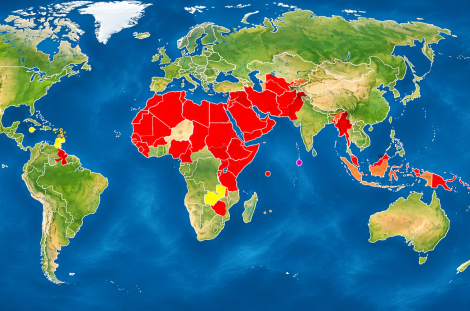
While Trinidad and Tobago ended criminalisation, legislation in several West African countries moved in the opposite direction. In June 2026, Niger introduced a new law criminalising homosexuality (German). This makes it the latest country to have passed such criminal provisions. The neighbouring countries of Burkina Faso (German) and Mali had already criminalised same-sex sexual acts in 2024, with the laws taking effect in 2025. The three countries thus represent a development that has at least temporarily halted the years-long decline in criminalisation worldwide.
Before these laws were tightened, the number of countries with such criminal provisions had fallen to 63. The new laws in West Africa pushed it back up. Following the latest ruling in Trinidad and Tobago, the figure currently stands at 65, according to 76 Crimes. Hopes are high that the number will fall again next year. However, these developments also make clear that progress in protecting gay and lesbian people is by no means irreversible. While existing bans are being overturned in some countries, other governments are creating new legal grounds for prosecuting same-sex relationships.
Bans abolished
In the long term, the number of countries criminalising same-sex sexual acts has nevertheless fallen significantly. In the early 2000s, the figure was still more than 90. Since 2022 alone, several countries and territories have repealed such criminal laws. Recent examples include St Lucia (German), which decriminalised same-sex sexual acts in 2025. A year earlier, Namibia (German), Niue and Dominica (German) did so. In 2023, Mauritius and the Cook Islands (German) abolished their respective bans. There were particularly many decisions in 2022. That year, Singapore (German), Antigua and Barbuda, St Kitts and Nevis and Barbados (German) ended the criminalisation of same-sex sexual acts.
These changes came about in different ways. In some countries, parliaments voted to abolish the criminal provisions; in others, courts struck down existing laws. However, repealing such bans does not automatically mean that gay and lesbian people in those countries enjoy comprehensive protection against discrimination. Decriminalisation first removes the threat of prosecution for consensual same-sex sexual acts.
Different legal situations
The current overview also shows that the legal situation varies considerably in some cases across the 65 countries covered. In some countries, existing criminal laws are currently being challenged in national courts. These countries are marked in yellow on the published world map. The ongoing proceedings could lead to further decriminalisation in future, but their outcomes are not yet known. Sri Lanka presents a particular situation. A bill to repeal the ban on same-sex sexual acts is before parliament there. In Indonesia, meanwhile, such criminal provisions apply only in certain parts of the country, rather than nationwide. The legal situation therefore differs from that in countries with a nationwide ban.
Progress remains contested
Developments over recent decades show a clear decline in the criminalisation of same-sex sexual acts worldwide. More than 25 countries have abolished their respective bans or had them overturned by court rulings since the early 2000s. At the same time, new criminal laws in some countries show that gay and lesbian people are once again facing additional legal restrictions. Whether the global number of countries with such criminal laws continues to fall in future depends in part on the outcome of ongoing court cases and parliamentary decisions. The long-term trend does point towards decriminalisation. However, recent developments make clear that the criminal prosecution of gay and lesbian people remains a reality in many countries in 2026. Gay men and lesbians are still criminalised in around a third of all countries worldwide.








