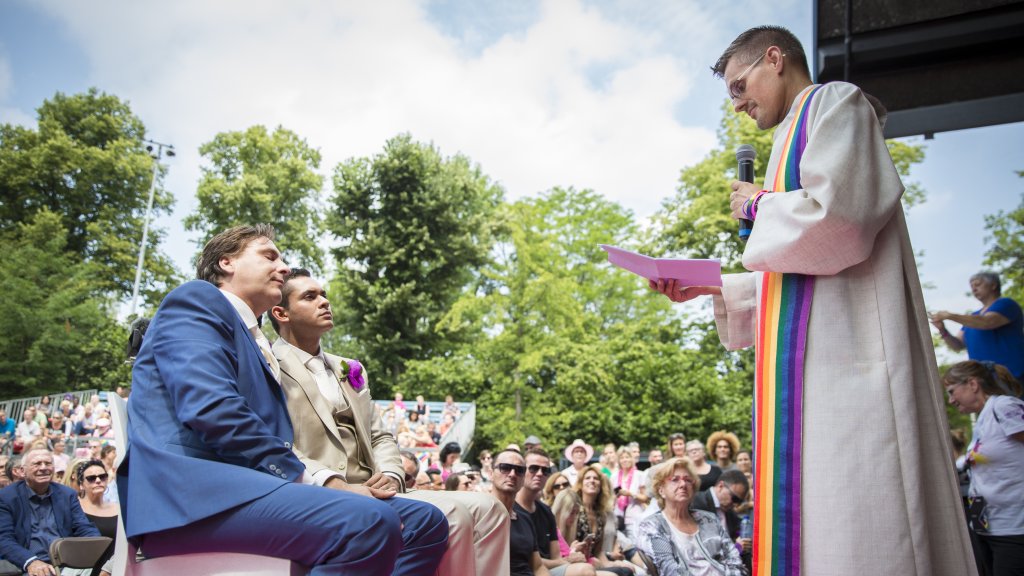
Same-sex married couples will no longer have a separate term for their church wedding in the Evangelical Lutheran Church in Bavaria (ELKB). The regional church is preparing new rules that would remove the existing distinction between a blessing and a wedding. According to information obtained by the German Press Agency, services marking a marriage are to be described as weddings as a matter of principle. Whether two men, two women or a man and a woman are marrying would no longer make any difference.
The key points at a glance
- Equal church weddings: The Evangelical Lutheran Church in Bavaria wants to abolish the existing distinction between weddings and blessings for same-sex couples.
- Decision in Amberg: The 108 members of the regional synod are discussing the new rules at their autumn session. The vote is scheduled for Wednesday.
- Conscience protection remains: Pastors will still be able to refuse to conduct weddings for same-sex couples. In such cases, the deanery is to arrange a replacement.
- Wide-ranging reforms: Alongside church weddings, the reorganisation of regional structures and the strained financial situation are on the agenda.
- Declining membership: According to a forecast, church membership could fall by around 40 per cent by 2035.
Equal rights for gay people
The church parliament intends to establish the necessary legal framework at its autumn session in Amberg. The gathering of 108 synod members began yesterday, Sunday evening, with a church service and runs until Wednesday. The first discussion of the matter is scheduled for Tuesday, with a final decision due on Wednesday morning. With its deliberations in Amberg, the regional church is continuing a reform process whose overall direction has already been established. At its spring session in Augsburg in April 2025, the regional synod voted by a large majority to open church weddings to all married couples. The change now planned is intended to enshrine that decision in the church's rules and terminology. The background is the differing treatment of marriages within the church. Although same-sex couples in Germany have been able to marry in civil ceremonies since 2017, the Bavarian regional church has so far maintained a distinction in terminology. Public blessing services for same-sex couples have been possible since 2018. However, these ceremonies have not so far been described as weddings.
The reform is not intended to change pastors' freedom of conscience. When taking its decision in principle in spring 2025, the synod had already explicitly stipulated that clergy would not be obliged to conduct weddings for same-sex couples. This protection of conscience will remain in place. If a pastor refuses to conduct such a wedding on personal grounds of conscience, the responsible deanery must appoint another member of the clergy to conduct the service. An examination of the church's past treatment of gay people also featured at the spring session. In Augsburg, the then president of the synod, Annekathrin Preidel, held a minute's silence in remembrance of people who had suffered within the church. She also acknowledged the responsibility of the institution and individual office-holders. “Individual people in positions of responsibility and the church as a whole have wronged those affected,” Preidel said at the time.
Preparing the regional church for the future
However, the planned equality in church weddings is only one of several issues occupying synod members in Amberg. Discussions about the regional church's future organisation and funding account for a much larger share of proceedings. Under the guiding theme “We in the region”, decisions are to be taken on how church responsibilities can be shared in future and how parishes can be better connected. This is linked to the question of how the church's work can be maintained locally despite limited staffing and financial resources. Parishes are to work more closely together and pool existing resources without losing direct contact with people. Synod president Tanja Keller sees this as a central task for the forthcoming discussions. “It is important to me that, in all questions of structures and finances, we keep local people in mind,” she said.
The problem of declining membership
The Bavarian regional church's need for organisational change is closely linked to its demographic and financial development. Membership has been declining for years. In 2025, it fell below two million. The causes include persistently high numbers of people formally leaving the church. At the same time, the regional church is losing more members through deaths than it gains through baptisms. This means that not only is the church community shrinking, but so too, in the long term, is the financial basis for its work. A forecast published by the ELKB last autumn shows how sharply this trend could continue. According to that forecast, membership could fall by around 40 per cent by 2035. The regional church expects to have just 1.2 to 1.5 million members by then.








