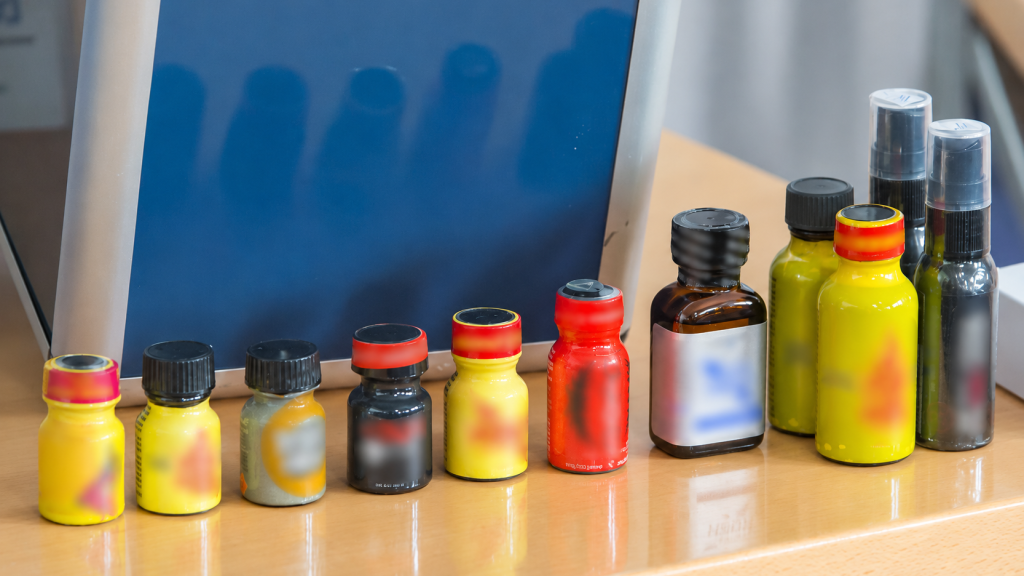
Poppers have been part of gay nightlife for decades. But the small bottles containing volatile chemical substances are now also common at student parties and in other young partygoing circles in Amsterdam. An investigation by Dutch local broadcaster AT5 now shows that sales largely take place without active government oversight. In addition, numerous products contain an active ingredient whose sale in poppers was effectively banned years ago.
Key points at a glance
- Use is increasing: poppers are becoming increasingly common among students and young partygoers in Amsterdam. According to the Trimbos Institute, the proportion of young people using them rose from 11.4 per cent in 2020 to 13.1 per cent in 2023.
- Sales despite restrictions: during an investigation by local broadcaster AT5, 20 of the 23 sex shops visited in the De Wallen red-light district offered poppers.
- Banned ingredient detected: of 33 products tested, 22 contained amyl nitrite, even though poppers containing it have been subject to Dutch medicines legislation since 2001 and their sale has effectively been prohibited.
- Little government oversight: two responsible regulatory authorities confirmed that they do not actively monitor poppers sales.
- Health risks: alongside headaches, dizziness and possible eye damage, experts warn particularly against combining poppers with erectile dysfunction medication, alcohol and stimulant drugs.
- Disagreement over regulation: while a chemist is calling for poppers to be classified as an intoxicant, a drugs expert advocates regulated outlets and better consumer information.
Poppers on the party scene
Their growing popularity is also evident in research by the Dutch Trimbos Institute. According to its findings, the proportion of young people using poppers rose from 11.4 to 13.1 per cent between 2020 and 2023. Something long associated primarily with the gay club and sex scene has thus reached a much wider audience. According to observations by young Amsterdam residents, sexual orientation and membership of particular social groups now play an ever smaller role in their use. Senna, a 23-year-old student, reports that he now encounters poppers at all kinds of events. The substance is by no means used only in clubs or at LGBTQ+ community parties. “Whether at a student society party, a surf party or among skaters – it doesn't matter which group you belong to. I see poppers being used everywhere,” he told AT5.
People who have been using poppers for some time are also noticing this change. Anthony says he uses the substance mainly to intensify sexual experiences. He describes the effect as a brief physical rush. “A warm, hazy feeling spreads through the body. Your body relaxes, your muscles tingle and your head feels very light.” He now notices more and more heterosexual people using poppers and being open about it. This is particularly apparent when out partying. “I see more and more heterosexual people loosening up and offering me a sniff of poppers on the dance floor. Then I think: ‘Huh, a heterosexual person is offering me poppers?’” Anthony says.
Manufacturers circumvent restrictions
The legal situation surrounding poppers in the Netherlands is complicated. Back in 2001, the health ministry intervened and made products containing amyl nitrite subject to the Medicines Act. This effectively prohibited their sale as poppers. Manufacturers responded by changing the chemical composition. Instead of amyl nitrite, they increasingly used isopropyl nitrite, a chemically related compound. At the same time, they changed the way they marketed their products. The bottles were offered as “leather cleaner” or “room fragrance”, for example. This allowed them to fall under less stringent goods legislation rather than medicines regulations.
Chemist Pim Linnebank sees this primarily as a way of circumventing legal restrictions. In his assessment, the two substances differ only slightly in their effects. “Poppers containing isopropyl nitrite have a shorter carbon chain. This makes the substance more volatile, and you inhale slightly more of it. That means the side effects can be stronger,” Linnebank explained to AT5. The change in chemical composition therefore affects volatility and potential side effects, but does little to alter the products' fundamental purpose. “In practice, it does exactly the same thing,” the chemist said.
22 products contain amyl nitrite
The findings of AT5's investigation in Amsterdam's De Wallen red-light district show how little attention retailers apparently pay to these legal distinctions. The journalists visited 23 sex shops there. They were able to buy poppers in 20 of them. They then had a total of 33 different products tested. The result: 22 of the 33 bottles contained amyl nitrite. This means that around two-thirds of the products tested contained an ingredient that cannot legally be sold in poppers under the rules in force since 2001. The investigation raises questions about the actual enforcement of the legislation. Although the products are available in numerous shops, checking their composition appears to play only a minor role in day-to-day oversight.
No urgent need for action
AT5 therefore approached the relevant government bodies. Both the Dutch Health and Youth Care Inspectorate (IGJ) and the Netherlands Food and Consumer Product Safety Authority (NVWA) confirmed that they do not actively monitor the sale of poppers. Both bodies cited their risk-based inspection systems as the reason. Since they receive almost no complaints about such products, monitoring them is currently given low priority. For consumers, this means they cannot simply rely on regular government checks of the ingredients in the products on offer when making a purchase.
There is another problem: because many poppers are officially sold as cleaning products, their packaging must not contain instructions for human consumption. As a result, advice on reducing health risks is often missing too. Drugs expert August de Loor criticises this situation. Clear information about effects and risks is particularly important for a substance that is actually used as an intoxicant, he argues. “Product information and sensible advice are missing. Yet they are crucial to preventing overdoses and hospital admissions,” de Loor said.
Headaches, dizziness, eye damage
Poppers are not without health risks. Known side effects include headaches and dizziness. Heavy use can also cause eye damage. Experts believe particular dangers arise when poppers are used alongside other substances. Different effects on the circulatory system can reinforce one another. Chemist Linnebank warns particularly against combining them with erectile dysfunction medication such as Viagra, as well as with alcohol. Like poppers, these can dilate blood vessels and thereby affect blood pressure. “Combining them with Viagra and alcohol, which dilate blood vessels just as poppers do, makes their use harmful. Or, for example, combining them with stimulant drugs such as cocaine or speed, which increase the heart rate,” Linnebank explained. Combining them with erectile dysfunction medication in particular can trigger a dangerous drop in blood pressure. Stimulant drugs, meanwhile, place additional strain on the body through their effects on heart rate and circulation. These health risks contrast with the relatively easy access to the products in numerous shops.
Disagreement over stricter rules
Experts disagree about what action should follow from the findings. Pim Linnebank believes a different legal classification is needed. Since poppers are actually used as an intoxicant, he argues that they should fall under the Dutch Opium Act. This governs the handling of narcotics and other controlled substances. Such a classification would fundamentally change the legal treatment of poppers. Drugs expert August de Loor, by contrast, favours an approach with a stronger focus on harm reduction. Rather than pushing the products out of the market, he advocates clear rules for their sale.
In his view, poppers should be available in so-called smartshops. Trained staff there could inform buyers about the products and their risks. He also believes the packaging should contain clear information about their composition and use. “Poppers should be sold in smartshops with trained staff. The bottles should carry product information and sensible directions for use. Rather than hiding and banning the products, I advocate regulation,” de Loor said. He considers it more sensible to acknowledge actual use and make it safer through binding standards than to continue selling the products under descriptions that disguise their real purpose.
The situation in Germany
In Germany, too, poppers occupy a complicated legal area. The alkyl nitrites they contain are generally not covered by the Narcotics Act. Possession and use are therefore not criminal offences. The situation is different when it comes to sales: certain active ingredients, such as amyl nitrite, are subject to medicines legislation. Supplying such products outside pharmacies can therefore breach the Medicines Act. To circumvent these restrictions, poppers are often offered as “room fragrance”, “leather cleaner” or “cleaning product”. However, the labelling alone does not automatically make their sale legal. The ingredients and the legal classification of the individual product are among the deciding factors. For consumers, this situation means that reliable information about composition and health risks is often lacking.








