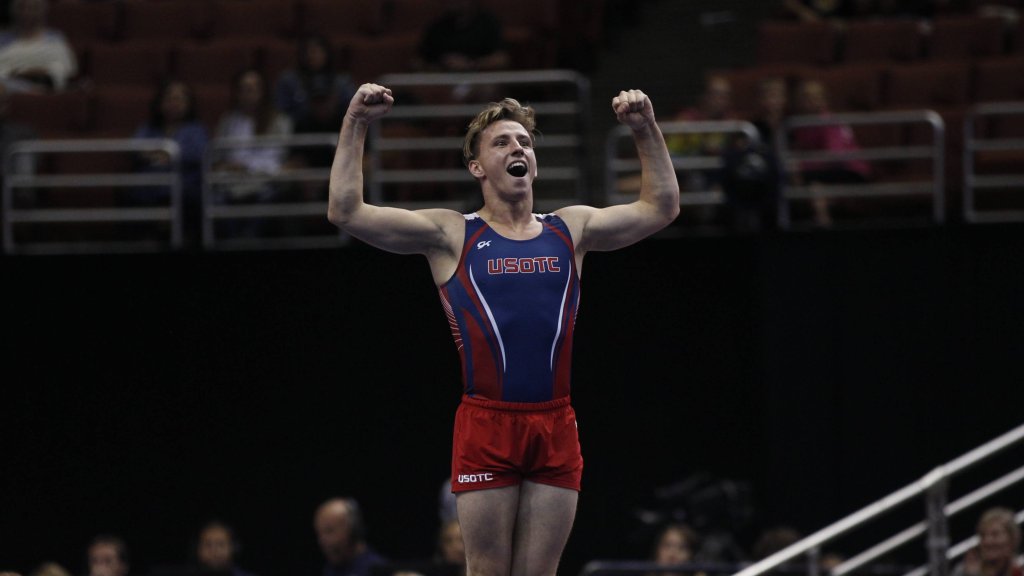
Openly gay artistic gymnast Eddie Penev (36) has taken on a new professional role: the former international elite athlete is working as an assistant coach for the women's gymnastics team at the United States Air Force Academy in the US state of Colorado. He says he is experiencing a level of acceptance there that would have been far from a given in a US military setting just a few decades ago.
The key points at a glance
- New role: former international artistic gymnast Eddie Penev is the new assistant coach for the women's gymnastics team at the US Air Force Academy in Colorado Springs.
- Change in the US military: around 20 years ago, military policy at the time would have made such a role significantly more difficult for an openly gay man, both socially and professionally.
- Widespread acceptance: Penev reports that he is fully accepted at the military academy and experiences no disadvantage because he is gay.
- Coming out with a major impact: following a public interview, the athlete received hundreds of positive responses, particularly from Bulgaria.
- A changing social climate: Penev now also finds Colorado Springs, previously known for being distinctly conservative, considerably more liberal.
Gay in the Air Force
Penev, who competed internationally for both the USA and Bulgaria, is now part of the coaching staff at the prestigious military academy. “It means a great deal to me. I don't think I really realised it at first,” Penev said of the opportunity to work at an American military academy as an openly gay man. His new role also reflects a fundamental shift within the American armed forces. Around 20 years ago, the “Don't Ask, Don't Tell” (DADT) policy was still in force there. Introduced during Bill Clinton's presidency in the 1990s, it prohibited gay members of the military from being open about their sexual orientation. The policy meant that gay and lesbian service personnel had to conceal their homosexuality if they wanted to continue serving. It was not finally abolished until 2011.
Penev might have been able to work as a civilian coach at a military institution even while “Don't Ask, Don't Tell” was in force. However, the social climate and the effects of the regulations at the time would have made such a decision significantly more difficult. Penev acknowledges that for a long time he knew little about the background to the military policy of that era. That makes him all the more appreciative of the openness around his homosexuality at the Air Force Academy today. He says he has had nothing but positive experiences since returning to Colorado Springs. “I think it's wonderful how fully they've welcomed me. I don't think about my identity all that much. Nobody treats me differently,” the former national team gymnast explained. For him, his sexual orientation is not an issue that affects his day-to-day work with the athletes or other coaches.
Coming out in the media
Within the gymnastics community, Eddie Penev has been open about being gay for many years. Among the wider public, however, few people knew that the athlete was gay for a long time. It was only at the beginning of this year that he spoke in greater detail to “Outsports” about his experiences as an openly gay elite athlete. He says the subsequent response exceeded all expectations. Penev was particularly struck by the many messages he received from Bulgaria. “Everyone was incredibly kind,” he said of the responses to the interview.
Above all, he said he had been surprised by how much his public coming out meant to other people in Bulgaria. “What touched me most was the number of people from Bulgaria who got in touch. They said how important this was for the community in Bulgaria, because not many people there can be open about being gay.” Penev had not expected his personal story to prompt such a strong response in the south-eastern European country. “There were literally hundreds. My story attracted attention in a community where I hadn't thought I could make a difference,” he reported. He said the many personal messages had changed his view of the significance of coming out publicly. “It made me feel wonderful. It made me realise that I hadn't simply told my story, but had also helped other people by doing so.”
Return to Colorado Springs
The job at the Air Force Academy also marks a return to familiar surroundings for Penev. During his competitive career, he had already spent several years living in Colorado Springs. At the time, he trained there with the American men's national artistic gymnastics team. He says the city has changed considerably in social terms since then. Colorado Springs was long regarded as distinctly conservative and was strongly shaped by the military and conservative social currents. On his return, however, Penev finds the atmosphere considerably more open. “I've seen enormous change in Colorado Springs. The city is becoming more and more liberal. I'm really enjoying moving back here now,” he said. In his view, his experiences at the military academy reflect that change. He says he is not defined by his homosexuality there, but valued as a member of the coaching team. “I'm very grateful to the Air Force Academy for giving me this opportunity,” Penev said.








