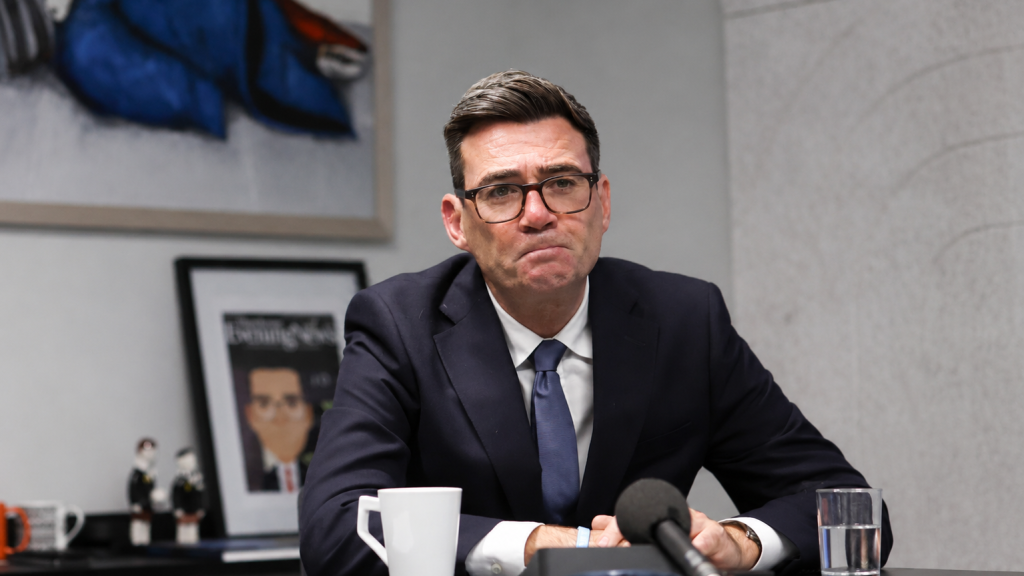
British Prime Minister Andy Burnham (56) (German) has once again made a public show of solidarity with the LGBTQ+ community amid growing hostility towards LGBTQ+ people. In an interview with podcaster Luke Hamnett, the Labour politician reaffirmed his long-standing commitment to tackling discrimination and criticised the increasingly aggressive tone of political debate.
Key points at a glance
- British Prime Minister Andy Burnham explicitly describes himself as an ally of the LGBTQ+ community.
- Amid rising hate crime, the Labour politician criticises the coarsening of political debate.
- As Mayor of Manchester, Burnham made a conscious decision to attend Pride with his daughter.
- Right-wing parties in Britain want to abolish key laws protecting LGBTQ+ people.
- Burnham has campaigned against discrimination and conversion therapy for years, but has adjusted his position on single-sex spaces.
- Youth organisation The Proud Trust calls on the Prime Minister to show political courage in an open letter.
An ally of the community
Asked what responsibility he felt in the face of rising hate crime against LGBTQ+ people, Burnham replied: “An enormous responsibility; I am an ally.” The former Mayor of Manchester has led the British government since July 2026. Following his predecessor Keir Starmer’s term in office, Labour has regained support under his leadership. Burnham is Britain’s seventh prime minister in ten years. Referring to discriminatory remarks made during his most recent election campaign, the Prime Minister expressed concern about the direction of political debate.
“Politics has taken this direction and has gone decidedly too far: things are now being said openly that would once have been unacceptable.” Burnham urged people to remain true to their convictions and stand up to attempts at intimidation. “You have to remember your own values and what you deeply believe in: being proud to be an ally of the community, but also proud to stand up to any form of discrimination or intimidation.” It was often about intimidating behaviour towards other people, the Prime Minister stressed. “I am proud to be called an ally.”
At Pride with his daughter
In the interview, Burnham also recalled his time as Mayor of Manchester and his regular support for the city’s LGBTQ+ community. Taking part in the Pride parade with his daughter had been a conscious decision, he said. “I was always very proud to be at the front of Manchester Pride, and I very deliberately did that alongside my daughter. We were there because that reflects who we are, and we wanted to send a very clear message.” The Prime Minister’s remarks come at a time when right-wing parties in Britain are increasingly challenging fundamental laws on equality and the protection of LGBTQ+ people.
In February, Suella Braverman, equalities spokesperson for the right-wing party Reform UK, announced plans to abolish the Equality Act if the party won the election. The law, in force since 2010, provides protection against anti-LGBTQ+ discrimination, among other things. Reform UK wants to replace it with a so-called “Workplace Fairness Act”. Details of the proposed workplace fairness legislation have not yet been fully worked out. The far-right party Restore Britain, led by Rupert Lowe, is meanwhile calling for the abolition of the “Gender Recognition Act”, which enables trans people to have their gender legally recognised. Under the party’s manifesto, biological sex would be legally defined as immutable. Trans women would be denied access to women-only spaces.
Commitment to tackling discrimination
As Mayor of Manchester, Burnham had already spoken out publicly on LGBTQ+ rights on several occasions. He apologised for historic homophobic persecution by Greater Manchester Police (GMP). LGBTQ+ people had faced “unacceptable discrimination”, he said at the time, apologising for “the resulting pain and suffering”. In 2022, Burnham explicitly supported allowing trans women to use women’s toilets. However, following the UK Supreme Court’s ruling on single-sex spaces based on biological sex, he adjusted his position. He supported implementing the guidance issued by the Equality and Human Rights Commission (EHRC). In doing so, he stressed both the need to protect single-sex spaces and the importance of avoiding the exclusion of trans people.
Burnham also took a firm stand against so-called conversion therapy. As mayor, he pledged not to give public funding to organisations in Greater Manchester that support or promote such practices. The Labour government has announced a ban on conversion therapy for LGBTQ+ people (German). In current British opinion polls, Burnham’s public approval rating is significantly higher than those of his rivals on the right-wing fringe of the political spectrum. While the Labour politician has a rating of plus nine per cent, Rupert Lowe stands at minus 19 per cent and Reform UK leader Nigel Farage at minus 26.6 per cent.
Youth organisation calls for courage
Meanwhile, British LGBTQ+ youth organisation The Proud Trust has addressed the Prime Minister in an open letter. Chief executive Rachel Williams reminded Burnham of his previous commitment in Manchester and urged him to continue consistently championing equality and inclusion as head of government. Manchester had “proudly presented itself as a city where LGBTQ+ people are welcome, celebrated and valued; you helped shape that sense of identity. You marched through our streets at Pride, spoke publicly about equality and inclusion, and always recognised that diversity is one of this city’s strengths.”
That commitment had meant far more than political symbolism to thousands of young LGBTQ+ people. It had helped both people who had found a community for the first time in Manchester and parents who wanted to better understand and support their children. Organisations such as The Proud Trust had also benefited. “I hope that, in your role as Prime Minister, you bring that same commitment to inclusion. Because, from our perspective, many young LGBTQ+ people feel that the progress they thought was already secure is gradually being lost again.”
Williams called on the Prime Minister to stand up to growing social polarisation. “It is time to show political courage. In recent years, we have seen public debate about LGBTQ+ people become increasingly hostile and polarised.” Rights that many people had taken for granted were being questioned or rolled back. Young people were having to hear their identity discussed as a “political problem”, rather than recognised as a natural part of who they are. Changes to school policies, uncertainty over healthcare and the tone of political debate had left many young LGBTQ+ people feeling less safe today and more anxious about the future. Williams concluded her open letter with an appeal: “Equality is not a goal that is achieved once and for all. It must be protected, defended and strengthened, especially when doing so becomes difficult.”








