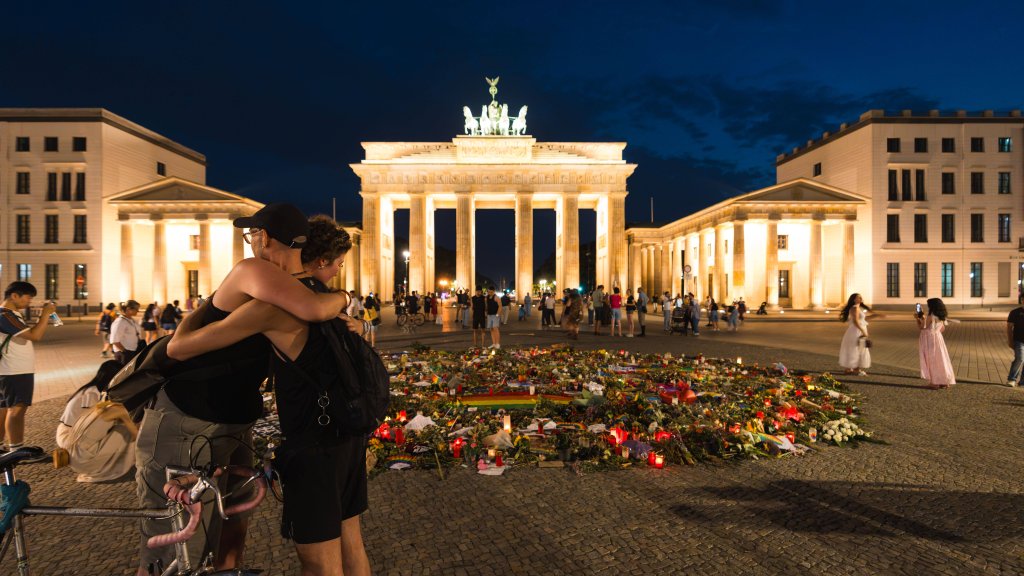
Ten days after the Islamist attack on Christopher Street Day (CSD) in Berlin (German), the Bundestag's interior affairs committee is examining the circumstances behind it. The special session continues to centre on the crucial question of why the attack could not be prevented, even though the suspected attacker, 21-year-old Abdul Ballout, had been known to the security authorities (German) for some time.
The key points at a glance
- The Bundestag's interior affairs committee is holding a special session today to examine the Islamist attack on Berlin's Christopher Street Day.
- The central question is why Abdul Ballout was still able to carry out the attack despite being classified as a high-risk individual.
- Federal Interior Minister Alexander Dobrindt and the heads of the Federal Police, the Federal Criminal Police Office and the domestic intelligence service are answering MPs' questions.
- The Greens and the Left Party are demanding a complete chronology of the actions taken by all security authorities involved.
- The attack has prompted renewed debate about tougher measures against individuals deemed potential Islamist threats.
- Four individuals deemed potential threats in Berlin have now been fitted with electronic ankle tags.
- The attacker's second mobile phone raises suspicions of an accomplice.
Interior affairs committee seeks answers
The committee is meeting for a special session at the request of the Greens and the Left Party. With parliament in its summer recess, the discussion is taking place by video link. Federal Interior Minister Alexander Dobrindt is expected to attend, along with the presidents or heads of the Federal Police, the Federal Criminal Police Office (BKA) and the Federal Office for the Protection of the Constitution. According to the findings so far, Abdul Ballout had been classified as a potential Islamist threat for months. Investigations by NDR, WDR and Süddeutsche Zeitung also found that the Federal Criminal Police Office had listed him as a high-risk individual. According to these reports, security authorities were still keeping him under surveillance shortly before the attack and took images of him in the process.
A special session of the Berlin House of Representatives' interior affairs committee had already revealed that the domestic intelligence service had been monitoring Ballout's activities within Salafist circles for several years. Despite these findings, the Greens' interior affairs specialist Konstantin von Notz believes substantial questions still need to be answered. In his view, it must be made clear, among other things, which security authority made which threat assessment at what point. As after previous attacks, he is also demanding a complete chronology detailing when state and federal authorities took which measures.
Von Notz told ARD's Berlin bureau: “Alexander Dobrindt must answer the many outstanding questions. His ministry must present such a chronology as quickly as possible to provide a basis for further investigation.” It must also be established why the federal government had not coordinated the security authorities much more closely before the attack. “After all, that is precisely why we set up joint conferences and counter-terrorism centres years ago.”
Debate over potential Islamist threats
The attack took place on 25 July during Christopher Street Day in Berlin's Tiergarten park. According to the findings so far, Abdul Ballout first drove a car into a group of passers-by. He then attacked other people with a machete. A woman from Poland was killed and 31 people were injured (German). A day later, police officers shot the Islamist dead during an operation in Berlin as they attempted to arrest him.
The attack has triggered renewed debate over how to deal with individuals deemed potential Islamist threats. Federal Interior Minister Dobrindt is calling for a significantly tougher approach. In his view, people classified as potential threats should, as a rule, be monitored using electronic ankle tags. The CSU politician also advocates placing such individuals in precautionary detention more frequently. Preventive detention for individuals deemed potential threats is “absolutely necessary”, he said. The SPD's interior affairs specialist Sebastian Fiedler also advocates reviewing all existing options. “Every available tool” must be discussed. Both electronic ankle tags and preventive detention fall largely within the remit of Germany's federal states. Both measures are already legally possible, but their use varies across the country.
The Left Party's interior affairs spokesperson, Clara Bünger, however, warns against rushing to tighten the law. She says it must first be established whether the security authorities consistently made full use of their existing legal options. Bünger told ARD's Berlin bureau: “Before new laws are passed and fundamental rights are restricted further, it must be established whether the existing options were used consistently.” She also pointed to possible shortcomings in information-sharing between authorities. “New powers are no help if existing intelligence is not properly brought together,” Bünger said.
Was there an accomplice?
While political discussions about the consequences of the attack continue, investigators are now focusing on new leads. According to a report in Welt, a second mobile phone belonging to the attacker, Abdul Ballout, is of particular interest. The device was reportedly seized in the vehicle used in the attack and, according to the newspaper, is currently being analysed by the Federal Criminal Police Office. The report explicitly states that this is not the phone that Berlin's security authorities had been monitoring because Ballout had been classified as a potential threat.
Investigators hope that analysing the mobile phone will provide further insight into whether Ballout was in contact with other people before the attack or may have received instructions during it. According to Welt, the movement data from the hire car used as a weapon lends particular support to these lines of inquiry. The report says Ballout did not drive directly to Berlin's Tiergarten park, where he later drove the car at speed into a crowd on the fringes of Christopher Street Day. Instead, the car is said to have followed a conspicuous zigzag route for an extended period. According to information from investigative sources cited by the newspaper, the vehicle repeatedly accelerated and stopped. Investigators believe this driving behaviour could indicate that Ballout was in contact with, or receiving instructions from, an as-yet unidentified person during the attack.
Four potential threats fitted with ankle tags
Immediately after the attack, Berlin's security authorities stepped up their measures against individuals deemed potential Islamist threats. As Berlin's interior minister Iris Spranger (SPD) told rbb in response to an enquiry, four people classified as potential Islamist threats are now wearing electronic ankle tags at the request of Berlin Police. According to rbb, they are three men and one woman. The court-ordered measure initially applies for 30 days and is intended to monitor their whereabouts.
According to Spranger, another individual deemed a potential threat was also temporarily placed in preventive detention. This was prompted by a possible threat to Christopher Street Day in Hamburg the previous weekend. The preventive detention ended overnight from Sunday to Monday. Spranger pointed to the legal options already introduced. “I would like to emphasise once again: the options we have created in recent months through the reform of the General Security and Public Order Act and the amendment to the Protection of the Constitution Act are available,” the SPD politician said.
Support for greater use of electronic ankle tags is also coming from Berlin's CDU. Its lead candidate for the House of Representatives election, Stefan Evers, advocates more extensive technological monitoring of people classified as dangerous. At the same time, he believes that the legal thresholds for using the measure remain too high, despite the recent reform of Berlin's police law.








