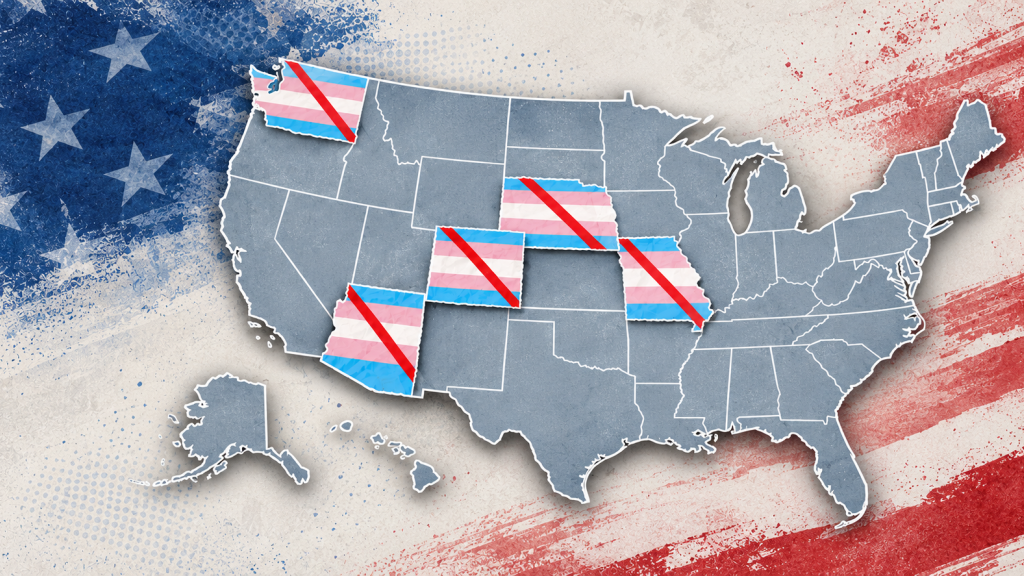
Just days before the US midterm elections on 3 November the political battle over trans people's rights is once again taking centre stage. In five states, voters are to decide on initiatives proposing far-reaching restrictions on sport, medical care and the use of sex-specific facilities.
Key points at a glance
- Initiatives that could restrict trans people's rights are on the ballot in Arizona, Colorado, Missouri, Nebraska and Washington at the US midterm elections.
- Sport and toilets in focus: several proposals seek to exclude trans girls and women from certain sporting competitions. Arizona also proposes restrictions on the use of changing rooms and toilets.
- Controversial sex checks: in Washington, female athletes could be required to prove their sex on the basis of physical, genetic or hormonal characteristics.
- Colorado wants to ban gender-affirming surgery for minors. Missouri could enshrine an existing treatment ban in its constitution.
- Conservative organisations, wealthy businesspeople and Republican politicians are providing financial and political support for several initiatives.
Ballot initiatives under way
The states concerned are Arizona, Colorado, Missouri, Nebraska and Washington. Several proposals aim to expand existing bans or permanently enshrine them in the respective state constitutions. The dispute is accompanied by extensive advertising campaigns. As during Donald Trump's 2024 presidential campaign, Republican supporters are relying on advertisements targeting trans people. Some Democratic politicians are also taking up similar demands. Candidates are campaigning on promises to “keep transgender ideology out of our schools” or prevent “biological men in women's sport”. Wealthy businesspeople, conservative organisations and political action committees are backing several ballot initiatives.
Sporting bans and restrictions
In Arizona, Proposition 318 would extend existing restrictions on trans female athletes to almost all organised competitions. As well as state schools, private schools, colleges, universities and private sports leagues would be affected. In addition, toilets, changing rooms, showers and other areas directly associated with sporting activities would have to be used exclusively according to the sex recorded at birth. If approved, the measure would take effect as early as January 2027. Arizona's legislature cannot easily repeal a successful ballot initiative.
Two different proposals are on the ballot in Colorado. Proposition 134 seeks to exclude trans girls from girls' sports teams. The athletes' “biological reproductive system” would be the determining factor. Opponents fear that this wording could allow invasive sex checks. Proposition 135, meanwhile, targets gender-related surgery for minors. Such procedures would be banned for people under 18. Funding through government programmes, including Medicaid, would also be ruled out. In Nebraska, Initiative Measure 442 likewise concerns trans people's participation in sport. In 2025, the state passed a law excluding trans female athletes from teams that match their gender identity. The initiative seeks to enshrine this ban in the state constitution.
Burden of proof on female athletes?
In Missouri, Amendment 3 seeks to enshrine the existing ban on gender-affirming healthcare for minors in the state constitution. It also seeks to roll back the right to abortion. The treatment ban for trans minors has been in place since 2023 and would remain in force regardless of the vote's outcome. Enshrining it in the constitution would, however, make it considerably harder to repeal later.
Initiative 638 in Washington state proposes particularly far-reaching checks. In addition to excluding trans girls from girls' sports teams, it would require all female athletes to prove their sex. The proposal lists “the student's reproductive anatomy, genetic makeup or normal, endogenously produced testosterone levels” as possible evidence. No comparable requirement is proposed for boys' teams. Educators and human rights organisations warn that girls could consequently be pressured into genital examinations unless they undergo expensive genetic or hormonal tests. In all five states, supporters justify the bans by citing fair competition in women's sport, the protection of girls and the health of minors. LGBTQ+ organisations, by contrast, criticise discrimination, infringements of personal self-determination and the potential psychological strain on trans young people.








