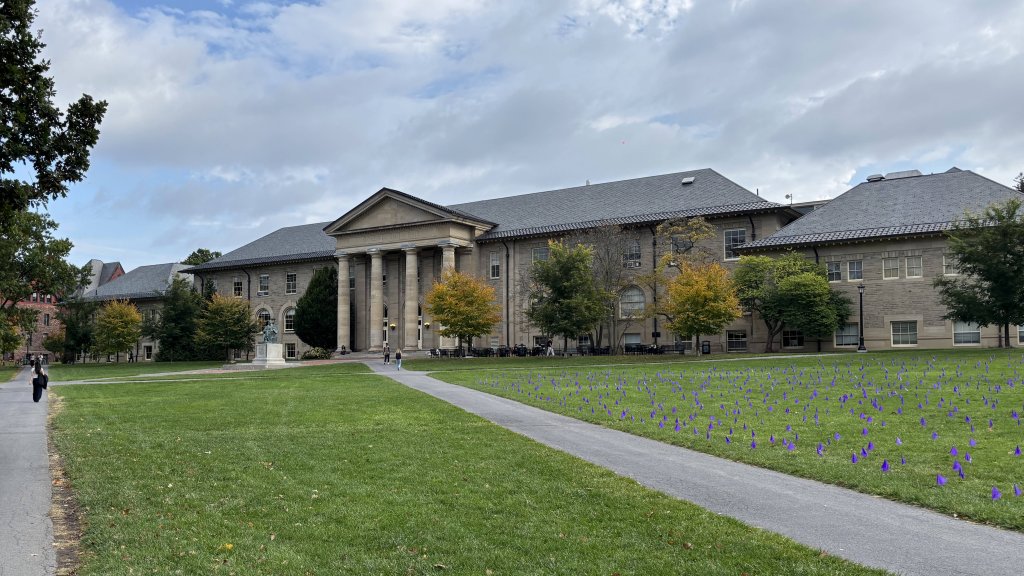
The death of a non-binary person at the prestigious Cornell University in the US state of New York is now the subject of legal proceedings. Almost two years after Winter Knutson's suicide, their mother has filed a lawsuit against the university and several other people. She accuses those responsible of failing to respond adequately to a series of serious conflicts and alleged harassment in a residence hall for LGBTQ+ students.
Key points at a glance
- Winter Knutson, a non-binary person at Cornell University, died by suicide in November 2024.
- Alleged harassment: according to the lawsuit, Knutson was repeatedly harassed and faced false accusations in a residence hall for LGBTQ+ students.
- Allegations against the university: Winter's mother, Sofia Akber, accuses the university of failing to investigate six increasingly serious incidents adequately and breaching its duty of care.
- Damages sought: the lawsuit names the university, two female students and ten other, unnamed individuals as defendants.
- Cornell remains silent on allegations: the university describes Knutson's death as a tragedy but is not commenting on the allegations because of the ongoing legal proceedings.
Suicide two years ago
Winter Knutson was found dead on 10 November 2024. The local news outlet The Ithaca Voice was the first to report the death at the time. The university newspaper, The Cornell Daily Sun, later confirmed that Winter was the child of mathematics professor Allen Knutson, who also works at Cornell University. Winter's mother, Sofia Akber, has now filed a lawsuit. According to her account, the suicide was preceded by several incidents alleged to have occurred between mid-September and 10 November 2024. She alleges that the university administration failed to investigate the events adequately and respond to the situation.
A residence hall as a safe space
The legal dispute centres on a residence hall known as Loving House. It is part of Cornell University's accommodation provision and is explicitly intended for students from the LGBTQ+ community. According to its own description, the residence hall aims to “create an environment that protects and supports Cornell University's LGBTQ+ student community”. Winter Knutson also lived there. According to media reports, Winter initially became friends with a female student and her roommate there. Both women are now also defendants in the proceedings. The lawsuit also names the university and ten other individuals whose identities are not publicly disclosed in the court documents. According to the mother's account, a romantic relationship developed between Winter and one of the students. However, she alleges that the affection was not mutual. The student in question allegedly later admitted that she had only begun the relationship “to manipulate Winter and give them false hope”.
Sexual assault allegations
Relations between those involved are alleged to have deteriorated significantly over time. According to the lawsuit, the student and her roommate began deliberately harassing Knutson. Among other things, they are alleged to have made serious accusations against Knutson. These included a false accusation that Knutson had sexually assaulted a friend. There was also a claim that Knutson had secretly drugged other people. The person alleged to have made the sexual assault accusation is said to have withdrawn it after Knutson's death.
The mother argues that these incidents were part of a wider pattern that became increasingly distressing. The legal complaint refers to “six increasingly serious incidents”. These are alleged to have been instigated primarily by the two female students. Whether the events described actually took place in this way is a matter for the court proceedings. The allegations have not yet been established in court.
Promises of protection not kept?
A central point of the lawsuit concerns Cornell University's responsibility for the safety of its students. The mother cites Title IX, a US federal law prohibiting discrimination on the basis of sex in education. The claimant argues that the university should have investigated the alleged incidents and taken appropriate action. Instead, she alleges, the university administration failed to establish adequately what had happened. The mother considers it particularly serious that Loving House is explicitly advertised as safe and supportive accommodation for LGBTQ+ students. She argues that the university thereby raised expectations and assumed specific obligations which it failed to fulfil in Winter Knutson's case.
The legal complaint states: “Cornell made these promises in writing – on the university's publicly accessible website, in information and promotional materials for the residence halls, and through the formal agreement that all Loving House residents, including Winter, were required to sign. Cornell promised not only acceptance, but also protection, support and safety.” The claimant sees this as a basis for her allegations against the university. In her view, the crucial point is not simply that the university offered an inclusive residential environment, but that it should also have fulfilled the associated promises of protection.
Mother seeks damages
Through her lawsuit, Sofia Akber is seeking damages in an amount that has not yet been specified. Her claims include negligence, violations of the New York State Human Rights Law and legal liability for her child's death. The mother wants the court to examine both the conduct of those allegedly involved and the university's handling of the incidents described. Her lawyer, Reza Yassi, said he intended to substantiate the allegations during the proceedings. “We look forward to proving Winter's claims in court and holding Cornell and the individual defendants accountable. We also hope that this case leads to meaningful and lasting changes at Cornell University so that no one else has to go through what Winter experienced,” Yassi said. Alongside the defendants' potential legal liability, the family is therefore also seeking changes in the way the university deals with students facing conflict or distress.
No statement from the university
Cornell University has not yet commented on the specific allegations. A university spokesperson referred to the pending legal proceedings. “The loss of Winter Knutson was a tragedy. We will not comment on the ongoing legal proceedings,” the university said. The proceedings must now establish whether the harassment described took place, what university officials knew about the alleged incidents and whether this gave rise to legal obligations that the university failed to fulfil.
The elite university is also currently facing criticism on another matter: several members of the Chi Phi fraternity at Cornell University are accused of gang-raping a female student who was under the influence of drugs and alcohol over a period of hours in October 2024. Following a civil lawsuit filed in autumn 2026 and sharp criticism of the allegedly inadequate response by the university and local authorities, New York Governor Kathy Hochul has launched a special investigation.
Where to find help
Reporting on suicide is an extremely sensitive matter. We do not wish to glorify or romanticise it in ANY way. Many people who die by suicide have a mental health condition. If you are struggling or thinking about taking your own life, try to talk to other people about it. These could be friends or relatives. There are also many support services you can contact. Telefonseelsorge is anonymous, free and available around the clock. The telephone numbers are 0800/111 0 111 and 0800/111 0 222.
The Coming Out Day association also offers advice via messenger, email and video chat at www.coming-out-day.de and www.comingoutundso.de . Telefonseelsorge also offers a support chat service. Email counselling is available too. You can register on the website – again anonymously and free of charge. You can find information at: www.telefonseelsorge.de








