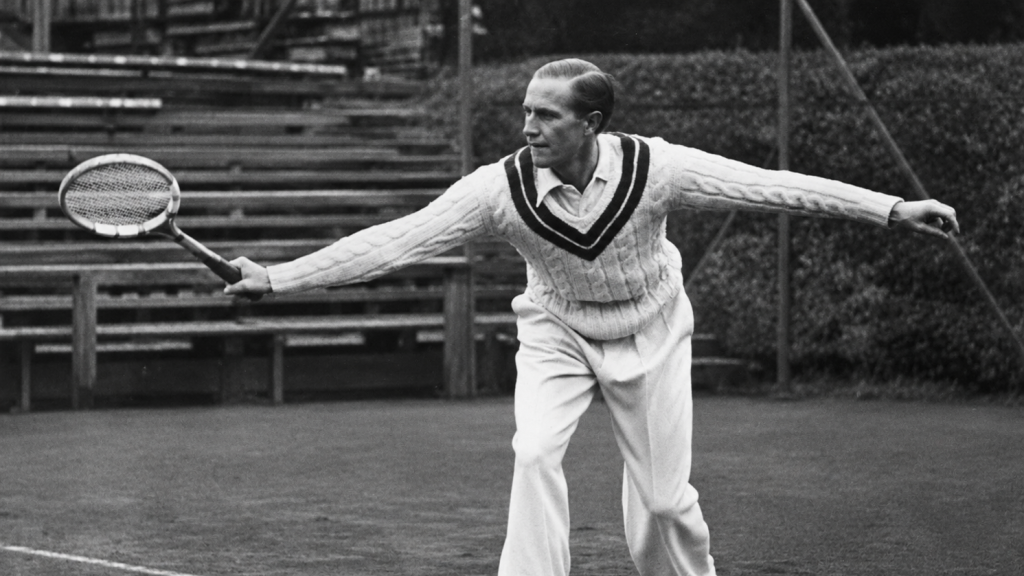
Long before Boris Becker and Steffi Graf turned tennis into a mass phenomenon in Germany, the bisexual Gottfried von Cramm was one of the country’s best-known sportsmen. The aristocratic tennis player captivated audiences in the 1930s with exceptional performances and an elegant presence. Yet his life was shaped not only by sporting success, but also by persecution by the Nazis, personal setbacks and a tragic end.
The key facts at a glance
- Germany’s first tennis superstar: Gottfried von Cramm won the French Open twice, reached three Wimbledon finals and ranked among the world’s leading players in the 1930s.
- Persecution by the Nazis: The bisexual sportsman was arrested by the Gestapo in 1938 and sentenced to prison over a homosexual relationship with a Jewish man.
- Distance from the Nazi regime: Despite his sporting success and international fame, von Cramm refused to support Nazi propaganda.
- Success after the Second World War: The Tennis Baron was voted Sportsman of the Year in 1947 and 1948 and played an important role in rebuilding German tennis internationally.
- Death 50 years ago: On 9 November 1976, von Cramm died in a road accident in Egypt at the age of 67. A year later, he became the first German to be inducted into the International Tennis Hall of Fame.
A global star of days gone by
Today marks the 50th anniversary of the death of the sportsman known as the Tennis Baron. Von Cramm died in 1976 at the age of 67 in a car accident while on a business trip in Egypt. Born near Hildesheim on 7 July 1909, Gottfried Alexander Maximilian Walter Kurt Freiherr von Cramm was one of the first German tennis players to achieve international stardom. While Alexander Zverev attracts attention today, and Becker and Graf shaped German tennis particularly in the 1980s and 1990s, von Cramm had set standards decades earlier. His story, however, extends far beyond sport. As a bisexual man who refused to submit to Nazi propaganda, he became a target of the Nazi regime. Ultimately, his international popularity could not protect him from persecution and imprisonment.
Elegance and sporting excellence
Von Cramm began playing tennis relatively late. He only discovered the sport at the age of eleven, but would later become one of the finest players of his generation. In the 1930s, the Berlin-based aristocrat developed into an international tennis great. His style of play was characterised by technical precision, elegance and remarkable composure. As early as 1937, the American sports journalist John R. Tunis described his exceptional presence with the words: “To watch this athlete, tall, elegant, robust and unshakeable on court, is to enjoy one of the most beautiful spectacles the galaxy of sport can offer.”
His sporting record was equally impressive. Von Cramm reached the final of the prestigious Wimbledon tournament three years in succession, in 1935, 1936 and 1937. He secured the French Open singles title in 1934 and 1936. Further Grand Slam successes followed in doubles. In 1937, he won both the French Open and the US Open. He made a total of 101 appearances for Germany’s Davis Cup team. His successes made von Cramm an internationally respected representative of German sport. Yet it was precisely his cosmopolitan outlook and his stance towards Nazism that increasingly brought him into difficulty.
Nazi suspicion
After Adolf Hitler’s rise to power in 1933, the Nazi regime sought to exploit sporting success for propaganda. Von Cramm’s international fame made him one of the athletes whose achievements were particularly suited to this purpose. However, relations between the tennis player and the Nazi authorities remained strained. On the one hand, his victories mattered to Germany’s international reputation. On the other, the well-connected sportsman was regarded as politically troublesome.
Von Cramm refused to support Nazi propaganda and kept his distance from the regime’s ideology. His international circle and personal lifestyle did not conform to the authorities’ expectations. His bisexuality in particular made him vulnerable at a time when homosexual men were systematically persecuted (German). The Nazis eventually used an earlier relationship with a Jewish man to take action against the successful tennis player.
The Gestapo arrested Cramm
In 1938, von Cramm was arrested after returning from an extended international tournament tour. The arrest took place at the family seat, Schloss Brüggen. The family were in the castle’s drawing room after dinner when the Gestapo arrived and took the tennis star away. The arrest concerned a homosexual relationship with a Jewish man. Von Cramm was sentenced to a year in prison as a result.
The persecution demonstrated that even internationally celebrated sportsmen were not protected from the Nazi regime’s repressive measures if their private lives or beliefs conflicted with Nazi ideas. After seven months, the remainder of his sentence was suspended and he was released on probation. An intervention by his mother also played a part. She had approached Hermann Göring and asked for leniency for her son. The senior Nazi and President of the Reichstag belonged to the same Berlin tennis club as von Cramm. However, early release did not mean that he was fully exonerated. His conviction remained in place and significantly hampered his subsequent sporting career.
Criminal record barred him from tournaments
Although von Cramm was free again after his release from prison, he could not resume his international career without restrictions. His criminal record prevented him from taking part in numerous major tournaments. This deprived the leading German player of important opportunities to build on his earlier successes. His personal situation deteriorated further with the outbreak of the Second World War. Von Cramm was conscripted into the Wehrmacht and sent to the Eastern Front. He suffered frostbite there and returned to Germany on home leave. He was later discharged from the Wehrmacht. In the final years of the war, he increasingly opposed the Nazi regime. By that point, political persecution, imprisonment and war had already severely affected his sporting career. Nevertheless, after the end of Nazi rule, he managed to make a remarkable fresh start.
Voted Sportsman of the Year
The international reputation von Cramm had built before the Second World War proved valuable after 1945. He became the first German sportsman to receive permission from the Allied occupation authorities to travel abroad again. This enabled him to renew his international contacts at an early stage and help German tennis return to the world stage. He also remained successful as a player. He was voted Sportsman of the Year in both 1947 and 1948.
Von Cramm also worked to rebuild the organisational structures of tennis. In 1948, he was among the co-founders of the Deutscher Tennisbund. His international influence helped the association gain admission to the International Tennis Federation just two years later, in 1950. Von Cramm thus played an important role in restoring German tennis’s international relationships, not only as an active sportsman but also as an administrator.
A successful businessman and marriage
Alongside his sporting career, von Cramm developed business interests. Among other ventures, he imported Egyptian cotton, establishing another source of income. His private life also repeatedly attracted public attention. From 1930 to 1937, he was married to Baroness Elisabeth. Years later, he entered into a second marriage that once again placed him at the centre of international society’s attention.
In 1955, von Cramm married the American heiress Barbara Hutton. She came from the family behind the Woolworth retail business and was one of the best-known wealthy figures of her time. With the marriage, von Cramm also ended his active tennis career. However, the union between the former top sportsman and the prominent society heiress did not last. The marriage was short-lived. Regardless of his private relationships, von Cramm remained an outstanding figure in German tennis thanks to his sporting achievements and international fame.
Road accident and recognition
The former tennis star’s life ended in tragic circumstances on 9 November 1976. Von Cramm was on a business trip in Egypt when the vehicle he was travelling in collided with a lorry. According to accounts of the accident, his driver had failed to notice a lorry crossing their path. The 67-year-old was killed in the crash. His death brought to an end a life marked by exceptional sporting achievements, social prominence, political persecution and personal upheavals. Von Cramm had continued to pursue business interests outside tennis until the end of his life.
A year after his death, von Cramm received one of tennis’s highest international honours. In 1977, he was posthumously inducted into the International Tennis Hall of Fame. He was the first German to receive this honour. His two French Open singles titles, three Wimbledon finals and numerous Davis Cup appearances had already made him one of the defining figures of his sport during his lifetime.








