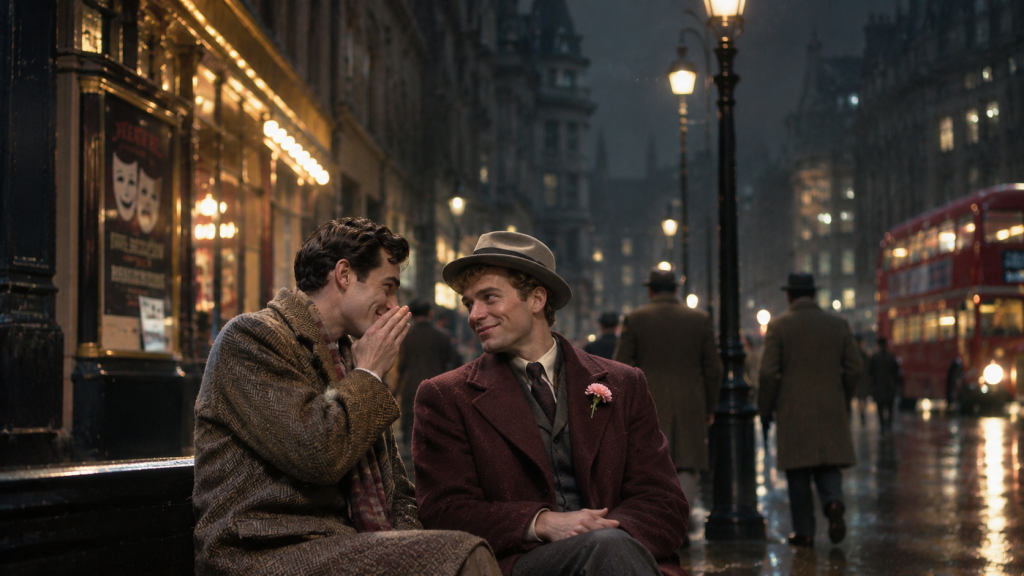
Anyone who heard the sentence “Vada the naff strides on the omee ajax” in Britain, and later in other parts of Europe, a few decades ago might not have understood a word. For those in the know, however, its meaning was clear: “Look at the awful trousers that man over there is wearing.” The sentence comes from Polari, a British slang particularly widespread among gay men between the 1920s and the 1960s. It allowed them to talk about other people, make connections or hint at their own sexual orientation without outsiders necessarily understanding what was being said. Some terms were also adopted in Germany – alongside many symbols used among gay people from the 1950s onwards. (German)
Key points at a glance
- Secret communication: Polari was particularly widespread among gay men in Britain between the 1920s and the 1960s. The slang enabled discreet conversations at a time of criminal prosecution.
- Diverse origins: It combines English grammar with words from languages including Italian, Romani and Yiddish. Its vocabulary comprises around 500 terms.
- Millions of radio listeners: The BBC comedy “Round the Horne” made Polari known nationwide in the 1960s.
- Social change: The partial decriminalisation of homosexual acts in 1967 and changes within the gay liberation movement contributed to its decline.
- Cultural heritage: Books, films, exhibitions and art projects are now exploring Polari once again, along with its significance for gay history.
Belonging at a time of criminalisation
At a time when sexual acts between men were subject to criminal prosecution, this form of communication could offer protection. At the same time, Polari expressed a distinct culture of humour, wordplay, mockery and numerous affectionate terms. The linguist Paul Baker of Lancaster University has studied the history of the slang extensively. His research shows that Polari did not serve exclusively to maintain secrecy. It was also a means of social belonging and personal expression. In linguistic terms, Polari is not a separate language with its own grammar. The etymologist Michael Quinion instead describes it as slang that largely follows the grammatical rules of English.
A characteristic feature is the substitution of individual words. While ordinary English sentence elements remain, key words are replaced with expressions often unfamiliar to outsiders. The name Polari derives from the Italian verb “parlare”, meaning “to speak”. Polari was also used as a verb meaning “to chat”. According to Lancaster University’s “Fabulosa” research project, its documented vocabulary comprises approximately 500 terms. Most speakers, however, knew only a core vocabulary of around 20 words. That was often enough to send a signal during an ordinary conversation and find out whether the other person was also familiar with Polari.
Origins among travelling performers
The precise origins of Polari remain uncertain. Its linguistic roots extend into a range of social settings. An important precursor is thought to be “Parlyaree”, a way of speaking used among travelling entertainers, street musicians, market traders and beggars. According to Lancaster University, its influences include French expressions, rhyming slang, thieves’ cant and terms from the American military. Other elements come from Italian, Romani, Shelta and Yiddish, among other languages. One possible explanation for the spread of Italian words is the immigration of Italian performers and traders to Britain in the early 19th century. Seafarers may also have contributed to its development (German). Another distinctive feature is “backslang”, in which words are spoken backwards or rearranged.
Communication under pressure
In its later development, Polari was not used solely by gay men. Lesbian women, female impersonators, theatre workers and sex workers were also among its speakers. In the British Merchant Navy, gay seafarers known as “Sea Queens” also used these expressions. Polari always held particular significance for gay men. Individual terms could be used to cautiously establish whether someone they were talking to was also gay, or at least familiar with the relevant social circles.
Baker describes how words such as “bona” or “palone” were casually slipped into conversations to observe the other person’s reaction. Given the threat of arrest, blackmail and violent attacks, this possibility was highly significant. The slang did not, however, offer complete safety. People hostile to gay men could sometimes understand Polari too. Beyond this, it developed into an important part of social life. It offered space for friendship, flirting, insults, wordplay and humorous remarks.
BBC comedy and Polari
In the 1960s, Polari finally moved beyond relatively closed social circles and into the British public sphere. This was largely thanks to the BBC radio programme “Round the Horne”, broadcast from 1965 to 1968. According to the BBC, the comedy series reached around 15 million listeners. The characters Julian and Sandy, played by Hugh Paddick and Kenneth Williams, became particularly well known. In the sketches, presenter Kenneth Horne frequently encountered the pair running unusual businesses. Their conversations were full of double entendres and Polari expressions. Many of the sexual innuendos apparently escaped BBC censorship. This enormous popularity had consequences, however. The more people became familiar with Polari through the radio, the less suitable it became for secret communication. Baker sees this as a major reason for the subsequent decline in its use.
Decriminalisation of homosexuality
Alongside Polari’s growing public profile, legal and social conditions for gay men in Britain were changing. The Sexual Offences Act 1967 partially decriminalised sexual acts between men in England and Wales. However, the reform applied only under certain conditions: both men had to be at least 21 years old, act consensually and be in private. The legal definition of privacy was narrow. Public toilets were excluded. Sexual acts in the presence of more than two people were also outside the scope of the new provisions. Other criminal laws remained in place. Equivalent reforms did not take place in Scotland until 1980, and in Northern Ireland until 1982.
This limited decriminalisation also meant that discretion remained important for many gay men. Nevertheless, attitudes towards Polari changed within the gay liberation movement. Some activists also criticised the slang for its associations with secrecy and a deliberately flamboyant mode of expression. At the same time, American gay lifestyles and ways of speaking were becoming more influential. For some men, Polari increasingly represented a past from which they consciously wanted to distance themselves.
Declining significance among gay men
A study by Paul Baker around the year 2000 showed how far its significance had declined. Of approximately 800 gay men surveyed, about half had never heard of Polari. Many gay men were no longer familiar with it. However, Polari did not disappear completely. According to Lancaster University, some older gay men and people in theatre circles continue to use individual expressions. Polari also increasingly became the subject of linguistic research and cultural projects. Books, films and exhibitions repeatedly brought Polari back to public attention over the following decades. An evening service in Polari at an Anglican college in Cambridge in 2017 also attracted attention. During the service, God was referred to as “the Duchess”. The college later expressed regret over the event.
The words of Polari
Polari’s historical vocabulary comprises several hundred terms drawn from different languages and social settings. The meaning and spelling of individual expressions could vary from speaker to speaker. Many words were used to describe everyday situations, while others enabled discreet communication about people, relationships and sexuality. Simple terms of appraisal were particularly common. “Bona”, for example, meant “good”, while “cod” or “naff” described something as awful, tasteless or inferior. Anyone wanting to describe something as pretty or pleasant could use the word “dolly”. For something especially splendid, there was “fantabulosa”, which can be translated as “fantastic” or “wonderful”. “Bijou”, by contrast, meant “small”, while “feely” described a young person or something young.
There were also specific terms for people. A man was called an “omi” or “omee”, a woman a “palone”. Combining the two words produced “omi-palone”, a term for a gay man. The expression “trade” could mean a sexual partner. The police, meanwhile, were known as “lily law” – a term with particular significance at a time of criminal prosecution. Numerous words referred to physical appearance. “Eek” meant the face, “riah” the hair and “lally” a leg. Speakers used “batts” for shoes, while clothing in general could be described as “drag”. Trousers were called “strides”. Anyone wanting to improve their appearance or make something particularly striking could use the verb “zhoosh”, meaning roughly “to spruce up” or “beautify”.
There were also terms for everyday places and actions. “Lattie” could mean a house, a flat or a room. “Ajax” indicated that something or someone was close by. “Vada” meant “to see” or “to look”, while “troll” meant “to go for a walk” or “to wander”. Anyone wanting to express a negative could use “nanti”, meaning “no”, “nothing” or “not”, depending on the context. These words could be combined with ordinary English. This allowed speakers to have conversations that initially sounded like incomprehensible wordplay to outsiders. Anyone familiar with the core vocabulary, however, could quickly recognise what was being discussed. Individual words from Polari’s vocabulary have since spread beyond the original speech community. Modern expressions such as “camp”, “butch”, “drag” and “trade” were also used in Polari.
Signs of recognition among gay men
Polari was just one of several ways in which gay people could signal their belonging to a community (German). Another example is the “Hanky Code”, which was particularly widespread in the American leather scene. It used coloured handkerchiefs to indicate particular sexual preferences or roles. The green carnation, associated with the writer Oscar Wilde (German), is another historical sign of recognition among gay people. Unlike visible symbols, however, Polari could be slipped unobtrusively into an ordinary conversation. A single word was sometimes enough to establish familiarity without anyone else present noticing the signal.








