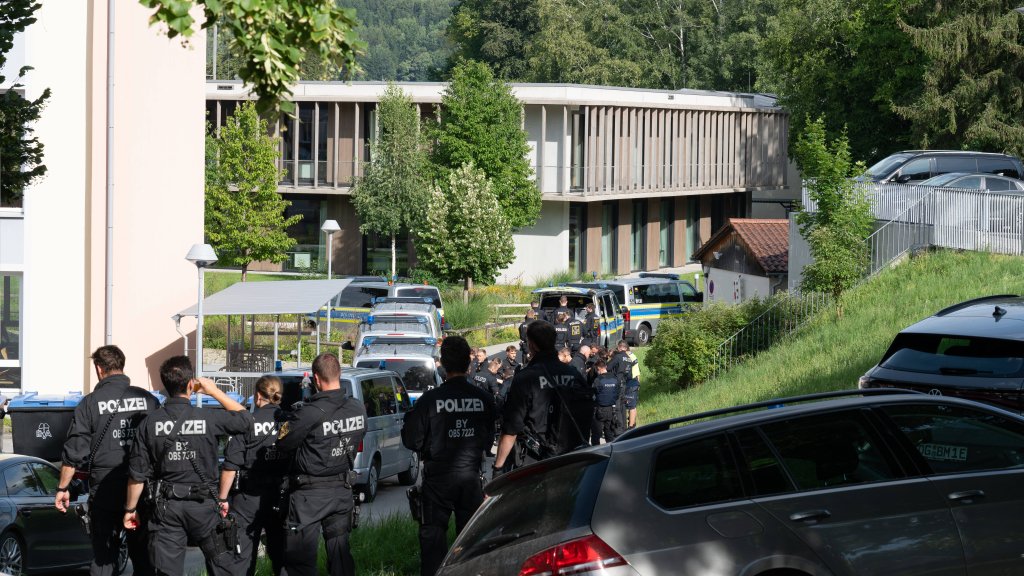
Misogyny, anti-LGBTQ+ hostility, racism and antisemitism: these ideologies are reportedly expressed in a manifesto that surfaced online after the attack at Welfen-Gymnasium in Schongau. Investigators believe the document is highly likely to have been written by the suspected attacker. Bavaria’s Interior Minister Joachim Herrmann (CSU) has now confirmed that assessment before the state parliament’s interior affairs committee. Police classify the attack as an act of right-wing violence.
Key points at a glance
- Anti-LGBTQ+ hostility as part of the ideology: according to Interior Minister Joachim Herrmann, a manifesto allegedly written by the Schongau attacker is characterised by misogyny, anti-LGBTQ+ hostility, racism and antisemitism. Police therefore classify the attack as an act of right-wing violence.
- Earlier warning signs were known: the 16-year-old had already been investigated in 2025 over threats and the glorification of rampage attacks. Despite various measures, he was not included in Bavaria’s threat management programme.
- Politicians call for action: following the attack on two schoolgirls, the interior ministry intends to review the approach taken so far. At the same time, concern is growing over the rapid online radicalisation of potential violent offenders.
A manifesto of hatred
The case also raises questions that go beyond the attack itself: what role do hateful attitudes play in the development of potential violent offenders? And how can the authorities respond in time when threats are already emerging before an attack? A 16-year-old is alleged to have seriously injured two schoolgirls in Schongau on 8 July this year. The fact that the teenager had already come to investigators’ attention makes the review of the case particularly sensitive. The suspected attacker’s ideological outlook is a central aspect of the investigation. Yesterday, Herrmann described the manifesto’s content to the parliamentary committee as “characterised by misogyny, anti-LGBTQ+ hostility, racism and antisemitism”.
Police therefore classify the attack as right-wing violence. The attitudes cited reflect different forms of group-based hatred. This brings anti-LGBTQ+ hostility in particular into focus. The information available so far does not yet allow firm conclusions about the specific significance of each of these views for the attack. However, investigators’ assessment of the manifesto shows that, alongside the attack itself, the suspected attacker’s worldview is also being examined. The case also forms part of a broader security context. In Bavaria, the authorities receive reports of threats of violence in public places an average of twice a day. The more than 600 cases each year range from scribbles on toilet doors and disturbing online posts to anonymous phone calls. Many threats turn out not to have been serious. In Schongau, however, such a threat became a serious act of violence.
Serious injuries
The consequences of the attack could have been even more severe. According to the findings so far, the 16-year-old’s pistol malfunctioned after the first shot. He is then alleged to have stabbed two 13-year-old girls in the back with a combat knife. Fellow schoolgirls intervened and provided first aid. In doing so, they prevented the seriously injured pupils from bleeding to death in the school playground. Two members of school staff overpowered the suspected attacker. The headteacher had raised the alarm at 12.50 pm. Just 17 minutes later, the teenager’s arrest was reported over the radio. The swift response at the scene appears to have prevented an even worse outcome. However, that does not answer the question of whether the attack could have been prevented in the first place.
Teenager was known to the authorities
The suspected attacker was not unknown before 8 July. As Herrmann confirmed, the public prosecutor’s office had already investigated the teenager in 2025. He is alleged to have threatened fellow pupils and glorified rampage attacks on social media. As part of the investigation, police searched his parents’ homes. Officers seized items including a protective vest, a balaclava and several knives. The teenager is alleged to have made further threats against a fellow pupil, probably in December last year. According to the legal assessment, these statements established “initial suspicion of disturbing the public peace by threatening criminal offences”.
The authorities responded with various measures. Police formally warned the teenager, and discussions were held with the youth welfare office and the school. He was also required to attend a prevention course and leave Welfen-Gymnasium. In addition, the public prosecutor’s office commissioned a psychiatric assessment. However, this was not yet available at the time of the attack. Herrmann explained that there had been no legal basis for detaining the teenager.
Criticism of the risk assessment
For SPD home affairs politician Christiane Feichtmeier, this leaves key questions unanswered. In particular, she sees a need to clarify how the teenager was supported and supervised after the first warning signs. “Even if there were no grounds for detention, why wasn’t he supervised more closely?” she asked. “It still leaves me speechless. Much more could have been done here.” Feichtmeier is calling for a closer examination of the options for monitoring potential lone attackers over a longer period. This also concerns how the authorities can deal with people who repeatedly show signs of a possible propensity for violence without meeting the conditions for detention. Her central question is: “How can we keep a closer eye on lone attackers like this?”
Bavaria has had what is known as a threat management programme since 2021. The relevant structures are based at the individual police headquarters. The aim is to identify potential violent offenders as early as possible and reduce risks through appropriate measures. The teenager from Schongau was not included in this programme. Given the high number of more than 600 reports of threatened acts of violence each year, his case apparently did not seem urgent enough. Following the attack, the procedure is now to be reviewed. The interior ministry plans to revise the threat management programme. Herrmann acknowledged: “I am not blaming anyone, but we must learn from Schongau”. The danger may also have been underestimated because the suspected attacker was still so young.
Online radicalisation
The debate about the attack also draws attention to the spread of extremist and hateful attitudes online. This concerns not only individual threats but also online milieus in which violence is glorified and hostile ideologies can spread – hatred of gay and queer people is repeatedly particularly prevalent here. Florian Siekmann (Greens), deputy chair of the interior affairs committee, pointed to the increasing speed at which people can become radicalised online. His party is therefore calling for an expansion of the Bayern-Allianz gegen Desinformation. Herrmann, by contrast, is relying on the work of the domestic intelligence service and the police.
The security authorities have to take account of different manifestations of extremist violence. These include Islamist extremists as well as the so-called “attacker fan scene”. In these circles, rampage attacks and their perpetrators are admired, while the victims become objects of fascination. According to the authorities, the transition from passive observer to dangerous perpetrator can now take place within just a few months. This makes prevention considerably more difficult: when attitudes and the propensity for violence change rapidly, there is less time to recognise warning signs and initiate effective measures. Police director Oliver Penonic pointed to the limits of monitoring given the enormous volume of content online. There is “more than we know about, and more than we can monitor”, he said.








