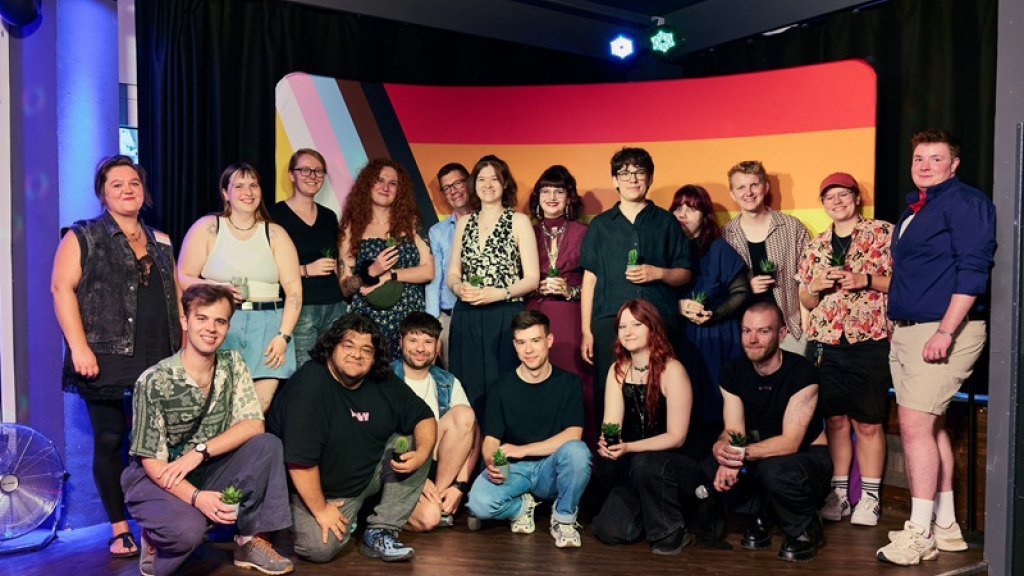
Cologne’s queer youth organisation anyway is celebrating the tenth anniversary of its education and anti-discrimination project “WiR* – Wissen ist Respekt”. Young lesbians, gay men, bisexual and trans people under the age of 27 volunteer to deliver workshops on gender and sexual diversity to school classes and youth groups.
Key points at a glance
- Cologne’s anyway is celebrating the tenth anniversary of its education project “WiR* – Wissen ist Respekt”.
- Young queer people volunteer to deliver workshops on gender and sexual diversity in schools and youth groups.
- Around 70 workshops currently take place each year, reaching approximately 1,500 pupils.
- The project takes a peer-to-peer approach: young queer people talk to other young people about diversity and discrimination.
- The City of Cologne has supported the project since 2018 and intends to continue funding it.
- According to the project, hostility towards queer people in school classes has increased significantly in recent years.
- With provocations and insults on the rise, the project leadership now attends every workshop.
Queer education under pressure
“You bring knowledge to places where prejudice can develop. And you help turn knowledge into respect, and respect into solidarity. In doing so, you are not just working for queer people. You are working towards a more open and democratic society for us all,” says Cologne mayor Derya Karadag on WiR*’s tenth anniversary. According to its own figures, the project currently runs around 70 workshops a year. In the past, it says, there were as many as 120 sessions annually. WiR* currently reaches around 1,500 pupils a year.
This work is made possible by what is known as the peer-to-peer approach. The workshops are deliberately delivered by young queer people who have received appropriate training beforehand. This means their own experiences are not far removed from those of the pupils, allowing them to talk more freely about lesbians, gay men, bisexual and trans people with others of roughly the same age. Teachers can request the workshops free of charge. The service is funded by, among others, the City of Cologne. “Wissen ist Respekt has been supported by the city since 2018, and there are plans to continue funding it in the future. We are convinced of the value of this work,” says mayor Derya Karadag.
Growing hostility towards queer people
Despite the increased public visibility of queer issues, the project is concerned about developments in schools. It says conditions for educational work with pupils have deteriorated over the past ten years. At first, this seems contradictory. After all, more and more young people are encountering LGBTQ+ issues. Queer issues are now more prominent in the media, in families and in public life than they were ten years ago, the project says. Schools have also become more open and request workshops more frequently. “At the same time, however, for over three years we have been experiencing growing and increasingly entrenched hostility towards queer people in school classes,” says project leader Marlo Fuchs.
As reasons for this, the project points, on the one hand, to right-wing populist and far-right actors campaigning against diversity in schools and society using terms such as “gay propaganda” and “early sexualisation”. On the other hand, it says, social groups ranging from religious conservatives to fundamentalists spread the view that LGBTQ+ people supposedly contradict Islam or Christianity. Both developments result in vehement rejection of LGBTQ+ people. According to the project, WiR* volunteers are increasingly experiencing this in their workshops. Individual pupils deliberately provoke them, and insults are also a recurring occurrence.
Project leadership attends every workshop
“This development worries us. That is why, a few months ago, we decided that the WiR* project leadership would attend every workshop — to support and empower volunteers, but also to be able to intervene as a trained professional,” says Rabea Maas, executive board member of anyway. However, this additional support has direct consequences for the number of sessions that can be offered. Together, the volunteers could deliver significantly more workshops than one professional who also has to coordinate the project within a 20-hour working week.
According to the project, this creates a vicious circle: although hostility towards queer people in schools is increasing, and with it the need for education, fewer pupils can be reached. The tenth anniversary of “WiR* – Wissen ist Respekt” therefore comes at a time when the project describes its work as both particularly necessary and increasingly difficult. The initiative intends to continue sharing knowledge about gender and sexual diversity to counter prejudice and discrimination.








