Gay LGBTQ+ activist Agustín Romero was brutally assaulted in a homophobic attack in Buenos Aires late last week. The young man was riding a bicycle when a motorist suddenly attacked him. The case has prompted widespread discussion on social media and criticism of President Javier Milei’s government.
Key points at a glance
- Gay LGBTQ+ activist Agustín Romero reports a homophobic attack in Buenos Aires.
- According to his account, he was punched and needed four stitches for an injury.
- Romero links the attack to the political climate and hate speech from Javier Milei’s government.
- A report by the National Observatory for LGBTQ+ Hate Crimes recorded a total of 227 such offences in 2025, with an estimated 90 per cent going unreported.
Attack by a motorist
Romero described the incident in a video posted on Instagram. “While I was cycling to the rally marking the 50th anniversary of the Noche de los Lápices, I suffered a homophobic attack by a guy,” he said. According to his account, the driver braked without warning. “He suddenly braked without looking behind him, where I was approaching on my bicycle. Without me having ridden into him or touched him, he got straight out of the car and punched me twice in the face and once in the back, shouting ‘you’re sick, you damn homo’.” Images circulated later show injuries to his face. According to Romero, one wound required four stitches. Speaking about his health, he said: “Fortunately, I’m OK; nothing worse happened.” He also announced that he intended to report the attack to the police.
Link to the political climate
The well-known gay Argentinian activist placed the attack in the context of the political and social situation under President Javier Milei. “These guys feel legitimised by the government’s hate speech,” Romero said. LGBTQ+ organisations in Argentina have repeatedly criticised the Milei government’s rhetoric before. In January 2025, the president attacked feminism, so-called “gender ideology” and progressive political approaches at the World Economic Forum in Davos. His remarks led to protests in various parts of Argentina.
This was followed by the first major nationwide LGBTQ+ demonstration for anti-fascist and anti-racist Pride. Events took place in Buenos Aires and numerous other cities. Human Rights Watch also addresses Milei’s remarks in its World Report 2026 chapter on Argentina. It highlights derogatory statements by the president about same-sex marriage, gender identity and inclusive sexuality education.
227 hate crimes recorded
Romero’s case comes against a backdrop of documented violence against LGBTQ+ people in Argentina. The National Observatory for LGBTQ+ Hate Crimes, run by the LGBT-Ombudsstelle, the Federación Argentina LGBT and the Defensoría del Pueblo de la Nación, recorded a total of 227 hate crimes based on sexual orientation, gender identity or gender expression in 2025. According to the observatory, this amounts to approximately one offence every 38 hours. It was also the highest figure the organisation had recorded to date.
As early as the first half of 2025, 102 victims had been documented. According to these figures, 17 people were killed and a further 85 injured. This represented an increase of 70 per cent compared with the same period the previous year, as Human Rights Watch also reported. However, the statistics cover only cases that come to the observatory’s attention through police reports, media coverage or information from local organisations. The actual number of cases could therefore be higher. As a rule, 90 per cent of attacks are never reported to the authorities and consequently are not publicised either.
Victims of the military dictatorship
Romero was on his way to an event marking the 50th anniversary of the Noche de los Lápices when the attack took place. Those events are among the best-known examples of repression during Argentina’s last military dictatorship. On the night of 16–17 September 1976, ten school pupils aged between 14 and 18 were abducted in La Plata. The teenagers were politically active and had taken part in protests. They were taken to secret detention centres and tortured. Four of them survived. Six remain missing to this day. Events and student demonstrations marking the 50th anniversary took place in various parts of Argentina in 2026.
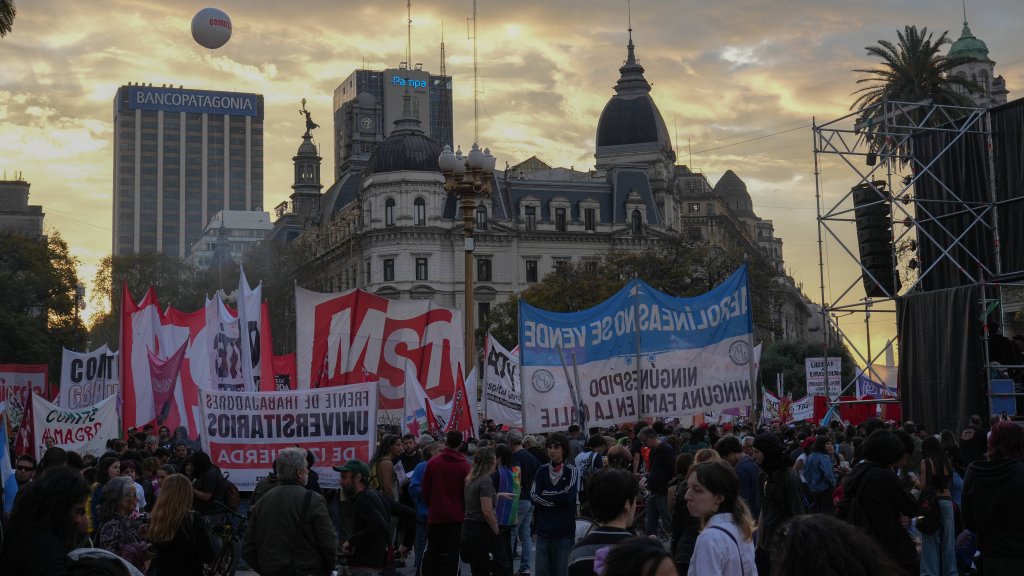
The main demonstration was organised in La Plata. Buenos Aires also hosted events to commemorate the victims and defend human rights. In his video, Romero also called on people to take part in the Marcha de la Bronca on 19 September. The nationwide mobilisation opposed the policies of Milei’s government and was supported by trade unions as well as student, political, feminist and LGBTQ+ organisations. Romero said people needed to be “out on the streets in our thousands upon thousands” to send a clear message against homophobia and transphobia.








