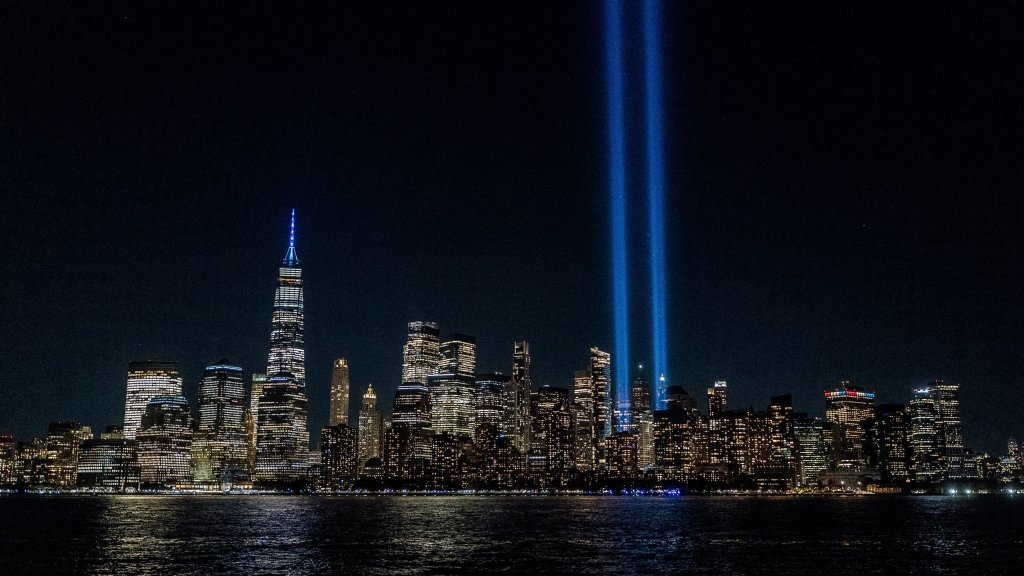
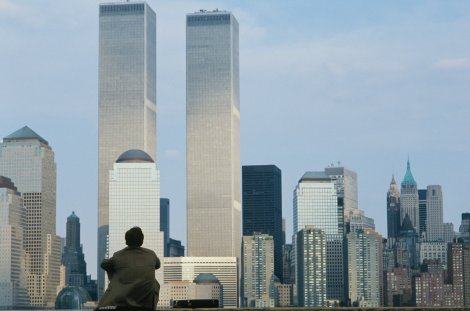
Today, 11 September 2026, marks the 25th anniversary of the terrorist attacks of 11 September 2001. Nineteen members of the Al-Qaida terrorist network hijacked four passenger planes. Two aircraft hit the World Trade Center in New York, one hit the Pentagon near Washington, D.C.; Flight 93 crashed in Pennsylvania after passengers fought back. A total of 2,977 people from 90 countries were killed. It was a dark day whose impact is still felt today – including within the LGBTQ+ community.
Key points at a glance
- A total of 2,977 people were killed in the attacks of 11 September 2001.
- Gay, lesbian and queer people were among the victims.
- Mark Bingham, who was openly gay, was among the passengers on Flight 93 who tried to overpower the hijackers.
- Mychal Judge, a gay Catholic priest and fire service chaplain, died at the World Trade Center.
- For many same-sex partners, the disaster also presented a legal problem: in 2001, they were often not automatically recognised as next of kin.
- LGBTQ+ organisations therefore established a dedicated relief fund for the gay and lesbian partners of 9/11 victims.
- New York and, later, the federal government changed rules to make better provision for same-sex partners in relation to certain benefits.
- The attacks also affected LGBTQ+ people in the US military, who continued to serve under “Don't Ask, Don't Tell” during the wars that followed.
- 9/11 made it particularly clear who was legally recognised as family – and who was not.
11 September and LGBTQ+ people
Lesbian, gay, bisexual and queer people were among the victims, first responders and relatives. The exact number of LGBTQ+ victims cannot be established because the victims' sexual orientation and gender identity were not systematically recorded. However, historical studies document a number of gay and queer victims and make clear that the attacks also directly affected same-sex partnerships and LGBTQ+ families.
One of the best-known gay victims was Mark Bingham. The 31-year-old entrepreneur from San Francisco was on board United Airlines Flight 93. Bingham was openly gay and a member of San Francisco Fog, a gay rugby club. After the plane was hijacked, he called his mother and told her what had happened. Together with other passengers, he took part in the attempt to retake the cockpit. Flight 93 subsequently crashed in Pennsylvania. After his death, Bingham became a prominent figure in the commemoration of 9/11. His story was also significant because an openly gay man was portrayed as an American hero at a time when gay people in the United States still faced substantial legal disadvantages. An academic study of the culture of remembrance after 9/11 describes how Bingham and other gay men were explicitly portrayed in news coverage as brave American heroes.
Fire service chaplain Mychal Judge
Another central figure was Father Mychal Judge, a Catholic priest and chaplain to the New York City Fire Department. He rushed to the World Trade Center on 11 September and died there. According to the US Senate, Judge was one of ten public safety personnel killed in the attacks whose survivors were initially ineligible for the relevant benefits under federal law at the time. Judge was described as gay. His identity was increasingly discussed publicly after his death, while his service as a fire chaplain was also honoured. His case illustrated what was still a reality for many gay Americans at the time: someone could be recognised by society as an equal in their role as a rescuer, fire chaplain or hero, while their same-sex partner was not automatically considered family in law.
When a partner was not recognised
This contradiction became particularly apparent in compensation for the victims. Following the attacks, the US Congress established the September 11th Victim Compensation Fund. The fund was intended to provide financial compensation to those injured and the relatives of those killed. However, individual states' inheritance and family laws played a central role in determining who was entitled to benefits as a survivor. In 2001, virtually no US state recognised a same-sex partnership in the same way as a marriage for all relevant inheritance matters. This created a problem for many gay and lesbian partners: they might have lived with the victim for years, built up assets together and been financially dependent on each other – but legally, they were not their spouse.
Contemporary documents from the US Department of Justice show that, for this reason, civil rights organisations were already calling for same-sex partners to be explicitly included in the compensation fund in late 2001. The ACLU, Lambda Legal, the Empire State Pride Agenda and other organisations argued that eligibility should take account not only of formal marriage but also of a demonstrable shared economic and personal life. In total, around 22 surviving same-sex partners of 9/11 victims became publicly known at the time. Some received benefits; in other cases, a lack of legal recognition or disputes with the deceased's families prevented equal access to payments.
A relief fund for gay and lesbian partners
The legal difficulties also prompted a specific response from the LGBTQ+ movement. In late 2001, Lambda Legal, the Human Rights Campaign, the Empire State Pride Agenda and other organisations established the “September 11 Gay & Lesbian Family Fund”. The fund raised around US$380,000. The known surviving same-sex partners each received just under US$17,000 in immediate financial assistance. Among other things, the fund was intended to address gaps arising because same-sex partners were not automatically treated as spouses for benefits such as Social Security, survivors' benefits, workers' compensation and the government’s 9/11 compensation fund. LGBTQ Nation The significance of this initiative went beyond the financial support itself: the attacks brought public attention to the fact that there were families in the United States who functioned as families in everyday life but were not treated as such in law.
New York changed its laws
In New York, the debate led to concrete legislative changes. In 2002, the state passed the “September 11th Victims and Families Relief Act”. The law also included “domestic partners”, meaning registered or legally recognised partners, in provisions for supporting survivors. New York's Workers' Compensation Law was also amended in 2002. This allowed domestic partners of people who died in the attacks of 11 September to receive survivors' benefits under certain conditions. The provision made no distinction based on the partners' sex. This established an important precedent: in the specific circumstances of a disaster, the state recognised that a long-term partnership could have legal significance even without a marriage.
The Mychal Judge Act of 2002
A change also followed at federal level. The “Mychal Judge Police and Fire Chaplains Public Safety Officers' Benefit Act” was passed in June 2002 and applied retroactively to 11 September 2001. Among other provisions, the law extended benefits under the Public Safety Officers' Benefits Program to fire and police chaplains and, in certain cases, allowed payments to the person a public safety officer killed in the line of duty had designated as the beneficiary of their life insurance policy. This meant that people who were not married to the victim – including same-sex partners – could also benefit. Research into the history of the law therefore describes it as the first federal benefit that could be available to same-sex partners under certain conditions. The law was not explicitly framed as LGBTQ+ legislation, but it had a tangible effect on same-sex couples.
Visibility in the American military
Another consequence affected gay people in the military. It is important to note that “Don't Ask, Don't Tell” was not introduced because of 9/11. The policy had been in place since 1994. Gay, lesbian and bisexual service members were allowed to serve but had to keep their sexual orientation secret; if it became known, they could be discharged from the military. After the attacks, however, the scale of military operations changed considerably. The wars in Afghanistan and, later, Iraq led to a large number of deployments. LGBTQ+ service members were therefore serving in a military environment in which they were still not allowed to speak openly about their sexual orientation. More than 13,000 members of the US armed forces were discharged because of their sexual orientation over the entire period in which “Don't Ask, Don't Tell” was in force.
In 2010, Congress passed legislation to repeal “Don't Ask, Don't Tell”; the policy finally ended on 20 September 2011. This allowed gay, lesbian and bisexual service members to serve openly for the first time. Its abolition cannot be attributed solely to 9/11. It was the result of a longer political and social process. However, the wars after 9/11 formed the military backdrop against which the issue of openly gay service members became particularly visible.
9/11 and subsequent LGBTQ+ rights
An important distinction must be made when placing these events in historical context: the major advances in gay rights in the United States after 2001 were not exclusively consequences of 9/11. In 2003, the Supreme Court ruled in Lawrence v. Texas that laws against consensual same-sex relations between adults were unconstitutional. In 2013, the Supreme Court ruled in United States v. Windsor that the central part of the Defense of Marriage Act was unconstitutional. In 2015, the court ruled in Obergefell v. Hodges that same-sex couples had a constitutional right to marry, thereby opening marriage to gay men and lesbians (German).
These developments had numerous causes: decades of LGBTQ+ activism, court cases, social changes, political campaigns and shifts in public opinion. 9/11 was not the sole cause of this development. At the same time, historical research shows that the attacks had a tangible political effect. Public tributes to men such as Mark Bingham and Mychal Judge placed gay men directly within a national narrative of courage, self-sacrifice and patriotism. In parallel, the debate over survivors' benefits forced politicians and public authorities to address whether same-sex partnerships should be treated as families in the face of a national disaster.
What remains after 25 years
The history of 9/11 from a gay perspective therefore encompasses several facts at once. Gay men and lesbians were among the victims and those who helped. As an openly gay man, Mark Bingham became one of the best-known heroes of Flight 93. Mychal Judge was killed while serving as a fire chaplain and later had a federal law named after him. Immediately after the attacks, victims' same-sex partners had to fight for inheritances and financial support that were far more readily available to heterosexual spouses. This led to concrete legislative changes, particularly in New York and at federal level.
The attacks therefore changed more than foreign policy, security legislation and the lives of those directly affected. They also revealed which people in the United States were legally considered family in 2001 – and which were not. Twenty-five years later, this dimension is part of the history of 9/11. The names of the 2,977 people killed on 11 September 2001 are being read out again today. The 9/11 Memorial notes that the victims came from more than 90 countries and had diverse ethnic, social and religious backgrounds. That diversity also included people who were gay, lesbian, bisexual or queer. The LGBTQ+ history of 11 September is therefore also a history of death, partnership, legal inequality, public recognition and the changes that a national disaster brought about in American society.








