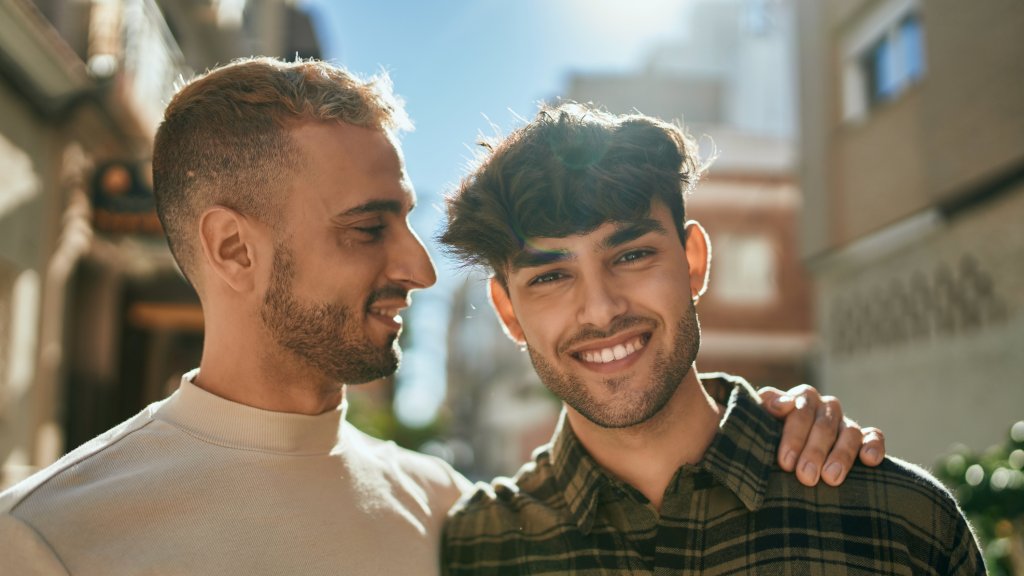
For many gay men, coming out is one of the defining experiences of their lives. But the way this step is experienced has changed significantly over the past three decades. While homosexuality in the 1990s was often associated with fears of social exclusion and the stigma of HIV and AIDS, younger generations today are growing up with more visible role models and new opportunities for self-determination. In the US, an appeal to gay men is now sparking debate nationwide, with one central argument: people need to do more to share their experiences with one another.
The key points at a glance
- A clear generational difference: while coming out in the 1990s was often associated with fear and secrecy, many younger gay men today experience greater openness and support.
- HIV and AIDS shaped a generation: 30 years ago, society often equated homosexuality with a life-threatening illness. This intensified stigma and exclusion.
- Social media are changing coming out: some young men now make their relationship public with a photo together on Instagram, without having to explicitly explain their sexual orientation.
- More role models and visibility: gay men today have far more people to identify with in film, television, politics and social media.
- Discrimination persists: despite social progress, homophobia, religious prejudice and political disputes continue to make coming out difficult.
- Experiences differ: US writer John Casey argues that older and younger gay men should share their different experiences with one another.
Debate about coming out
American journalist John Casey describes just how different these experiences can be. His starting point is an encounter with two 30-year-old gay men that brought home to him how much the social context has changed. Casey says he often asks other gay men about coming out when he first gets to know them. For him, this is far more than a casual question. Sharing experiences of one's sexual orientation creates mutual understanding and connects people with similar experiences. But during a conversation with two younger neighbours, he realised that his previous expectations no longer necessarily matched the realities of a new generation's lives. His account of the encounter has sparked discussion within the US gay community in recent days.
Coming out among younger men
Last summer, Casey met a new neighbour and his boyfriend at the swimming pool in his residential building. Both were 30 years old and therefore considerably younger than the journalist. When the conversation turned to their experiences of coming out, the two men spoke about them relatively matter-of-factly. Although each had his own story to tell, neither described coming out as a dramatic turning point. Casey found this sense of ease remarkable. He had been asking the question for decades and had apparently often expected accounts of fears, conflicts or difficult decisions. When the two men then asked him about his own experiences, his answer was markedly different. “Thirty years ago,” he explained.
This gave the younger men an insight into a period whose social conditions they had not experienced themselves. In the 1990s, coming out was often associated with fear. Casey describes the mid-1990s as an era in which gay men could expect to face significant social barriers when coming out. Publicly visible role models were rare at the time, he says. Rainbow flags were not a familiar sight on the streets, and there was no broad social acceptance of homosexuality. For him, coming out was therefore not a single, liberating step. Rather, he was trying to find a way to speak openly about his sexual orientation at all under difficult circumstances.
HIV weighed on a generation of gay men
Society's perception of HIV and AIDS was particularly distressing at the time, he says. The disease shaped the public image of gay men in the 1980s and 1990s. HIV infection was considered life-threatening, particularly before the introduction of effective combination therapies. According to Casey, anyone who identified themselves as gay had to expect others to associate them immediately with HIV or AIDS. Fear of such suspicions and social stigma made coming out even more difficult. Casey recalls initially revealing his sexual orientation only to a few people he trusted.
Even when he had found the courage to confide in a friend or family member, he says, this came with the worry that the information might be passed on against his wishes. “Please promise me you won't tell anyone else,” he would often say at the time. For him, coming out was therefore not just about whether other people would accept his homosexuality. Equally important was retaining control over who was allowed to know about it at all. According to Casey, the two younger men responded to these accounts with great interest. They found the idea of having to explicitly ask for secrecy after coming out particularly unfamiliar. The journalist was left with the impression that the men he was talking to had previously heard few personal accounts of what life was like for gay men in the 1990s.
Coming out on Instagram
For Casey, the story of one of his neighbours showed particularly clearly how much attitudes towards homosexuality have changed. The neighbour said he had posted a photo of himself with his first boyfriend on Instagram. He then received numerous positive responses and congratulations. What Casey found remarkable was that the post had apparently been seen less as an explicit coming-out statement than as an announcement of a new relationship. While he himself had once been deeply worried that other people might find out he was gay, the younger man he was talking to was able to show a same-sex relationship publicly and receive positive feedback.
The example illustrates how social media and changing social attitudes are enabling new ways of coming out. Sexual orientation does not necessarily have to be announced in a personal statement. It can also become visible through the matter-of-fact public presentation of a relationship. However, this experience cannot be generalised to all young gay men. How coming out unfolds still depends heavily on family circumstances, social conditions and an individual's personal situation.
More gay role models
Casey sees the significantly increased visibility of gay people as a major difference between the generations. Younger gay men today have numerous role models in television, film, politics and social media. There are also online communities, local LGBTQ+ groups and other opportunities to connect with people who have similar experiences. Such resources can be particularly important for young people who receive little support from those around them. Casey reports that his two neighbours were able to count on support through social media when they came out. They had also grown up in a society where the existence and rights of gay people were, at least in principle, much more widely recognised than in his youth. He says he could scarcely have imagined such a reality 30 years ago.
Political conflicts
Despite these changes, Casey stresses that coming out is by no means always straightforward for younger people either. In the United States in particular, LGBTQ+ rights remain the subject of fierce political and social disputes. The journalist points to growing political polarisation and proposed legislation targeting LGBTQ+ rights, particularly in Republican-dominated parts of the country. There is also religiously motivated rejection and distressing experiences within families or faith communities.
As a result, barriers familiar to older gay men from their own youth could once again become more significant for younger generations. According to this assessment, greater social visibility does not automatically mean that every young person can disclose their homosexuality without fear. The differences between the generations therefore lie less in discrimination having disappeared entirely. Rather, the opportunities and social conditions in which people come out have changed.
Personal experience
For Casey, the conversation with his two neighbours had particular significance because it connected the experiences of different generations. The exchange made it clear that gay men's experiences cannot be compared on the basis of age alone. Social acceptance, personal safety and the ability to live openly differ depending on people's surroundings and historical circumstances. Casey therefore sees listening to one another as an important contribution to understanding between older and younger LGBTQ+ people. Even though the social context has changed considerably, the question of coming out remains a significant part of many gay men's personal life stories.








