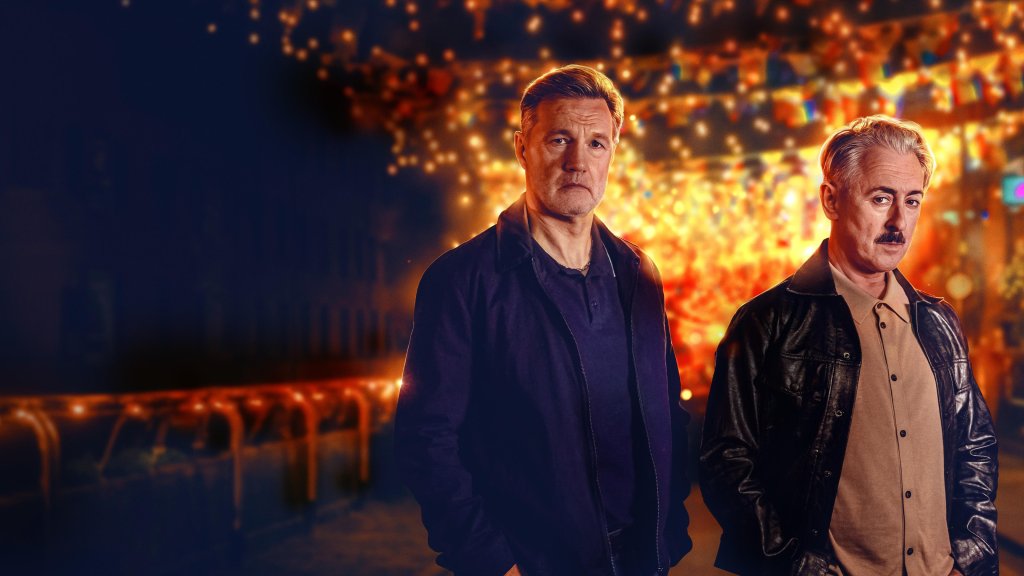
An English suburban estate, two neighbours and a conflict that ultimately ends in a hate crime: this is the premise of the miniseries “Tip Toe”, available on HBO Max from today (German). Alan Cumming and David Morrissey play the leading roles. The opening is harrowing. Right at the start, a man is hanging from a lamppost with a noose around his neck. The five-part series then uses flashbacks to tell the story of how this happened. In Britain, the new masterpiece from “Queer as Folk” creator Russell T Davies sparked heated debate (German).
The key points at a glance
- The five-part miniseries “Tip Toe” launches on HBO Max on 13 August.
- It centres on neighbours Leo (Alan Cumming) and Clive (David Morrissey), whose relationship spirals out of control.
- Clive has become radicalised online and develops increasingly hostile attitudes towards gay men and trans people.
- Clive’s sons George and Saul are also central to the plot: one struggles with his sexuality, while the other earns money from pornographic content.
- Series creator Russell T Davies explores a social backlash against LGBTQ+ people.
- Davies had already created a groundbreaking series about gay life with “Queer as Folk” in 1999.
- The optimism of that time has largely disappeared in “Tip Toe”.
- In Britain, the series received predominantly positive reviews from critics.
- The ending sparked a controversial debate about the state of society in the United Kingdom.
A deadly conflict between neighbours
At the centre are Leo and Clive. The two have lived next door to each other in terraced houses for almost 15 years – door to door, with very little distance between them. For a long time, they seem to get along as neighbours. But one day, the relationship turns sour. A conflict develops into a climate of mistrust, prejudice and mutual dislike. Clive, an electrician, has become increasingly radicalised online. He regards Brexit as a fraud that was not carried through properly and the coronavirus pandemic as a conspiracy. He sees gay men as predatory and trans people in particular as a danger to children and young people.
His neighbour Leo, by contrast, runs a queer bar on Manchester’s famous Canal Street. But Leo also contributes to the misunderstandings. His communication with Clive is often ironic and apparently assumes a level of understanding that his neighbour does not possess. Clive’s attitude towards Leo becomes particularly fraught when it comes to his sons. George is shy, while Saul is considerably more self-confident. Both are attractive and, in their father’s eyes, increasingly become a reason for him to mistrust his gay neighbour.
Two sons, two paths in life
As the story unfolds, it becomes clear that the two young men are themselves struggling with their sexuality and their relationship with public exposure and intimacy. The teenager George is secretly gay. He struggles with the idea of coming out while also using dating apps. His brother Saul is already in his mid-20s. He earns money through a porn platform, producing explicit content that includes footage of him masturbating. While his sons have to navigate their own choices in life, Clive’s life is also falling apart. His marriage is in a serious crisis, and things are going badly for him at work too.
Walking on tiptoe
Series creator Russell T Davies, however, sees the true heart of the story in a character who expresses a crucial thought in the very first episode: Melba. The former drag queen is played by Paul Rhys. The character wears red lipstick and looks back on a time when, as a gay man, he moved through the world with greater confidence and less fear. Today, things are different. Melba prefers to keep a low profile – just in case. In the original, the character says: “I used to just walk into a room and shout ‘Ta-da!’ Now I creep in on tiptoe – just in case.”(“I used to walk into a room and just go "Ta-da"! Now i tiptoe, just in case”.) This is precisely where the series takes its title from: “Tip Toe” refers to walking cautiously on tiptoe.
Fear of going backwards
Melba’s words also describe a central theme of the series: the feeling among many gay and queer people that a sense of safety they had once come to take for granted could be lost again. Social prejudice, growing hostility, online hate and the fear of physical violence can make people more cautious. Visibility fought for over many years could consequently diminish again.
The series connects this development with real social debates and also refers to violence against LGBTQ+ people. Melba wonders what he would have imagined the world to be like if, in 1996, he had been asked about the situation in 2026. He would have pictured a bright future. Instead, he sees growing homophobia, malice and contempt. “We’re going backwards... it’s a storm, a tidal wave, an enormous tsunami, we’re right in the middle of it.” The statement encapsulates the social backlash that Davies describes in his series (German).
None of the optimism of “Queer as Folk”
Russell T Davies (German) knows the history of gay television series better than almost anyone. More than 25 years ago, the now 63-year-old created “Queer as Folk”, (German) a series that put gay life centre stage and was considered groundbreaking at the time. That story was also set in Manchester. A US remake, set in Pittsburgh, followed later. It focused on the various problems and life circumstances of a group of young gay men. Yet the underlying mood of “Queer as Folk” was different from that of “Tip Toe”. Back then, the prevailing hope was that society would continue to become more liberal over time. In “Tip Toe”, barely any of that optimism remains.
Leo himself initially believes that the current backlash against queer people is only temporary. The social pendulum will always swing back the other way, he says. Melba disagrees with this assessment. A long-standing friend and regular at Leo’s bar, he develops a much darker theory. In his view, opponents of queer people have waited patiently. They allowed more and more people to come out and live openly. Now those people are visible and therefore easier to target.
The US president’s policies are also addressed without him being named. Melba holds his political rhetoric partly responsible for the fact that opponents of non-heterosexual people now turn against them more openly. “They’ve always hated us, only now they no longer have to pretend otherwise.” In this way, the series connects the personal story of the two neighbours with a broader political and social development.
Radicalisation and visibility
The strength of “Tip Toe” lies not only in the classic conflict between a gay man and his homophobic neighbour. The series depicts several generations and different ways of dealing with sexuality. George represents a young person who cannot yet live openly as a gay man and faces the opportunities and dangers of digital dating. Saul, in turn, takes a much more forthright approach to sexuality and even turns his revealing performances into a source of income. Clive experiences these developments from the perspective of a man whose own life is becoming increasingly unstable and who is growing ever more radicalised in digital echo chambers. Leo, meanwhile, embodies a generation that fought for its visibility and now faces the question of whether those gains are genuinely secure for the long term.
The five-part miniseries launches on 13 August. The first three episodes will be released that day. Episode four follows on 20 August, with the fifth and final episode on 27 August. The leading roles are played by Alan Cumming (German) and David Morrissey. In Britain, “Tip Toe” aired on public-service broadcaster Channel 4. Critics gave the production predominantly positive reviews. The ending of the series in particular prompted discussion. In Britain, there was heated debate over whether the social situation for queer and gay people really is as bleak as “Tip Toe” portrays it.








