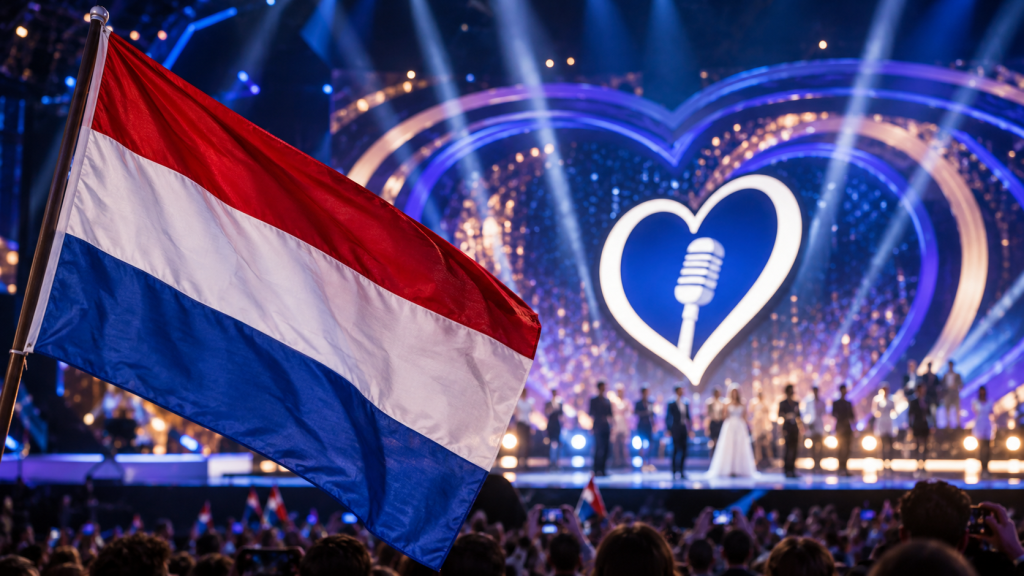
The Netherlands will not be represented at the Eurovision Song Contest (ESC) in 2027 either. Although public broadcasting organisation NPO only announced a return to the international music competition in September, that decision has now been reversed. The continuing disputes over Israel’s participation remain the decisive factor. According to the European Broadcasting Union (EBU), at least 36 countries are therefore confirmed for next year. Confirmation is still pending from a small number of countries, including Spain and Slovenia.
The key points at a glance
- Netherlands withdraws again: public broadcasting organisation NPO has withdrawn its participation in the Eurovision Song Contest 2027, which it announced in September.
- Israel remains a source of dispute: differing positions on the country’s participation and a lack of support among Dutch broadcasters led to the decision.
- Boycott continues: the Netherlands and four other countries had already stayed away from Eurovision 2026 in Vienna.
- Further withdrawals and deliberations: Ireland is staying away from the competition, while Spain is considering a boycott. Czechia is withdrawing for financial reasons.
- Host city confirmed: Eurovision 2027 is planned for May in Burgas, Bulgaria. Dutch viewers will still be able to watch the competition on television.
A tense situation
Following discussions within Dutch broadcasting, those responsible concluded that there was insufficient support for participation next year. The country is thus continuing the boycott of the competition it began in 2026. NPO’s media director Jurre Bosman explained that Israel’s participation prompted “different reactions in society” as well as “debate and division” in the Netherlands. Following talks with the broadcasting council, they had therefore decided against taking part in Eurovision 2027. In addition, there was “insufficient support” among the broadcasters involved for a return to the competition.
The chair of the public broadcasting organisation, Jet de Ranitz, also cited the continuing tensions as the reason for withdrawing. Following extensive discussions, those responsible had concluded that it was “still too early to take part in the Eurovision Song Contest in 2027”. De Ranitz explicitly referred to the current “sensitivities” surrounding Israel. In the broadcasting organisation’s view, these made it difficult for the broadcasters involved to reach a common position. The decision marks another change of course. Within just a few months, there had been differing announcements about the future of Dutch participation in Eurovision.
First a boycott, then participation
Back in August, Avrotros, the broadcaster normally responsible for the Dutch entry in the Eurovision Song Contest, had said it did not intend to take part in 2027. The broadcaster cited the war in the Gaza Strip and Israel’s participation in the competition as its reasons. This was intended to continue the boycott already in place for Eurovision 2026. In September, however, a different solution began to emerge. Public broadcasting organisation NPO announced that it intended to take over organising the Dutch entry from Avrotros. The plan was for a joint production involving several public broadcasters. This was intended to enable the Netherlands to return to the Eurovision Song Contest, even though Avrotros maintained its opposition. Those plans have now been abandoned. The proposal did not receive enough support from the individual broadcasters, prompting NPO to withdraw the commitment it had already made.
However, the renewed decision not to submit an entry does not mean that the Eurovision Song Contest will disappear entirely from Dutch television schedules. National news broadcaster NOS still plans to broadcast both semi-finals and the final. Eurovision will therefore remain available on television to Dutch audiences, even though the country itself will not be sending a performer to compete.
Further boycotts possible
The Netherlands is not the only country questioning its participation in the Eurovision Song Contest because of the political controversies (German). At Eurovision 2026 in Vienna, five countries in total, including the Netherlands, had already declined to take part in protest at Israel’s participation. Ireland, too, has no intention of changing its position. The country has announced that it will also not compete in 2027, citing Israel’s actions in the Gaza Strip as the reason. A possible boycott is also being discussed in Spain. Such a move remains under consideration, but no decision has yet been made. Separately from the dispute over Israel, Czech television has also withdrawn from the 2027 contest. The broadcaster had announced two weeks earlier that it would not submit an entry because of financial uncertainty. The next Eurovision Song Contest therefore once again faces the challenge of several countries not being represented.
A politically neutral competition
The continuing debate over Israel also presents difficulties for the European Broadcasting Union (EBU) as the organiser of the Eurovision Song Contest. Under its rules, the music competition is intended to be a neutral and non-political event. However, the differing positions of the participating broadcasters show just how strongly international conflicts can influence decisions on participation. In response to the controversy, the EBU had already adopted an additional rule. Under this rule, countries at war may not host the Eurovision Song Contest. Nevertheless, the question of which countries will take part in future remains a subject of debate. The Netherlands’ withdrawal shows that even within individual broadcasting systems, there is no unified position on Israel’s participation.
Eurovision 2027 in Bulgaria
Despite the withdrawals, preparations for the next edition of the international music competition are already under way. The Eurovision Song Contest 2027 is due to take place in Burgas in May. The Bulgarian coastal city lies on the Black Sea and will host the competition. Bulgaria secured the right to host through singer Dara’s success at Eurovision 2026 in Vienna. She won the competition with her party song “Bangaranga”.








