
The LSVD+ Verband Queere Vielfalt Berlin-Brandenburg sees clear differences between the parties’ LGBTQ+ policy positions ahead of September’s election to Berlin’s House of Representatives. This emerges from an analysis of responses to ten election questions on key issues.
Key points at a glance
- The LSVD+ Verband Queere Vielfalt Berlin-Brandenburg has analysed responses from ten parties on ten LGBTQ+ policy issues.
- Bündnis 90/Die Grünen, Die Linke, Volt, Demokratische Linke, Tierschutzpartei and Partei des Fortschritts receive positive assessments across all ten policy areas.
- The SPD receives a positive assessment in nine areas, but did not answer the question on securing Berlin’s action plan and LGBTQ+ support structures.
- The AfD’s responses receive no positive assessments in any of the ten policy areas.
- The LSVD considers several CDU and FDP positions to be imprecise or to fall short of the communities’ demands.
Questionnaire for the community
According to the association, the election questions are intended as a guide for all voters and explicitly not as a voting recommendation. Topics included securing existing LGBTQ+ support structures, strengthening anti-discrimination law and Berlin’s state strategy for LGBTQ+ safety. Other issues covered LGBTQ+-inclusive education, healthcare for LGBTQ+ people, protection for rainbow families and LGBTQ+ refugees, and support for LGBTQ+ spaces and older gay and queer people in Berlin.
“Given the growing threats facing queer people, all parties have a duty to act, whether in government or in opposition. Queer communities do not need vague promises, but reliable structures, the ability to plan ahead and concrete political action. Our election questions reveal which parties offer meaningful solutions, where questions remain unanswered and where positions stand in the way of necessary protection,” said Florian Winkler-Schwarz, executive director of LSVD+ Berlin-Brandenburg.
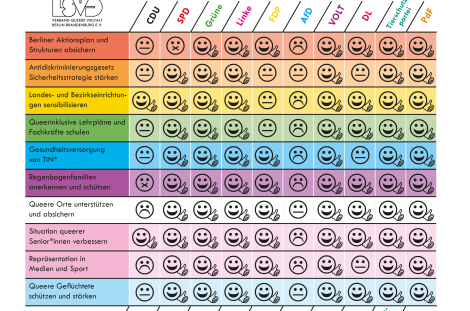
Parties assessed by the association
The association gives particularly positive assessments to the responses from Bündnis 90/Die Grünen, Die Linke, Volt, Demokratische Linke, Tierschutzpartei and Partei des Fortschritts. These six parties’ responses received favourable assessments across all ten policy areas, although the level of detail varied. The SPD receives a positive assessment in nine areas. However, the party did not answer the question on securing Berlin’s action plan and LGBTQ+ support structures.
The assessment of the AfD is markedly more critical: its responses receive no positive assessments in any of the ten policy areas. According to the LSVD, most of the CDU’s responses are imprecise. There are also some negative assessments and one unanswered question. The FDP takes supportive positions in seven areas. On three issues, however, it remains imprecise or falls short of the community’s demands. From the LSVD+’s perspective, the analysis thus shows that the parties take sometimes markedly different approaches to key LGBTQ+ policy issues – ranging from concrete, supportive positions to unanswered questions or positions that do not meet the protection requirements set out by the association.








