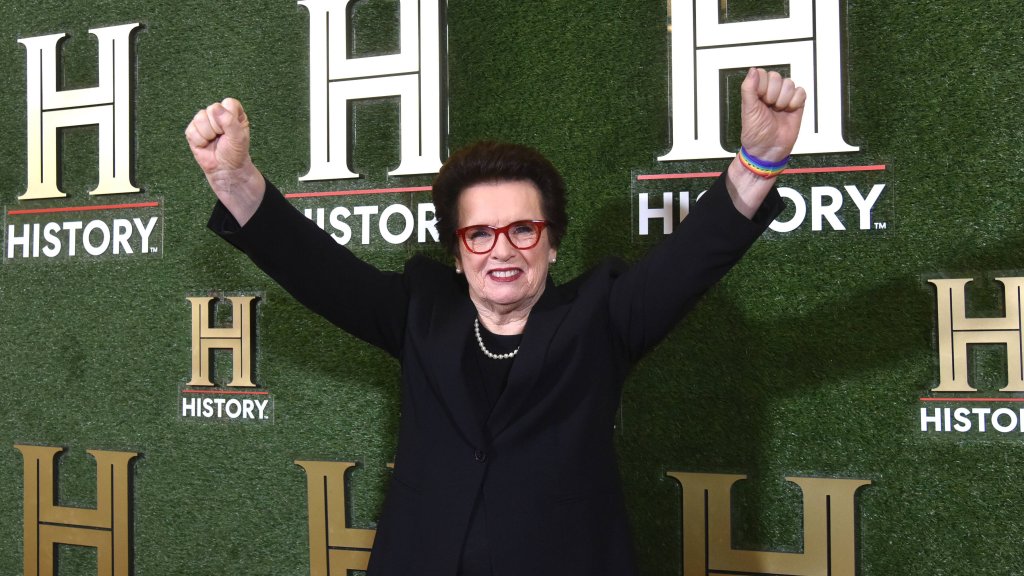
Former world number one tennis player Billie Jean King (German) has spoken openly at the age of 82 about being gay, losing sponsors after coming out and her concerns about LGBTQ+ rights. In an interview with the British newspaper The Guardian, she looks back on her career, her relationships and her unfulfilled wish to have children.
The key points at a glance
- Coming out with serious consequences: Billie Jean King lost all her endorsement deals in 1981 after publicly disclosing her relationship with a woman.
- Fighting for equality: the 82-year-old won 39 Grand Slam titles and played a pivotal role in the campaign for equal prize money in women's tennis.
- Love for Ilana Kloss: the two women have been a couple for more than four decades. They married in 2018.
- Concerns about LGBTQ+ rights: King warns that hard-won freedoms could be lost.
- A major unfulfilled wish: King regrets that she and her wife did not have children together.
A schoolmate changed her life
The occasion is the new documentary “Give Me the Ball!”, which explores King's sporting achievements and her decades of campaigning for equality for women in tennis. The film also addresses personal crises, including an abortion, her eating disorder and the public disclosure of her relationship with a woman against her will. During her career, King won 39 Grand Slam titles, including 12 in singles, 16 in doubles and 11 in mixed doubles. She won a total of 20 titles at Wimbledon, a record she shares with Martina Navratilova.
King owes her enthusiasm for tennis to a childhood encounter. When she was 11, her schoolmate Susan Williams asked her: “Do you want to play tennis?” At the time, King did not even know what tennis was. Williams explained: “You get to run, jump and hit a ball.” King's response: “Oh, three of my favourite things to do.” The daughter of a firefighter and a homemaker grew up in Long Beach, California. Her parents encouraged her sporting interests, as well as those of her brother, who later became a professional baseball player. King received free tennis lessons on public courts and declared early on that she wanted to become world number one. To this day, she tries to put together a mental “gratitude list” every day. Alongside her wife Ilana Kloss and family members, Susan Williams regularly features on it. “She changed my life,” King says of her former schoolmate. The two remain in touch. “Every time I see her, I say: ‘This is all your fault.’”
A historic battle
In 1970, King was one of nine female tennis players who founded an independent professional women's tennis tour. The so-called “Original 9” signed symbolic contracts worth one dollar each to protest against unequal prize money for women. The documentary focuses particularly on 1973, when King defeated the self-proclaimed “male chauvinist pig” Bobby Riggs in the legendary “Battle of the Sexes” exhibition match. It was “the defining year in women's tennis”, King says. In her private life, however, she felt “a complete emotional mess”. She was struggling with her sexual orientation while her marriage to lawyer and sports promoter Larry King came under increasing strain.
“Fuck it!”
The year 1981 was particularly momentous for King. After her secret relationship with hairdresser Marilyn Barnett ended, her former partner sued her. Barnett threatened to make personal love letters public unless her financial demands were met. King suspects that Barnett and her lawyers were counting on her paying out of fear of being publicly outed. Her former partner knew “how hard it was for us and that we had to stay silent”.
King had concealed her homosexuality during her playing career, partly to avoid jeopardising the newly established women's tennis tour. She feared that sponsors would avoid an event associated with gay people. “We wouldn't have had a tour,” she says in retrospect. “So what do you think I'm going to do? I'm not going to say anything. I want the tour for everyone. Sometimes it's not about you, it's about the future of the sport.” Faced with the legal threats, she eventually decided to speak publicly about her relationship. “This has been going on far too long,” she recalls thinking at the time. “I'm going to tell the truth. Fuck it.” The financial consequences after her press conference were considerable. “I lost all my endorsement deals overnight,” King recalls. At the same time, she was relieved that she no longer had to hide her sexual orientation.
Decades to find acceptance
King also attributes her courage to come out to her upbringing. Her parents taught her to “be true to yourself”. Yet both were “so homophobic” that it took them almost “their whole lives” to accept their daughter's homosexuality. King suspects that her mother, who died in 2014, wished until the end that she had stayed married to Larry. The former tennis player stresses, however, that her marriage was by no means entirely unhappy. She loved Larry, which was why it took her a long time to understand her own sexuality. “If I hadn't loved him, everything would have been different. But man, was he cute,” she says. Before her marriage, King had kissed a woman while at university. “Well, actually, she kissed me,” she clarifies. In romantic relationships, she tends to be the one who is pursued, even though she is otherwise considered particularly determined. “And I'm definitely one of those people who gets pursued,” she explains. “Everyone has always approached me.”
Her great love for Ilana Kloss
King has been with former South African tennis player Ilana Kloss for more than four decades. She says she knew from the start of their relationship that Kloss was the right partner for her. “I knew she was my life partner, for my whole, whole, whole life,” she says in the documentary. At the time, King was still married to Larry. She had first asked him for a divorce back in 1969, but he did not agree until 1987. Before his death in early 2026, Larry apologised to her. “We were able to find a good sense of closure,” King reports.
King and Kloss married in a small ceremony in 2018 (German). They chose not to have a big celebration and even turned down Elton John's offer to perform at their wedding. Getting married was nevertheless important to King. For one thing, she wanted to “make sure Ilana gets everything” when she dies. Kloss is 12 years younger than her. They also wanted to honour the people who had fought for decades for the legal recognition of same-sex marriage. King speaks of paying respect to “the people who came before us”.
The loss of LGBTQ+ rights
King fears that hard-won rights could be abolished again. “I was also afraid that these rights could be taken away from us again. And that could still happen,” she says of same-sex marriage. “We could lose them overnight. Look at Roe v Wade.” In its 1973 ruling, the US Supreme Court recognised a constitutionally protected right to abortion. The decision was overturned in 2022. King herself had an abortion in 1971. “I didn't want to bring a baby into the world without knowing what was going to happen to Larry and me,” she explains. The abortion became public against her wishes in 1972, after Larry agreed, without consulting her, to have her name published on a list of prominent women in Ms. magazine. “We're back where we started,” King says of the legal situation today.
Eating disorder and regrets
In the interview, King also talks about her long-standing struggles with an eating disorder involving recurrent episodes of binge eating. She suspects a connection with her earlier discomfort about her own sexuality. King remains curious beyond sport, too. During the interview, she repeatedly asks her interviewer questions of her own. She explains her curiosity in a simple sentence: “There's always so much to learn.” That was why, last year, she resumed the history degree she had abandoned in 1964, successfully completing it in early 2026.
Despite her sporting achievements, her long relationship and her social activism, there is something King particularly regrets in retrospect. She and Ilana Kloss have no children together. “I wish we had,” she says. In the 1980s, however, it was “too difficult” for two women to have a child together. The couple have close ties with many younger people. “But we know so many young people … we have nieces and nephews,” King says. King also wants to continue working for sport, equality and social change well into old age. “I'm running out of time, and that makes me really sad,” she says as she looks towards her 83rd birthday. “I still have so much I want to do before I'm gone.” Her advice to young people is to start by discovering their own interests. “Find out what you like,” King says. Then, she says, they should try to pursue that passion “every day for the rest of their lives”.








