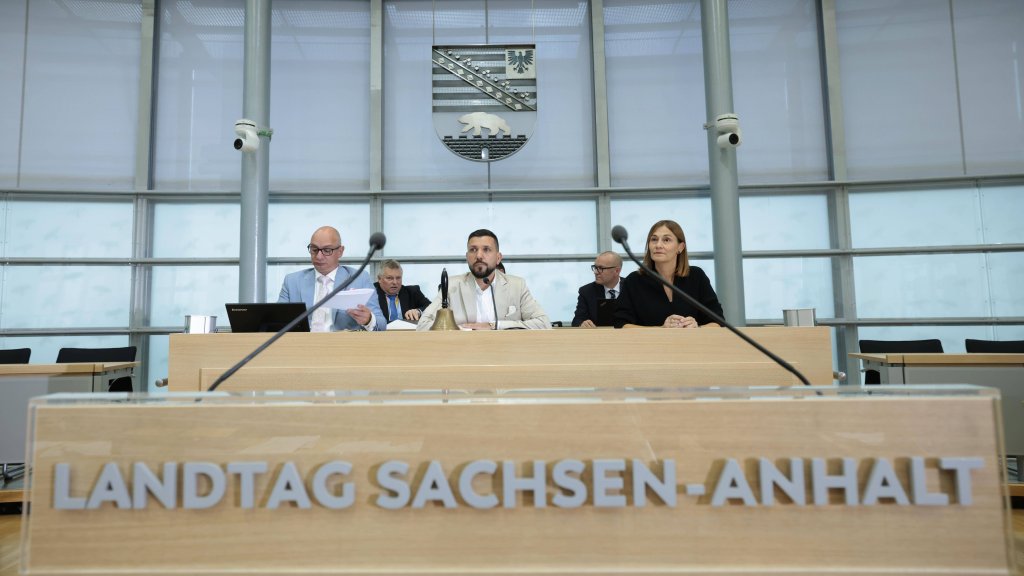
The election of an AfD politician as president of the state parliament of Saxony-Anhalt has sparked a new dispute over the CDU's approach to the AfD. The federal working group Die Linke queer is calling in particular on Lesben und Schwulen in der Union (LSU) to reconsider its political role within the CDU and CSU. This follows allegations that votes from the CDU may have enabled the AfD candidate's election
Key points at a glance
- Dispute over parliamentary president: The election of an AfD politician to lead Saxony-Anhalt's state parliament has prompted sharp criticism from Die Linke queer.
- Allegations against the CDU: The organisation suspects CDU parliamentarians played a decisive role and points to reporting by “Zeit” on possible agreements.
- LSU under pressure: Die Linke queer believes the LGBTQ+ association within the CDU/CSU should review its cooperation with the two parties at Pride events.
- Concern for LGBTQ+ people: Die Linke queer accuses the CDU/CSU of strengthening the AfD through political decisions and voting behaviour.
- Saxony-Anhalt's political future: Beyond the leadership of the state parliament, attention is turning to whether AfD politician Ulrich Siegmund will seek election as minister-president in December.
Consequences for the CDU/CSU
In a statement, federal spokespeople Daniel Bache and Shirmaira Yazici sharply criticise the decision. They see it as a far-reaching political development that goes beyond filling a senior parliamentary post. The debate comes at a time of political tension in Saxony-Anhalt. It concerns not only who leads the state parliament, but also the relationship between the democratic parties and the AfD, as well as possible shifts in the political balance of power.
The controversy stems from the state parliament's inaugural sitting on 6 October in Magdeburg. There, 35-year-old AfD parliamentarian Tobias Rausch was elected as the new parliamentary president. He is thus the first AfD politician to lead a state parliament in Germany. In the secret ballot, Rausch received 48 votes in favour. Twenty-nine parliamentarians voted against him and five abstained. The AfD holds 39 seats in the new state parliament, while Bündnis Sahra Wagenknecht (BSW) holds five. Together, the two parliamentary groups therefore have 44 seats. As the BSW had previously announced its support for Rausch, the result suggests that at least four votes came from other parliamentary groups. Because the ballot was secret, it is impossible to establish beyond doubt which parliamentarians cast them.
The CDU is a particular focus of attention. Its parliamentary leadership had recommended that its members abstain in the vote. Had all members of the parliamentary group followed this recommendation, there would have had to be significantly more abstentions. The small number of abstentions therefore heightened suspicions that individual CDU parliamentarians may have voted for Rausch against their leadership's recommendation. The result also drew criticism from within the CDU/CSU. CDU Secretary-General Franziska Hoppermann described the development as a “severe blow” to the party and its values of freedom.
Serious allegations against the CDU/CSU
The federal working group Die Linke queer sees the election as a political watershed. In their statement, Daniel Bache and Shirmaira Yazici point out that, for the first time since 1945, a member of a far-right party has been elected president of a German parliament. The organisation focuses its criticism in particular on the suspected support from CDU parliamentarians. It cites reporting by the weekly newspaper “Die Zeit”, which it says indicated possible agreements between the AfD and CDU. Bache and Yazici state: “Anyone who votes for the CDU must consequently expect that this will bring fascists into the highest offices in the state.” Whether agreements between the parties actually took place has not yet been independently established.
However, the criticism is not directed solely at voting behaviour in Saxony-Anhalt's state parliament. Die Linke queer fundamentally questions how credible the CDU/CSU's stance towards LGBTQ+ people can be if, at the same time, the impression arises that CDU parliamentarians are helping AfD politicians into senior parliamentary positions. The organisation describes the AfD as “the greatest political threat to queer people in the history of the Federal Republic of Germany”. The statement continues: “The CDU/CSU actively furthers this threat through its actions in government and its voting behaviour.”
LSU and Pride events
The statement is particularly explicit in addressing Lesben und Schwulen in der Union. The LSU is an organisation within the CDU and CSU that advocates for the interests of gay and lesbian people and for social acceptance of sexual diversity. In Die Linke queer's view, the events in Saxony-Anhalt leave the LSU facing a problem of political credibility. The organisation must ask itself what consequences it will draw from possible support for the AfD by CDU parliamentarians. In their statement, Bache and Yazici explicitly formulate this demand: “The LSU should, at the very latest now, ask itself to what extent it can still organise or take part in Pride appearances by the CDU/CSU under these conditions.”
Siegmund as minister-president
The political significance of the election of the state parliament's president goes beyond filling posts in its presiding body. The election of the minister-president is expected to take place in Saxony-Anhalt in December. Senior AfD politician Ulrich Siegmund is likely to try to become head of government himself. Based on statements from the AfD so far, such a candidacy is very likely. Within the party, Tobias Rausch's election is already being interpreted as an indication that votes from outside its own parliamentary group could also be secured in an election for minister-president. Statements by the new parliamentary president are particularly contentious. In response to a question from the Deutsche Presse-Agentur, Rausch said that there were also corresponding agreements on votes from the CDU parliamentary group for December's election of the minister-president. At the same time, he qualified this: “We will only know more once it happens.” Whether Siegmund could actually secure a majority to become minister-president therefore remains open. The AfD does not have an absolute majority in the state parliament and would consequently depend on additional votes.








