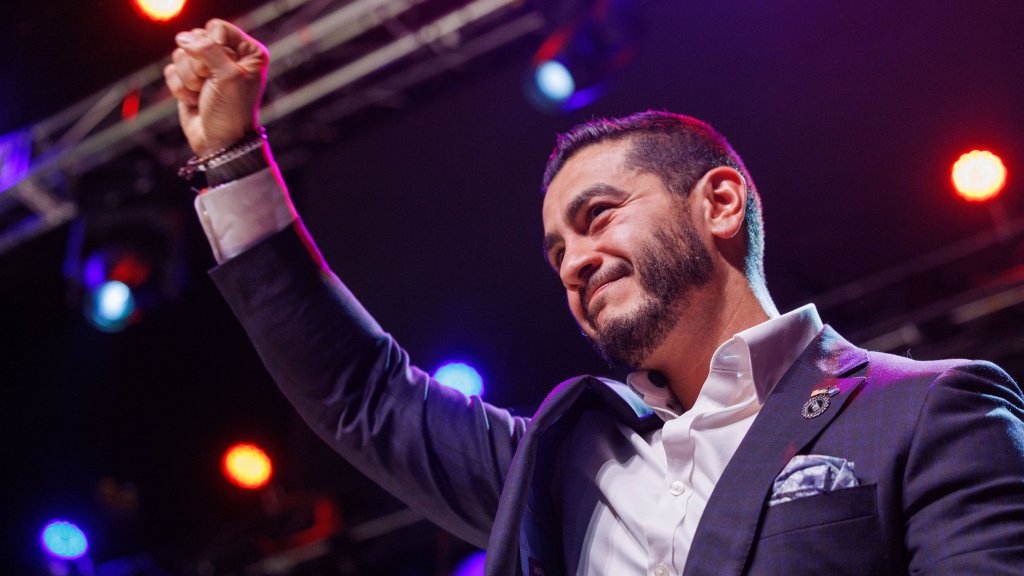
Democratic US Senate candidate Abdul El-Sayed has repeatedly spoken out strongly in recent years in favour of the rights of lesbian, gay, bisexual, trans, intersex and queer people. Following his victory in the Democratic primary in Michigan, his positions on LGBTQ+ policy are now coming under greater scrutiny. Democrats are hoping for the “New York effect”, after Zohran Mamdani, another LGBTQ+-friendly Muslim, won the election there last year and was elected the city’s new mayor (German).
The key points at a glance
- Democrat Abdul El-Sayed has won the US Senate primary in the state of Michigan.
- The doctor, epidemiologist and politician is regarded as a supporter of the LGBTQ+ community.
- El-Sayed calls for protection against discrimination and speaks out for trans people’s rights.
- He supports comprehensive sex education, including sexual and gender identity.
- Decisions about gender-affirming medical care should be made by patients, parents and doctors – not the state.
- On HIV, El-Sayed rejects criminalising the condition and advocates prevention, tackling stigma and access to PrEP.
- The Democrat will face Republican Mike Rogers in November.
“All people are equal”
El-Sayed has not previously held elected political office. However, as head of Detroit’s health department and later Wayne County’s health department, he worked with LGBTQ+ organisations and, by his own account, advocated better access to healthcare. The Democrat therefore has no extensive legislative voting record on LGBTQ+ issues. He has also so far commented relatively rarely on individual laws and policy proposals. His statements to date do, however, paint a clear picture of his stance.
As early as 2018, El-Sayed explained in an interview that his support for the LGBTQ+ community did not conflict with his Muslim faith. “Many people will say: ‘How can you, as a devout Muslim, be so supportive of the LGBTQ+ community?’ It is because, in my faith, we are told that all people are equal,” El-Sayed said. In June 2026, he reaffirmed his position: “I want the community to know that I intend to be a lion for their rights.” He also pointed to a fundamental conviction: “Any system in which we allow someone to be discriminated against is a broken, unfair and unjust system that deserves to be brought down.” The Michigan Democratic Party’s LGBT&A Caucus described El-Sayed as “a reliable ally of Michigan’s LGBTQ+ community”.
Opposing restrictions in schools
On so-called “Don't Say Gay” rules restricting discussion of LGBTQ+ issues in schools, it is not known whether El-Sayed has explicitly commented on individual laws. In principle, however, he has spoken in favour of comprehensive sex education. “It is crucial that we empower young LGBTQ+ students,” he said in 2018. “I think there is a responsibility to have comprehensive, clearly presented, anatomically and physiologically accurate conversations about sex and sex education – that includes conversations about sexual and gender identity, as well as how to protect yourself against sexually transmitted infections, including HIV.”
El-Sayed also took a clear position on trans young people. He said: “I think it is really important that we fight at state level to give young people access to the bathrooms, changing rooms and sports teams of their choice.” Bans in schools, by contrast, would turn trans people into outsiders, he said, when they were already at greater risk of bullying because of their gender identity. “The effects on mental health are real. They are tangible. We have a responsibility to protect and empower young people, no matter who they are. That includes trans men and women.”
Doctors should decide on treatment
On gender-affirming medical care for minors, too, El-Sayed favours medical decisions made between those receiving care, parents and doctors. On his campaign website, under the heading “Healthcare freedom for women and LGBTQ+ Americans”, he writes: “Healthcare decisions should be made by a patient (and their parents if they are a minor) and their doctor – by no one else. That includes reproductive and gender-affirming care.” He continues: “I oppose any attempt to criminalise certain medications or to use legal action or funding cuts to deter healthcare providers from offering comprehensive healthcare that meets all the needs of their diverse communities.”
Most recently, in June 2026, El-Sayed criticised the policies of President Donald Trump’s administration. “The Trump administration has tried to weaponise government against LGBTQ+ people in an area I know very well, namely healthcare,” he said. “We will not stand idly by while some people are thrown overboard. We demand that everyone has the same right to be who they are. We need more federal protections, particularly in healthcare.”
Do not criminalise HIV
Another focus of his work to date is HIV prevention. During his time in healthcare, El-Sayed says he was involved in efforts to stabilise and expand federal Ryan White funding for HIV prevention. “In that role, it was really about thinking about how we bring this programme into the 21st century, how we improve access to PrEP, tackle HIV stigma and fulfil our responsibility to ensure that people are safe and healthy,” he said.
He summed up his position on the criminalisation of HIV in one short sentence: “You cannot criminalise a disease.” Laws criminalising HIV would reinforce stigma and, in the long term, lead to “less safe and less helpful behaviours”, El-Sayed said. “We have a responsibility to tackle HIV stigma and prevent a disease from being criminalised. And then we need to empower people and involve them in the discussion about best practices for reducing the spread of HIV. We will only achieve the best results if we build partnerships with people rather than exclude them.”
Protection against discrimination
El-Sayed describes the LGBTQ+ community as socially disadvantaged. “The LGBTQ+ community has been marginalised, neglected and blamed instead of supported,” he said in 2018. “Every day, someone from the community is rejected because they cannot get a job, or is fired because of the person they love, or loses a career opportunity because they are transitioning. And that is a Michigan resident who has been held back as a result.”
In June, El-Sayed noted that he and his healthcare staff had received LGBTQ+ competency training. “I do not know what it is like to be gay or trans*, but I know what it is like to be discriminated against. My job is to be there, to be curious and to understand how such discrimination manifests itself in practice, but also to stand up when it is difficult, not just when it is easy. And that is what I hope people can count on me for.” He added: “I will always be there when someone tries to take away your rights – because I believe deeply in an America where everyone’s right to be who they are is respected, regardless of whether they love differently or identify differently from how they were told they should be. I always say that I support trans* rights because I believe in all rights. A government that is allowed to discriminate against some people and not others will ultimately discriminate against anyone and everyone for whatever reasons it chooses.”
From healthcare to the Senate?
El-Sayed was born in Detroit on 31 October 1984. In 2007, he graduated from the University of Michigan with a degree in biology and political science. He then studied at the university’s medical school for two years. In 2011, he received a Rhodes Scholarship to Oriel College at the University of Oxford, where he earned a doctorate in public health. In 2014, he completed his medical studies at Columbia University College of Physicians and Surgeons, earning an MD. That same year, El-Sayed became an assistant professor in the epidemiology department at Columbia University Mailman School of Public Health. In August 2015, the mayor appointed him health commissioner and executive director of the Detroit Health Department.
In 2017, El-Sayed ran for governor of Michigan but was defeated. A year later, he founded Southpaw Michigan, a political action committee supporting progressive candidates across the state. In December 2022, he was appointed head of Wayne County’s Department of Health, Human, and Veterans Services. He held that role until April 2025. He then announced his candidacy for the US Senate. El-Sayed will now face Republican Mike Rogers in November. His positions on LGBTQ+ rights could play an important role for progressive voters in Michigan.








