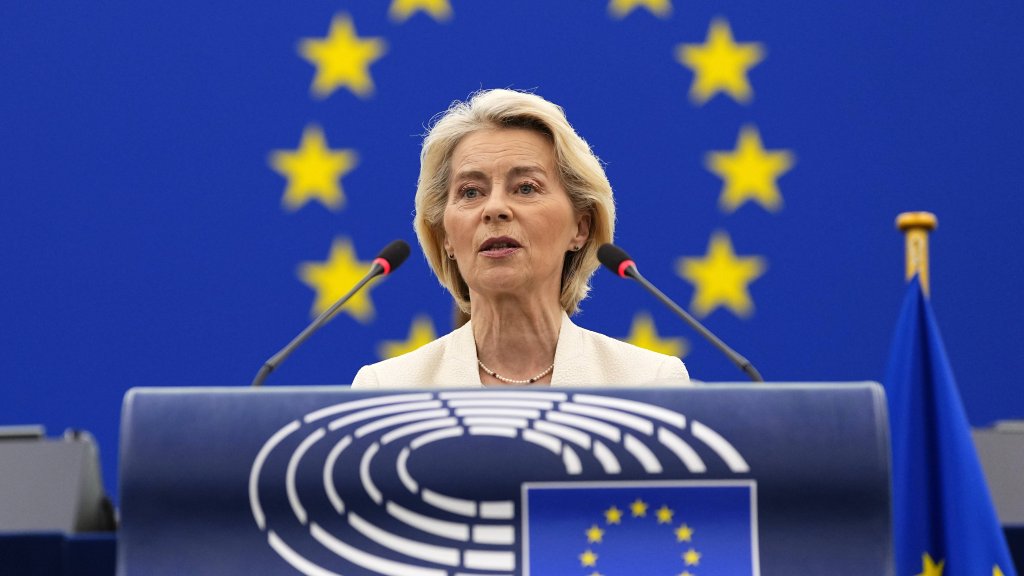
Access to social networks could change significantly for children and young people in the European Union. European Commission President Ursula von der Leyen announced new age limits today at the European Parliament in Strasbourg. “No social networks below the age of 13. No personal user account below the age of 15,” she said.
Key points at a glance
- European Commission President Ursula von der Leyen is announcing a push for stricter age limits on social networks.
- Under the proposals, children under 13 would have no access to social networks.
- Young people aged between 13 and 15 would be given so-called mini-accounts with limited functions and parental supervision.
- From the age of 15, users would be able to have their own accounts if the platforms meet certain safety standards.
- The European Commission wants to enforce the principle of “safety by design” more rigorously and restrict risky features such as potentially addictive algorithms or endless scrolling.
- No such rules have yet been adopted. Von der Leyen intends to present a concrete legislative proposal.
- FDP politician Svenja Hahn warns against blanket bans and potential restrictions on digital participation.
- The Jugendnetzwerk Lambda youth network rejects a blanket social media ban. Among other things, it warns that queer young people in particular could lose important spaces for sharing experiences, finding information, exploring their identities and receiving support.
Legislation in progress
However, this age limit has not yet been established in law. Von der Leyen intends to present a concrete legislative proposal soon. The European Parliament and the member states will then have to consider it. It could take months or even years to reach a final agreement. The initiative is part of the EU's efforts to better protect children online from harmful content and problematic platform mechanisms. Back in April, the European Commission provisionally found that Meta was not doing enough on Instagram and Facebook to prevent children under 13 from using its services.
A tiered model for young users
Under von der Leyen's plans, children under 13 would no longer be allowed to have their own accounts on social networks such as TikTok, Snapchat or Instagram. Many platforms already have a minimum age of 13. However, the European Commission believes that compliance with this requirement has not been adequately monitored so far. More responsibility would therefore be shifted to platform operators. They would have to demonstrate that their services are sufficiently safe for young users.
A tiered model is planned for the 13-to-15 age group. Young people would be able to have so-called mini-accounts. These would be set up and supervised by parents. Functions would also be restricted, and time limits could be imposed. From the age of 15, young people would be able to use their own accounts. However, this would depend on the respective platforms meeting certain safety standards. The EU had already announced in July that it intended to examine a phased approach to social media access for different age groups.
Protection through platform design
A central element of the planned rules is the principle of “safety by design”. This means that protective measures should be taken into account from the development and design stage of digital services. For example, features that the European Commission considers particularly addictive could be disabled or restricted. These include certain algorithmic recommendations, endless scrolling and automatic video playback.
Limits on screen time and other safeguards are also planned. The aim is to ensure that platforms do not wait until problems arise among children and young people before responding. Instead, their services should be designed to be safer from the outset. In earlier recommendations, the European Commission had already highlighted risks such as cyberbullying, problematic content, potentially addictive algorithms and other dangers for young users. At the same time, it stresses that children and young people should still be able to search for information, learn, communicate and participate in society safely.
What Brussels' plans mean for Germany
The initiative could have significant implications for Germany. In principle, the federal government can set its own minimum-age requirements for using social networks. In practice, however, enforcement would then fall mainly to parents and users. EU-wide rules, by contrast, could place greater obligations directly on the major platform operators. Politicians in several member states are calling for precisely this kind of common European solution. With the Digital Services Act, the EU already has far-reaching tools to regulate large online platforms. Uniform rules across the EU could also prevent different age limits and requirements from emerging in individual member states.
Prien backs a minimum age
Germany's Federal Minister for Education and Family Affairs, Karin Prien (CDU), also supports a minimum age of 13 for social networks. An expert commission she appointed presented proposals in the summer to improve online protection for children and young people. These include the possibility of a statutory age limit for the independent use of social media accounts. For young people aged between 13 and 18, Prien favours tiered protection measures for platforms such as TikTok and Instagram. Prien recently stressed that part of the solution lies at European level.
In France, the debate over age limits is already more advanced. A minimum age of 15 for social networks is envisaged there. The European Commission had deemed an initial legislative proposal incompatible with EU law. On Monday, Paris presented a revised version. Different models are also currently being discussed at EU level.
Digital wallet
One key question is how the age limits would actually be checked. The EU's digital wallet, known as the EUDI Wallet, could potentially play a role. It is due to become available in Germany in early 2027 and offer a means of age verification. Users could use it to prove that they have reached a certain minimum age without having to disclose personal data such as their name or date of birth directly to a platform.
If such rules are implemented, users of popular online services would probably have to verify their age regularly through this or a comparable method. Data protection and privacy are important considerations here. The EU is therefore already working on age-verification solutions intended to enable people to prove they have reached a certain age without unnecessarily disclosing personal data.
FDP warns against bans
The plans have, however, attracted considerable criticism. Responding to von der Leyen's State of the European Union address, FDP deputy federal chair Svenja Hahn said of the planned access restrictions: “Blanket outright bans exclude young people from digital participation, can easily be circumvented and are legally contentious, as the French Constitutional Council also recently ruled. Instead, the Commission should focus on ensuring that young people are informed about the dangers of social media and learn to use it responsibly. We must also prevent the Kids Act from introducing a real-name requirement or restrictions on freedom of expression under the guise of legitimate child protection.” Hahn is thus opposing blanket access restrictions and instead calling for a greater focus on education and media literacy. Many parents – and youth organisations – share this view.
Queer organisations see particular risks
Blanket age limits are also drawing criticism from those working with queer young people. Jugendnetzwerk Lambda has explicitly opposed a general social media ban for minors. The organisation argues that digital spaces are particularly important for queer young people. According to Lambda, social networks can offer accessible ways for young people who are still exploring their sexual or gender identity to find information, ask questions and connect with other queer people. This is particularly relevant in places where there are few or no local services for queer young people.
Lambda also points out that, for many young queer people, digital spaces are places of community, representation and identity exploration. They also enable social and political participation. Online services could be particularly important in rural areas, where in-person youth meeting places may be difficult to reach. At the same time, Lambda does not deny the existing problems with major platforms. The organisation cites issues including data protection problems, addictive mechanisms, hate speech and the negative effects of certain platform mechanisms. In the youth network's view, however, a blanket ban would not solve these problems. Instead, platform operators should be held more accountable and digital services made safer. There are also particular concerns about age verification: Lambda insists that such procedures must not create new risks to privacy or self-determination, or lead to people being outed against their will. The organisation therefore advocates a nuanced approach to regulation rather than blanket bans.








