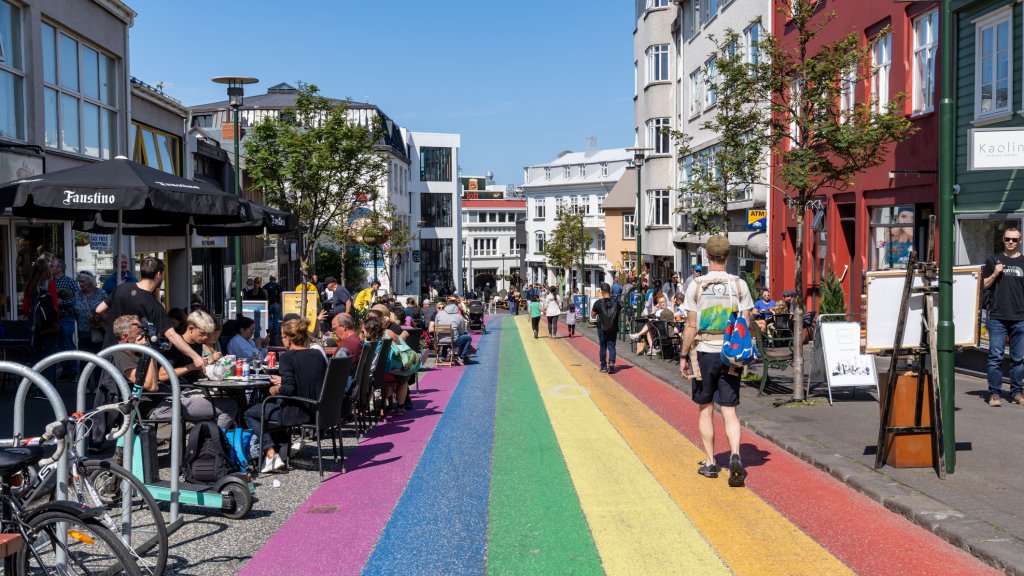
Europe is once again the world's leading region in reducing inequality between women and men. Nevertheless, significant disparities remain – particularly in economic opportunities and access to political power. The positive trend is also seen as a hopeful development for LGBTQ+ people. Equality between women and men and equality for LGBTQ+ people are described as two sides of the same coin.
Key points at a glance
- Europe has closed 75.7 per cent of its gender gap, putting it in the lead worldwide.
- Since the survey began in 2006, Europe's score has improved by seven percentage points.
- Equality has almost been achieved in education and health, but disparities in economic opportunities and political participation are significantly greater.
- Seven European countries are among the world's top ten. Iceland leads with 93 per cent.
- There are significant disparities within Europe: several Eastern European countries in particular perform considerably less well.
- At the current rate of progress, Europe would need around another 70 years to achieve full gender parity.
- The Gender Gap Index does not directly take LGBTQ+ rights into account, but is seen as a positive factor in advancing equality for gay and queer people.
Full equality in 70 years?
According to the latest Global Gender Gap Report from the World Economic Forum, Europe has now closed 75.7 per cent of its gender gap. This puts the continent narrowly ahead of North America, which still held the top spot last year. Since the survey began in 2006, Europe's score has improved by seven percentage points. The term 'gender gap' describes disparities between women and men in opportunities and participation.
The World Economic Forum examines four areas: economic participation and opportunity, education, health, and political empowerment. The index measures the parity achieved rather than a country's absolute level of development. Despite its progress, Europe is still a long way from full equality. Some 24.3 per cent of the measured gap remains. If progress continues at its current pace, Europe would need around another 70 years to achieve full parity.
Education and health
Europe has made particularly strong progress in education and in health and survival. The region scores 99.5 per cent for educational attainment and 96.9 per cent for health and survival. By the index's measures, this means near parity in these two areas. In global comparison, however, these high scores put Europe only third for educational attainment and fourth for health and survival. Other world regions achieve similarly high or even higher scores in these areas.
The gap remains significantly wider in economic life. Europe scores 69.5 per cent for economic participation and opportunity, ranking only fifth among the world's regions. North America, the leading region in this area, scores 77.1 per cent. By contrast, Europe performs comparatively strongly on political empowerment. With a parity score of 37 per cent, the region leads the world. Latin America and the Caribbean follow with 34.2 per cent. The remaining regions trail by at least ten percentage points. Women's political participation in particular is also regarded as an especially powerful tool for advancing LGBTQ+ rights.
Iceland takes a pioneering role
Europe's leading position is also evident when individual countries are compared. Seven of the world's ten highest-rated economies are in Europe. Since the index was introduced, European countries have accounted for 69 per cent of all top-ten places. Iceland, Finland, Norway and Sweden have been among the world's top ten in every edition of the index since 2006. This year, the United Kingdom, Germany and Ireland are also in the leading group. Germany scores 81.7 per cent and ranks ninth worldwide. Iceland once again leads Europe.
According to the calculations, the country has closed 93 per cent of its gender gap, making it the only country worldwide with a score above 90 per cent. Its score for political empowerment is particularly high, at 95.4 per cent. The country also has a long history of women in senior political positions. In 1980, Vigdís Finnbogadóttir became the first woman in the world to be democratically elected president of a country. In 2009, Jóhanna Sigurðardóttir followed as Iceland's prime minister, making history as the world's first openly lesbian head of government.
EU disparities and LGBTQ+ people
Europe's leading position nevertheless conceals significant disparities within the continent. While Northern European countries in particular rank highly, several countries in Eastern and South-Eastern Europe are at the bottom of the European rankings. The three lowest-ranked European countries are Turkey, Romania and Hungary. Each trails Iceland by more than 20 percentage points. The European Union is seeking to reduce existing disparities between women and men through various legislative measures. One focus is the world of work.
Queer organisations have recently stressed on several occasions that women's rights and equality have always been, and remain, closely linked to LGBTQ+ rights, because both rest on the principle that rights and opportunities in society should not depend on gender or traditional gender roles. Measures against gender-based discrimination can therefore also strengthen protection for LGBTQ+ people – and, conversely, rules against discrimination based on sexual orientation or gender identity can reinforce broader equality standards.








