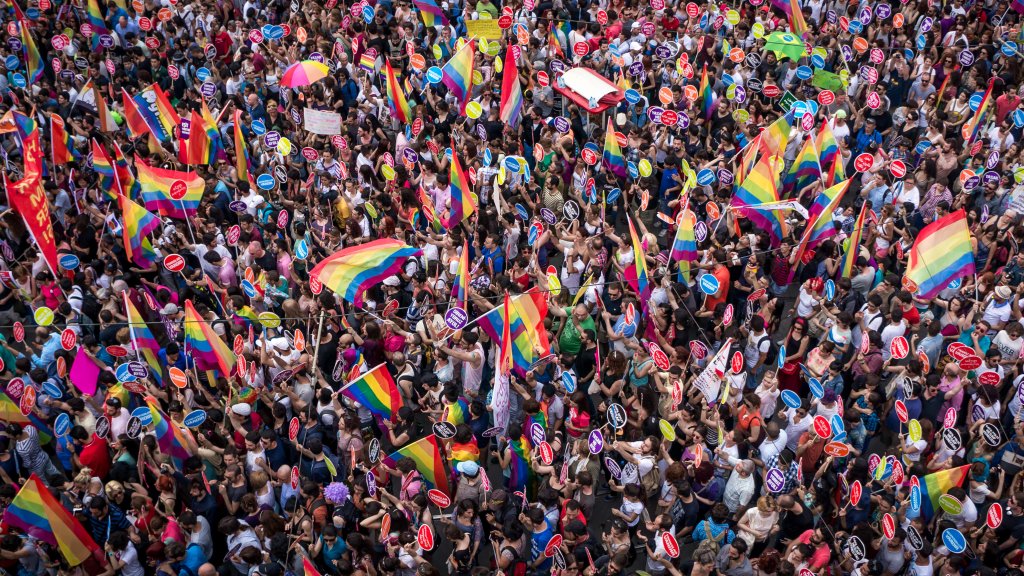
What political stance should Pride demonstrations in Europe take in 2027? Which demands should be at the forefront, which alliances are needed, and how can they gain influence in society beyond the annual events? These are the questions that European LGBTQ+ umbrella organisation ILGA-Europe intends to address at an international strategy meeting in Albania.
Key points at a glance
- New strategies for 2027: ILGA-Europe wants to work with Pride organisers from Europe and Central Asia to explore how demonstrations can have greater political influence in future.
- Summit in Albania: The second “UNSTOPPABLE Pride Organisers’ Summit” will take place in Tirana from 10 to 13 December, organised by ILGA-Europe and Aleanca LGBT.
- The focus will be on political alliances, long-term mobilisation and how Pride organisations can remain active between annual events.
- Growing challenges: Restrictions on freedom of assembly, far-right and Islamist mobilisation, political polarisation and financial uncertainty are putting organisations under pressure.
Where initiatives can be particularly effective
Together with the Albanian organisation Aleanca LGBT, ILGA-Europe is holding the second “UNSTOPPABLE Pride Organisers’ Summit” in Tirana from 10 to 13 December. The aim is to bring together experienced organisers from Europe and Central Asia to discuss political strategies for future Pride work and explore opportunities for closer cooperation. This is not about imposing a uniform approach on all European Prides. Rather, the organisers want to compare different political approaches and identify where joint initiatives could be particularly effective. The outcomes of the discussions are then intended to inform the 2027 Pride season.
Greater political influence
In ILGA-Europe’s assessment, Pride events are among the most visible forms of collective LGBTQ+ activism in Europe and Central Asia. They bring people onto the streets, give visibility to demands for social change and can influence political debates. They also connect the concerns of the queer movement with other struggles in society. Yet, according to the organisation, the conditions in which they operate are becoming more difficult. Restrictions on freedom of assembly, the mobilisation of far-right and Islamist forces, and increasing political polarisation are making the work of many organisers harder. Added to this are financial and organisational uncertainties. Against this backdrop, numerous Pride organisations are considering what role they should play in future. The summit in Tirana is intended to offer an opportunity to develop these ideas together. A particular focus is on when a Pride demonstration can actually bring about political change and what conditions are needed for it to do so.
Celebration and political movement
One central point of discussion will be how Pride events define their role. Prides serve different functions: they are political demonstrations, public celebrations of queer diversity, meeting places for the community and, at the same time, potential tools for social mobilisation. These functions are not always easy to reconcile. Participants will therefore discuss how political demands can be agreed and priorities set. Different expectations within their own communities will also be addressed.
Further questions concern engagement with state institutions and political partners. The organisers want to discuss the opportunities offered by public recognition and political cooperation, but also the compromises these may entail. They will specifically examine the conditions under which Pride mobilisation generates political influence — and when it fails to do so despite attracting considerable public attention.
Other protest movements
Another focus is the connection between the Pride movement and other civil society initiatives. ILGA-Europe wants to explore how queer organisations can work with movements campaigning for democratic rights, freedom of assembly or other social causes, for example. This also involves difficult questions of political solidarity. The interests of different protest movements do not always fully align. Nevertheless, they may share concerns, such as protecting fundamental freedoms. Organisers will discuss how such alliances can be built, how to deal with disagreements and how Pride organisations can preserve their political independence. The contribution that queer demonstrations can make to defending democratic freedoms more broadly is also on the agenda.
Summit in Tirana
The Albanian capital, Tirana, has been chosen as the venue. ILGA-Europe points out that public protests have been taking place there for months (German). These address issues including corruption, environmental protection, and demands by students and young people for better educational conditions and social security. In the organisers’ view, the city thus provides a current political backdrop for discussions about protest, public space and collective action. The summit builds on the first UNSTOPPABLE event, held in Ljubljana, Slovenia, in 2025. Unlike conventional training, the gathering in Tirana is primarily intended to bring together people who already bear responsibility for political decisions within their Pride organisations.
Engagement beyond the parade
Particular attention will be paid to how Pride organisations can mobilise their supporters on a lasting basis. While annual demonstrations bring large numbers of people together in many places, maintaining this engagement beyond the day of the event is more difficult. Participants will therefore discuss how short-term participation can develop into long-term political cooperation. This includes stable relationships within the community, opportunities for regular involvement and structures that enable collective action between Pride events. ILGA-Europe thus wants to raise the question of how the demonstrations’ high public visibility can be translated into lasting opportunities for action in society. Cross-border cooperation also has a role to play. Topics for discussion include joint political analysis, coordinated advocacy, monitoring social developments and practical support between Pride organisations. However, the organisers stress that not every organisation needs to pursue the same political priorities or strategies.
Security risks and funding
Alongside the broader political debates, there are plans for a practical exchange of experience. This will allow participants to discuss current challenges in their day-to-day work. Possible topics include new security threats and how to prepare for them, long-term cooperation with volunteer teams, and maintaining stable leadership structures. The financial pressure on Pride organisations will also be addressed. The summit combines short accounts of participants’ experiences with facilitated discussions and conversations in smaller groups.
Participants are expected not only to present successful projects, but also to speak openly about difficulties, mistaken decisions and unresolved political conflicts. In this way, different experiences are intended to inform future work. Participation is open to Pride organisations and LGBTQ+ associations from Europe and Central Asia that organise Pride demonstrations or other public Pride actions themselves. The full programme takes place on 11 and 12 December.








