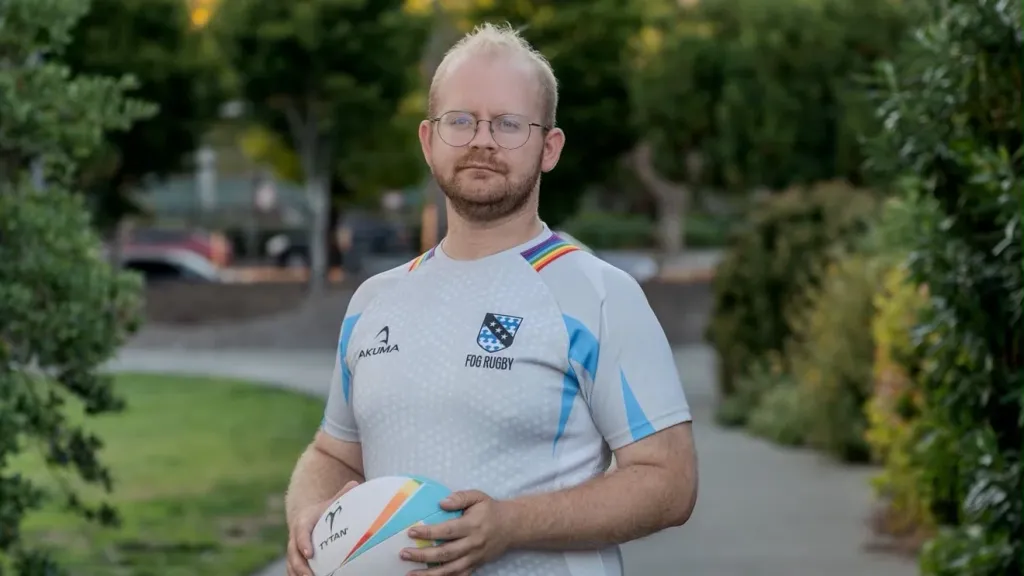
For Kyle Loughman, things are coming full circle in Australia. He played rugby as a child in Ireland, but coming out as gay made his time in the sport increasingly difficult. Some teammates did not want him in the changing room because of his sexual orientation. As a result, Loughman gave up rugby before his 20th birthday.
The key points at a glance
- Kyle Loughman gave up rugby as a young gay man in Ireland.
- Years later, he found an inclusive rugby community in the San Francisco Fog.
- He is now taking part in the Bingham Cup in Brisbane for the first time.
- The international tournament brings together teams from around the world and is regarded as a highlight of inclusive rugby.
- For Loughman, the competition also represents the history and struggle of the LGBTQ+ community in rugby.
- His most important insight: the right community does not change how you play rugby – but it does change how you see yourself.
Rugby as a family story
Today, he is playing again – and taking to the pitch with the San Francisco Fog at the Bingham Cup in Brisbane. The tournament is regarded as a highlight of international gay and inclusive rugby. In 2026, the Bingham Cup is being held in Brisbane for the first time. Loughman's connection to the sport runs deep in his family. His father saw rugby as a way to connect with his children. He wanted each of his children to develop the same bonds he himself had found on the pitch.
His older brother Jeremy is an Ireland international who plays at prop and took part in the 2023 Rugby World Cup. Loughman's twin brother also plays for and coaches inclusive teams. His sister, meanwhile, plays women's tag rugby. Rugby is therefore an integral part of life for the whole family. For Loughman, however, that connection was almost severed. He came out as gay at the age of twelve. At the time, his family lived in a rural Catholic community in Ireland. Coming out made his rugby years increasingly lonely. Some teammates did not want him in the changing room because of his sexual orientation. Yet, he says, rugby itself was not the problem. Rather, it was the environment surrounding the sport that he rejected.
An ending and a fresh start
If it had been entirely up to him, he would therefore have stopped much earlier. Before his 20th birthday, Loughman finally did give up rugby – at least, he believed at the time that it was for good. Later, Loughman lived in London and worked in hospitality. When much of the world came to a standstill in 2020 because of the coronavirus pandemic, he decided to make a fresh start. He moved to California to explore career opportunities in the wine and hospitality industries. Once he had settled in, he also began looking for a new community. Then, around nine months ago, he came across the San Francisco Fog. His twin brother had told him about International Gay Rugby (IGR) before, but Loughman had not initially looked into it further.
Then he went to training. Although he knew no one there, his first step onto the pitch immediately felt different. He describes the Fog as embodying genuine inclusion and offering an atmosphere in which people feel welcome. “It's more than just a pitch. It's a place where you can be vulnerable without fear of judgement. Someone is always there to listen.” Loughman himself is surprised that he is playing rugby again at all. Had someone told his twelve-year-old self that one day he would drive an hour and a half twice a week just to train with a team, he would have thought it was crazy. “I really love it. Rugby has become the part of my week that I genuinely look forward to. It has also reconnected me with my family through the sport we all share.”
The Bingham Cup as a high point
This unexpected passion has now brought Loughman to Brisbane for his first Bingham Cup. The San Francisco Fog teams have not travelled there simply to take part. They want to compete and win trophies. They have trained intensively for that. The players have worked on understanding their teammates' individual strengths and organising their teams strategically. For Loughman, however, the crucial work does not take place only on the pitch. The players go to the sauna together, share meals and look for ways to connect with one another. Trust, he says, is central to rugby. “People play better when they trust one another, and in rugby you need almost blind trust.” His guiding principle is: “Don't keep looking behind you. It's crucial to trust that your teammate believes in you.”
The Bingham Cup was first held in San Francisco in 2002. The San Francisco Fog hosted it and were also its first winners. The tournament is named after Mark Bingham, an openly gay rugby player and member of the San Francisco Fog who died aboard United Airlines Flight 93 on 11 September 2001. For Loughman, the Bingham Cup is therefore more than a sporting competition. It also represents the development of a community that had to fight for its place in rugby.
The fight for equality
He is particularly impressed by the tournament's international mix. People from different parts of the world come together, each with their own story and their own reasons for being there. “Regardless of politics and borders, this unity through rugby shows how small the world is and how much people seek community. The Bingham Cup also honours the pioneers who built these communities in our sport at a time when being gay could be incredibly difficult. Their sacrifices created the opportunities we have today.” Yet, in Loughman's view, the fight for equality is not over. In many parts of the world, gay people continue to be criminalised.
Inclusive rugby is growing
Looking to the future, Loughman stresses: “When I look beyond Brisbane, all I see is inclusive rugby continuing to grow and increasingly becoming part of mainstream sport. And to everyone who loves this sport but has not yet found their place in it, I say: keep looking.” Rugby, he says, offers the chance to get to know people all over the world. Loughman's own journey began as a child on a rugby pitch in Ireland. His experiences have changed his view of the sport. It is not the game itself that has changed, he says, but the community in which he plays it. “Along the way, I have learnt that the right rugby community for you doesn't change how you play the game. But it does change how you see yourself.”








