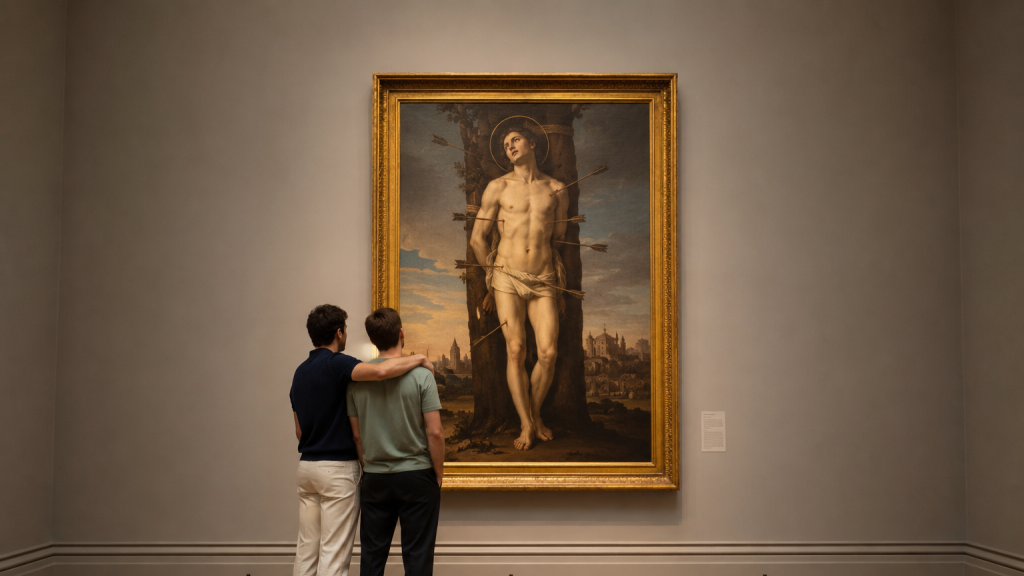
The term ‘gay icon’ is often associated with famous women such as Judy Garland, Cher or Madonna. Yet one of the oldest and most significant gay icons is a Christian martyr from late antiquity: Saint Sebastian.
Key points at a glance
- Saint Sebastian was killed in AD 288 because of his Christian faith.
- His depiction as a martyr pierced by arrows inspired numerous artists over the centuries.
- Art historians see scope for homoerotic interpretations in many depictions of Sebastian.
- In the 19th century, Sebastian became an important reference point within gay culture.
- Figures such as Oscar Wilde, Yukio Mishima and Derek Jarman drew on his image.
- During the AIDS crisis, many artists adopted Sebastian as a symbol of suffering, resilience and hope.
- To this day, the saint remains a significant source of inspiration for gay art and queer identity.
Dying for his faith
Sebastian was a Roman soldier who, according to Church tradition, was killed in AD 288 during the persecution of Christians under Emperor Diocletian. He is still venerated in both the Catholic and Orthodox Churches. Particularly well known is the account in which Sebastian was first tied to a tree and shot with arrows. Although he is said to have survived this attack, tradition holds that he was later beaten to death. It was this scene of his martyrdom by arrows that made Sebastian one of the most frequently depicted figures in art history. London's National Gallery alone owns 14 depictions of the saint.
Historians believe Sebastian's development into a gay icon can be traced back to the Renaissance, between the 14th and 17th centuries. Artists such as Guido Reni, El Greco and Sandro Botticelli portrayed the saint as a young, attractive man. His arrow-pierced figure was often imbued with powerful emotional and physical expressiveness. Art historian Daniel Fountain of the University of Exeter tells the BBC that art historians frequently interpret the arrows as a phallic ‘symbol of penetrative sex’.
Clare Barlow, director of the People's History Museum and curator of the exhibition ‘Queer British Art 1861–1967’, also sees particular significance in this. In many depictions, she says, the arrows take on ‘enormous psychosexual significance’ – regardless of whether the artists consciously intended this. ‘And the fact that Sebastian is often painted as a very beautiful young man only makes him more fascinating,’ she says.
Hidden gay messages
During the Renaissance, homosexual relationships were largely taboo in society. Many experts therefore believe that depictions of Sebastian offered a way to express male beauty and desire through art without having to name them openly. Barlow points out, however, that it is often no longer possible to establish with certainty whether the artists actually intended to convey homosexual messages or whether later generations read these interpretations into the works. ‘It is often very difficult to establish whether this was an artist's explicit intention or whether it was simply read into the works by a community of viewers looking for representation,’ she adds.
Sebastian as a secret sign of recognition
In the late 19th century, Sebastian increasingly became a kind of cultural code within homosexual circles. Writer and performer Holly James Johnston explains that the ‘cult of Saint Sebastian reached its peak’ at a time when intellectuals such as Oscar Wilde, Walter Pater and Marc-André Raffalovich openly expressed their affinity with the saint. ‘Sebastian became part of a kind of gay coded language at the time,’ says Johnston. ‘For educated men, he was a way to express their homosexual desires through an icon that other homosexual people would immediately recognise.’ The French writer Raffalovich, who explored homosexuality in depth, joined a Catholic order in 1896 and took the name Brother Sebastian. Oscar Wilde also drew on the figure. Following his conviction for homosexual relationships, he lived in exile in France, where he used the pseudonym Sebastian Melmoth.
A symbol of exclusion and suffering
Beyond his physical portrayal, Sebastian also holds a deeper symbolic meaning for many gay and queer people today. Art historian Dominic Johnson of Queen Mary University points to the depiction of the suffering martyr. ‘He is almost always shown in the same pose,’ says Johnson. ‘His leg gives way slightly, his body slumps elegantly. Then he looks up to heaven – pleading, or even desiring.’ Daniel Fountain sees parallels here with the experiences of many homosexual people. ‘He was someone who tried to hide who he was – a Christian – before being ostracised by society and persecuted for his faith,’ Fountain explains. ‘Many queer artists have found resonance in this narrative of exclusion.’
Influence on 20th-century artists
Sebastian remained an important figure in gay culture in the 20th century, too. The Japanese writer Yukio Mishima said that a depiction of Sebastian had triggered his sexual awakening. He later posed as Sebastian in a well-known photographic series. Following the Stonewall riots of 1969, the figure took on renewed significance. In 1976, director Derek Jarman released ‘Sebastiane’, which is regarded as a milestone in gay cinema. The film openly depicted homosexual love and male nudity at a time when such portrayals were still extremely rare. ‘It is an important film, partly because it was so controversial,’ says Johnson. ‘But it is just as significant because it is such a beautiful, thoughtful and provocative film about gay men and desire.’ Johnston believes the film ‘blew the lid off once and for all’, bringing Sebastian's status as a gay icon to a wider audience.
An iconic figure from the AIDS crisis to the present day
In the 1980s and early 1990s, Sebastian once again became an important symbolic figure during the HIV/AIDS epidemic. Artists such as Keith Haring and David Wojnarowicz drew on his image in their work. Both later died of AIDS-related illnesses. Sebastian had been regarded as a patron saint against the plague since the Middle Ages. Many saw a parallel with the AIDS crisis. ‘There are clear parallels with the way he was taken up in the 1980s during a very different epidemic,’ says Fountain. ‘Depictions of Sebastian at the time made him a kind of patron saint of queerness, illness and perseverance.’
Today, Sebastian continues to inspire artists and creatives from the LGBTQ+ community. In 2022, multidisciplinary artist Gray Wielebinski drew on the figure in an installation that also referenced pop star Britney Spears. In doing so, he drew connections between Sebastian's persecution and the public pressure Spears had faced for years. ‘There is a kind of knowingness in Sebastian's gaze, as well as dignity and grace,’ Wielebinski explains. ‘I wanted to give Britney that same dignity while also giving her more agency over her own fate.’ After centuries of artistic interpretation, religious veneration and gay appropriation, Saint Sebastian is now regarded as one of the most multifaceted gay icons of all. For many people, he represents exclusion, resistance, self-assertion and hope – and thus remains a significant source of inspiration in the 21st century.








