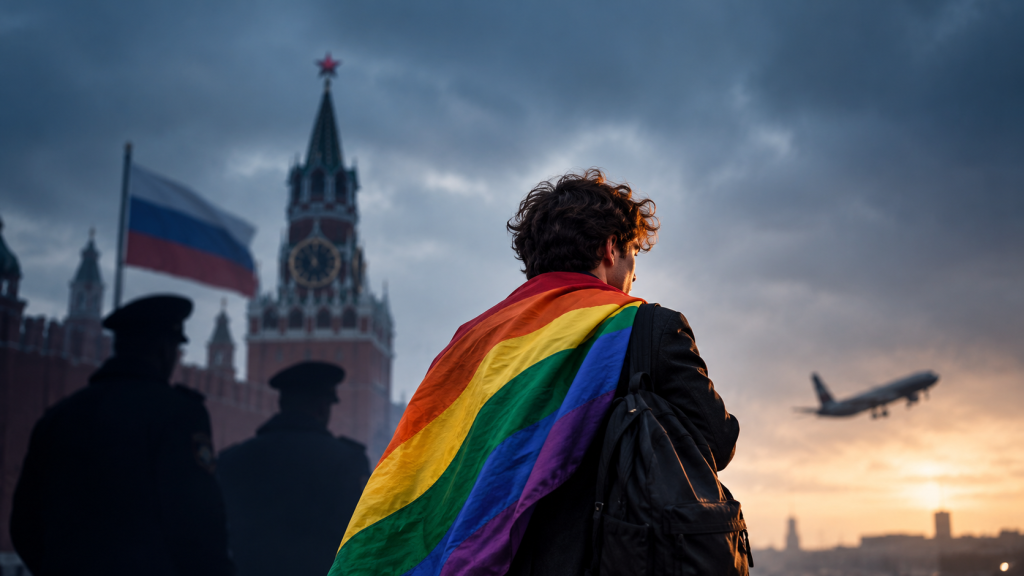
Russian journalist Vadim Vaganov has been living in exile since 2024. The openly gay reporter left his homeland a year after Russia’s Supreme Court declared the “international LGBT movement” an “extremist organisation” (German). The authorities are now not only pursuing him, but also taking action against the LGBTQ+ media outlet Parni+ (German) and other gay journalists and activists. This year, Russia placed the journalist on its wanted list.
Key points at a glance
- Fleeing Russia: Gay journalist Vadim Vaganov left his homeland in 2024 after the Supreme Court classified the so-called “international LGBT movement” as extremist.
- State persecution: Six administrative proceedings have been opened against Vaganov. He has been on a nationwide wanted list since May.
- LGBTQ+ media under pressure: The news and support service Parni+ is designated a “foreign agent”. Even readers and supporters risk legal consequences.
- Heavy fines: Even neutral statements about LGBTQ+ people can be deemed prohibited “propaganda” and result in fines.
- The journalist’s family members and friends also report employment difficulties, searches and questioning.
Journalist deemed a “security threat”
Vaganov and his employer are classified as “foreign agents” by the Russian government. Under its repressive legislation, the authorities treat organisations and individuals with this designation in a similar way to extremist groups. In an interview with the European Centre for Press and Media Freedom (ECPMF) this week, Vaganov described the growing state persecution. The Russian government was particularly “generous” in handing out such designations to independent media and organisations, he said.
Six administrative proceedings have already been opened against Vaganov over journalistic articles and social media posts. He has also been on a nationwide wanted list since May. Officials visited his relatives to gather information about him. At the same time, they falsely assured his family that he faced no legal trouble. “Who knows, perhaps they’ll even buy me an ice cream?” Vaganov said, commenting ironically on their actions. The investigation files describe him as a “sociocultural threat to the national security of the Russian Federation”. The authorities cite his alleged “ideological and psychological influence on citizens through the dissemination of a destructive ideology” as the reason.
Simply being gay is already too much
According to the journalist, even discussing one’s own sexual orientation in public can now have legal consequences. “Today, the simple fact that you are openly gay and write about it on your blog can lead to administrative proceedings against you,” he said. Even neutral statements about LGBTQ+ people can therefore be classified as prohibited “propaganda”. Individuals face fines of up to 400,000 roubles, equivalent to around €4,400. For organisations, fines can reach five million roubles, or around €54,000. By comparison, average monthly earnings in the country are around €800.
LGBTQ+ media outlet in the authorities’ sights
The media outlet Parni+ published guides for gay and queer people (German), organised webinars and offered self-help groups. Now, both those running it and its readers risk legal consequences if they communicate with one another or provide financial support for the service. “There was never anything extremist about this work at Parni+,” Vaganov stressed. He criticised the Russian authorities for interpreting almost every form of queer visibility as a political attack. “When LGBTQ+ people talk about themselves, the Russian government sees that as ‘promoting visibility’. When they talk about discrimination, it means they are ‘positioning themselves against the state’.” The legislation underpinning these actions has been tightened over the years. As early as June 2013, Russia used its anti-gay law to ban so-called LGBTQ+ propaganda (German) aimed at minors. In December 2022, the ban was extended to all age groups.

Coming out as resistance
Vaganov decided to speak publicly about being gay in 2022. He wanted to take a stand against the growing invisibility of gay people. At the time, many LGBTQ+ people in Russia began restricting their own speech and behaviour out of fear of state persecution. “I wanted other queer and gay people to see it and hopefully feel a little less alone as a result.” According to him, almost all LGBTQ+ media outlets and related initiatives in Russia have now been blocked by the authorities or shut down through state censorship. He sees this as more than an attack on press freedom. These actions also reveal the state’s ideas about which people, families, forms of love and role models should be considered “right”.
Investigations into private individuals
Vaganov challenges the widespread assumption that the restrictions primarily affect gay people who are politically active or particularly visible. The boundary between prohibited “propaganda” and ordinary private life is unclear and almost impossible to predict, he said. Decisions often depend on the arbitrary actions of individual officials. As an example, he cites an investigation into him over a quotation he published from drag queen RuPaul: “If you can’t love yourself, how in the hell are you gonna love somebody else?” Posts in dating groups or organising private parties online could also trigger action by state authorities.
Persecution takes its toll on family
The state’s actions against Vaganov are now also affecting those around him. According to the journalist, his uncle was turned down for jobs because a relative had been classified as a “foreign agent”. A friend was questioned intensively by Russian authorities at a border checkpoint. Officials searched his personal belongings and online chats after finding Vaganov’s contact details on his mobile phone. “It would be funny if it weren’t so sad,” the journalist said. Personally, he had always seen the “foreign agent” designation more as a sign that his work was apparently having an impact. “But of course, there is nothing good at all about this system existing in the first place.”
Exile puts the future at risk
Vaganov feels safer carrying out his journalistic work abroad. However, returning to Russia is no longer an option for him. His greatest concern is the future of independent LGBTQ+ media. He fears that growing state pressure will leave fewer and fewer gay journalists able to continue their work. Despite these developments, Vaganov still sees resistance to state repression. “There really are an incredible number of remarkably brave people in Russia. No matter how hard the authorities try to drive everyone underground, queer initiatives continue to emerge and communities continue to form – and not just in Moscow and St Petersburg,” he said. He concluded: “One of our tasks as journalists is to prevent the state from achieving its real goal: making these people invisible and convincing everyone else that somehow they don’t exist at all.”








