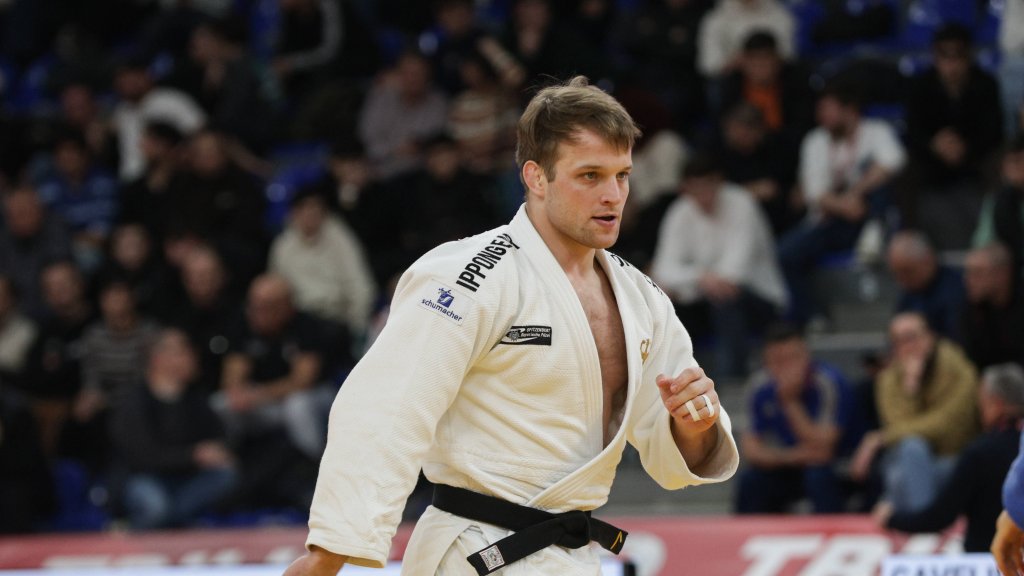
German judoka Timo Cavelius (German) faces uncertainty over his continuing Olympic qualification campaign after a serious attack by the opponent he had defeated. The 29-year-old gay elite athlete was taken to hospital after a Bundesliga bout in Leipzig. Cavelius suffered a broken jaw and serious facial injuries in the incident in early September.
The key points at a glance
- German Olympic judoka Timo Cavelius is recovering after an attack by the opponent he had defeated, Akaki Japaridze.
- The incident took place in early September at a Bundesliga competition in Leipzig.
- Cavelius suffered serious facial injuries, including a broken jaw and the loss of two teeth.
- His jaw was stabilised with three metal plates at Leipzig University Hospital.
- He must take at least ten to twelve weeks off and will therefore miss the World Championships in Baku in October.
- Police are investigating the attack. According to Outsports, there is no evidence that it was motivated by Cavelius' homosexuality.
- At the 2024 Olympic Games in Paris, Cavelius became the first openly gay man to compete in Olympic judo.
- Japaridze later said that a verbal remark and an insulting gesture by the German had triggered the attack. Cavelius denied insulting or humiliating his opponent.
- The Deutscher Judo-Bund strongly condemned the attack and warned of serious consequences for Cavelius' qualification for the Los Angeles 2028 Olympics.
Opponent “completely loses control”
Cavelius was competing for his club, TSV Abensberg, against hosts Leipziger Judo Club. His opponent was 24-year-old Georgian Akaki Japaridze, who ranks among the world's top 150 in the under-90kg weight category. Cavelius is currently ranked 41st in the world in his under-81kg category. His highest ranking to date was 14th. At the competition on 5 September, Leipzig had already secured the team victory over Abensberg.
Cavelius and Japaridze faced each other for the second time within an hour. Japaridze had won the first bout in the under-90kg category, while the German won their second encounter. After his victory, Cavelius raised a clenched fist towards his team — a gesture that also pointed in the Georgian's direction. According to Outsports, Japaridze then suddenly attacked him, striking him repeatedly. “The Georgian completely lost control,” said TSV coach Manuel Scheibel.
Serious injuries and a lengthy break
Cavelius, who works for the Bavarian police, suffered significant facial injuries. Doctors at Leipzig University Hospital treated his broken jaw and stabilised it with three metal plates. He also had two teeth knocked out. The injury means the judoka will be forced to take at least ten to twelve weeks off. A safe return to competitive sport is out of the question before then. Cavelius will therefore miss the World Championships in Baku, Azerbaijan, in early October.
The Deutscher Judo-Bund condemned the attack. In a statement, the federation also highlighted the sporting consequences for the 29-year-old. “This setback is particularly bitter for our athlete given his ongoing Olympic qualification campaign and his major goal of qualifying for the 2028 Olympic Games,” it said. Cavelius became German champion in 2023 and won silver at the IJF Grand Slam tournament in Paris that same year. Another silver followed in Astana the following year. This secured his place at the 2024 Olympic Games. Cavelius made sporting history by competing in Paris in 2024: he was the first openly gay man to compete in judo at the Olympic Games.
Federation announces consequences
The Georgian Judo Federation also responded to the incident. “Such behaviour goes against the spirit and principles of judo. The executive committee will shortly discuss the disciplinary matter and announce its decision publicly,” the federation said. However, no such decision has yet been issued. Instead, the dispute recently intensified again when Japaridze published a statement on his personal Instagram account.
It contained no apology. Instead, the Georgian held Cavelius partly responsible for the escalation. “Any kind of physical aggression is unacceptable in sport,” Japaridze wrote. “I am not evading responsibility for the incident. However, I would like to make clear that this incident was not the result of emotions caused by a sporting defeat. There have been defeats as well as victories in my career. I have accepted defeats with dignity, and setbacks have never been a reason for me to become aggressive towards my opponent. The reason was something else — a verbal remark and an insulting gesture directly from my opponent, which is also completely unacceptable in sport and under sporting ethics. For me, it is unacceptable above all as a Georgian and as a man. Thank you to everyone who supports me.”
Cavelius rejects the allegations
Cavelius disputed the claim that he had insulted or humiliated his opponent. Speaking to the Deutsche Presse-Agentur, he explained that his gesture had been directed solely towards his own team. “This celebration was for my own team and expressed my joy at winning the bout,” he said. “I would like to state explicitly that at no point was it my intention to humiliate Akaki Japaridze as an athlete or to insult him because of his background, his nationality or his identity as a Georgian man. If my celebration nevertheless struck him as a personal provocation or insult, I regret that he perceived it that way.” Cavelius added: “I am on the road to recovery. Even if my celebration may have triggered negative emotions in Akaki Japaridze, this can neither explain nor justify such a violent outburst. I neither insulted him verbally nor attacked him physically.”
Judo federation criticises Japaridze
One day after Japaridze's Instagram post, the Deutscher Judo-Bund published a detailed response. The federation was particularly outraged that the Georgian's statement had received support from well-known judoka. “We are appalled by yesterday's statement … as well as by the support and approval this post has received from some respected international judo stars,” the federation said. “Any attempt to downplay or even defend this serious physical attack … is unacceptable to us and incompatible with the fundamental principles of our sport.”
The judo federation made clear that, in its view, this had by no means been a brief, heat-of-the-moment altercation: “What happened on 5 September was not simply a loss of control or a quick shove after a heated argument. Timo Cavelius was attacked without warning with extreme physical violence. Even when the athlete was already on the ground, further heavy blows followed, until the situation was finally brought to an end by the courageous intervention of his teammates. We are not talking about an emotional scuffle or an understandable escalation after an alleged provocation. This was a severe attack that carried the risk of serious physical injury.”
Consequences for Olympic qualification
In the federation's assessment, the attack could also have serious sporting consequences for Cavelius. “Timo risks dropping out of the top 36 in the world rankings, which also jeopardises his participation in the Masters tournament at the end of the year. For all upcoming competitions, this means a lower seeding and therefore significantly tougher draws in the opening rounds.” It continued: “This makes his entire Olympic qualification campaign considerably more difficult — an extremely high sporting price for a victim of blind violence to pay.”
The federation also criticised Japaridze personally. “The fact that he publicly justifies this behaviour after several days to reflect and reconsider shows a dangerous refusal to recognise his wrongdoing. Imagine if those present had responded with equally violent retaliation — the sport would descend into chaos. Even with a sincere apology, this incident would have been difficult to forgive. With this unrepentant statement, however, Akaki Japaridze has shown that he has not understood the values of judo. Anyone who disregards the protected space of the tatami in this way has no place in the fair sporting spirit of judo. We continue to stand firmly alongside Timo Cavelius and call for disciplinary consequences within the sport.”
Cavelius came out at a young age
Cavelius began being open about his homosexuality at a young age. In 2012, at the age of 16, he first told a few family members and close friends. Three years later, after a conversation with a sports psychologist, he spoke more widely about his sexual orientation. He also told his teammates — including through a Facebook post. In 2020, at the age of 23, Cavelius finally made his story public. In an interview with Spiegel magazine, he spoke about coming out and homosexuality in elite sport.
Just a few months ago, Cavelius reflected again in a guest article (German) on his journey as a gay athlete. He wrote that he had initially been nervous about how other judoka would react to his coming out. Ultimately, his fears had proved unfounded. “There were athletes of many different nationalities in my team — Russians and Serbians, for example. Everyone reacted positively.” According to Outsports, there is no evidence that the attack in Leipzig had a discriminatory or homophobic motive or was connected to Cavelius' homosexuality.








